Kioxia Exceria Plus 1TB NVMe SSD Review (2026)
Quick answer
The Kioxia Exceria Plus 1TB is a well-rounded PCIe 3.0 NVMe drive with the unique selling point of Kioxia's vertically integrated controller-and-NAND design.
Read: 3400 MB/s Write: 3200 MB/s Endurance: 427 TBW Warranty: 5 years Interface: M.2 3.0 x 4
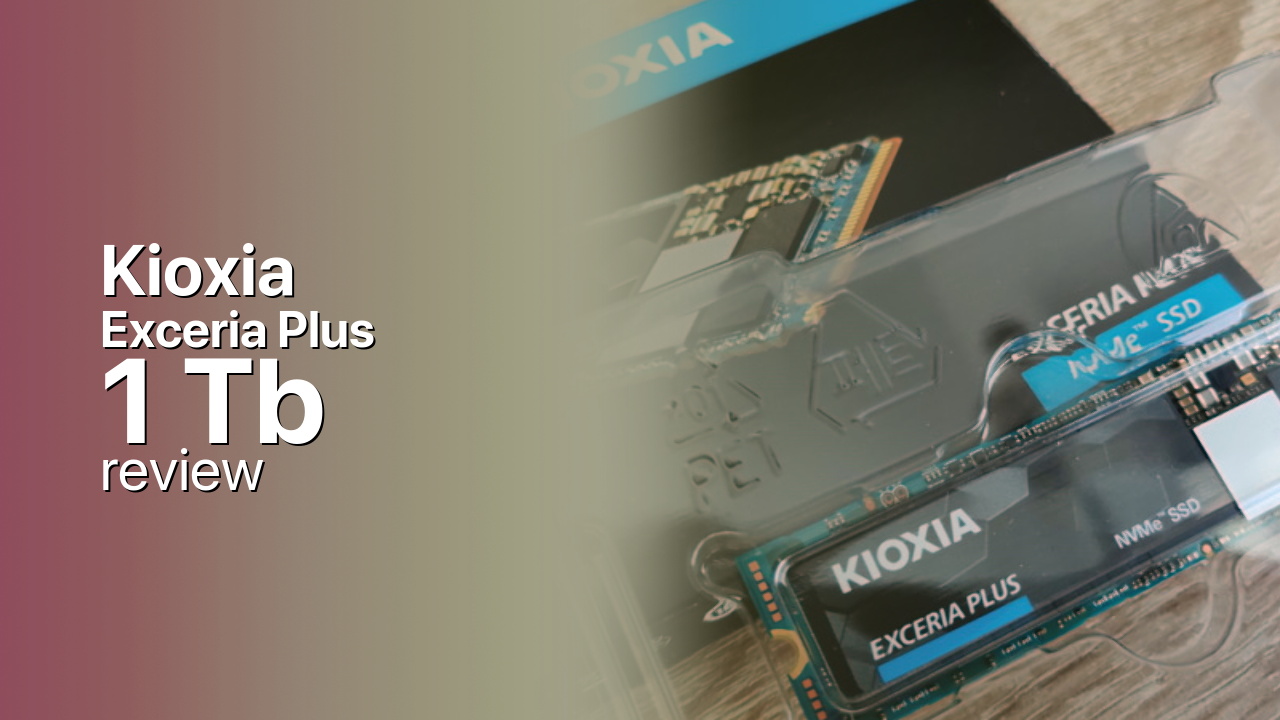
The Kioxia Exceria Plus 1TB is a PCIe 3.0 NVMe SSD built on Kioxia's own controller and Toshiba 96-layer BiCS5 TLC NAND, offering 3,400 MB/s reads, 3,200 MB/s writes, and 427 TBW endurance at a competitive price.
Controller & Memory
The Exceria Plus uses Kioxia's TC58NC1201GST in-house controller with Toshiba BiCS5 96-layer 3D TLC NAND and a DDR4 DRAM cache. Kioxia's unique advantage is vertical integration: they design both the controller and manufacture the NAND flash, giving them full control over the firmware and flash pairing. The 1TB model is rated at 3,400 MB/s sequential reads and 3,200 MB/s sequential writes, with 680K random read IOPS and 620K random write IOPS.
The Exceria Plus sits in Kioxia's enthusiast tier, above the mainstream Exceria (1,700/1,600 MB/s) and below the PCIe 4.0 Exceria Pro. The 1TB model's 427 TBW endurance and larger SLC cache make it better suited for sustained workloads than the 500GB variant. The range also includes a 2TB model with 800 TBW.
At 1TB, the Exceria Plus targets builders who want a single-drive solution for OS, games, and applications. The 3,200 MB/s write speed is notably higher than many PCIe 3.0 competitors that max out at 2,900–3,000 MB/s. Direct competitors include the Samsung 970 EVO Plus 1TB, ADATA SX8200 Pro 1TB, and Kingston A2000 1TB.
Storage Comparisons:
Exceria Plus Performance & Benchmarks
The Exceria Plus 1TB is rated for 3,400 MB/s sequential reads and 3,200 MB/s sequential writes, with 680K random read IOPS and 620K random write IOPS. The write speed is a genuine advantage — most PCIe 3.0 drives top out at 2,900–3,000 MB/s. The in-house controller and native BiCS5 NAND pairing delivers consistent performance across workloads.
Kioxia Exceria Plus 1 TB vs M.2 3.0 x 4 peers
Switch between sequential throughput and random IOPS to see how this drive stacks up against other M.2 3.0 x 4 SSDs in our database. The highlighted bar is the drive on this page — click any other bar to open that drive.
- ADATA SX 8800 Pro 512 GB: 3,500 MB/s read, 2,700 MB/s write
- ADATA SX 8800 Pro 1 TB: 3,500 MB/s read, 2,700 MB/s write
- ADATA XPG Spectrix S40G RGB 256 GB: 3,500 MB/s read, 3,000 MB/s write
- ADATA XPG Spectrix S40G RGB 512 GB: 3,500 MB/s read, 3,000 MB/s write
- Kioxia Exceria Plus 1 TB (this drive): 3,400 MB/s read, 3,200 MB/s write
The pseudo-SLC cache on the 1TB model absorbs roughly 40–80 GB of burst writes before folding to TLC. Native TLC writes hold around 1,500–2,000 MB/s — strong for PCIe 3.0. Random IO performance is competitive with the Samsung 970 EVO Plus. Gaming load times, file transfers, and application launches are all fast and consistent. The 1TB capacity holds 15–25 modern AAA titles alongside the OS.
Kioxia Exceria Plus vs Competitors
See how the Exceria Plus stacks up against other M.2 3.0 x 4 drives in our database:
Compare with rival drives:
Endurance, TBW & Warranty
Kioxia rates the Exceria Plus 1TB at 427 TBW with a five-year limited warranty. At 30–50 GB of writes per day, the endurance budget covers 23 to 38 years. The 2 million hour MTBF is a population-level statistic. Kioxia provides an SSD utility for health monitoring and firmware updates. Warranty service is handled through Kioxia's RMA process or the retailer.
Kioxia Exceria Plus 1 TB Specifications
| Category | Value |
|---|---|
| Capacity [?] | 1 TB |
| Interface [?] | M.2 3.0 x 4 |
| Controller [?] | Toshiba TC58NC1201GST-00-BB |
| Memory type [?] | Toshiba 96L 3D TLC |
| DRAM [?] | 2GB DDR4 pSLC-Cache |
| Read speed (MB/s) [?] | 3400 |
| Write speed (MB/s) [?] | 3200 |
| Read IOPS [?] | 680000 |
| Write IOPS [?] | 620000 |
| Endurance (TBW) [?] | 427 |
| MTBF (million hours) [?] | 2 |
| Warranty (years) [?] | 5 |
Verdict: Is the Exceria Plus Worth It in 2026?
The Kioxia Exceria Plus 1TB is a well-rounded PCIe 3.0 NVMe drive with the unique selling point of Kioxia's vertically integrated controller-and-NAND design. The 3,200 MB/s write speed is a real differentiator, slightly higher than most PCIe 3.0 competitors. The 427 TBW endurance and 1TB capacity make it suitable for a combined boot, game, and application drive. Kioxia's brand recognition trails Samsung and WD, but the product itself is competitive on performance and typically priced aggressively. The Samsung 970 EVO Plus 1TB is the safe pick; the Exceria Plus 1TB is the value-conscious alternative that gives up nothing in real-world performance.
+ Pros
- 3,400 MB/s reads and 3,200 MB/s writes on PCIe 3.0
- In-house Kioxia controller with native BiCS5 NAND
- 427 TBW endurance with 5-year warranty
- 680K/620K IOPS — competitive with best PCIe 3.0 drives
- Vertically integrated design — controller and NAND from one company
- Cons
- Kioxia brand less recognized than Samsung or WD
- PCIe 3.0 — surpassed by Gen4 drives
- Management software is basic compared to Samsung Magician
- SLC cache smaller than some competitors
- Double-sided PCB may limit slim-laptop compatibility
Buy this or similar SSD Storage:
Video Review
KIOXIA EXCERIA NVME SSD - Best Value NVME SSD?