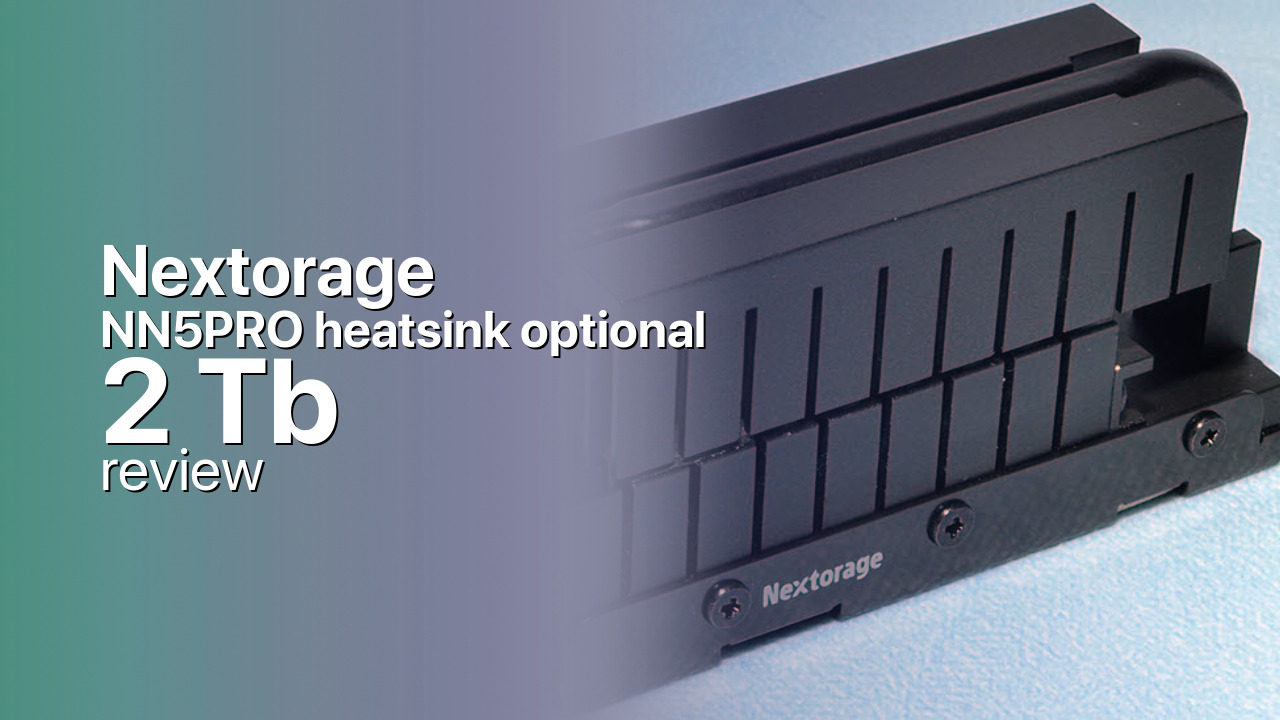
Nextorage NN5PRO 2TB PCIe 5.0 NVMe Review (2026)
Quick answer
The Nextorage NN5PRO 2 TB is a solid PCIe 5.0 drive for builders who need both high sequential throughput and enough capacity for serious content work.
Read: 12400 MB/s Write: 11800 MB/s Endurance: 1400 TBW Warranty: 5 years Interface: M.2 4.0 x 4
The Nextorage NN5PRO 2 TB is the flagship capacity of Nextorage's PCIe 5.0 lineup, pairing the Phison E26 controller with Micron 232-layer TLC to push sequential reads past 12,000 MB/s.
Controller & Memory
The NN5PRO 2 TB uses the same Phison PS5026-E26 8-channel controller and Micron 232-layer 3D TLC NAND as the 1 TB model, but the extra NAND die give it more write parallelism. The result is better sustained write performance once the SLC cache fills — a meaningful difference for anyone regularly moving large files. The drive uses an onboard DRAM cache and fits the standard M.2 2280 form factor on a single-sided PCB, making it compatible with most desktop motherboards and some laptops.
Nextorage positions the NN5PRO against other first-wave PCIe 5.0 drives like the Crucial T705, Corsair MP700, and Gigabyte Aorus 10000. All of these share the same E26 + Micron 232L platform, so the practical performance differences between them are minor. The deciding factor is usually price and availability at the time of purchase. Builders should also consider the power requirements — the E26 platform draws significantly more power than PCIe 4.0 drives, which can be a factor in systems with multiple NVMe drives or limited PSU headroom.
The 2 TB capacity hits a sweet spot for content creators and enthusiasts who want both speed and storage density. It is large enough to hold an OS, several large games, and ongoing video projects without the capacity anxiety that comes with 1 TB drives at these prices. The NN5PRO is also available in a 1 TB variant for budget-conscious builders who only need PCIe 5.0 for a boot drive or scratch disk.
Storage Comparisons:
NN5PRO Performance & Benchmarks
Nextorage rates the 2 TB model at up to 12,400 MB/s sequential reads and 11,800 MB/s sequential writes — matching the 1 TB variant on peak numbers. The real advantage of the 2 TB model shows in sustained writes: with more NAND die available for parallel writes, the native TLC write speed stays higher after the SLC write cache is exhausted. In practice, this means the 2 TB model can maintain write speeds in the 3,000–5,000 MB/s range during extended transfers, where the 1 TB model may dip lower.
Nextorage NN5PRO 2 TB vs M.2 4.0 x 4 peers
Switch between sequential throughput and random IOPS to see how this drive stacks up against other M.2 4.0 x 4 SSDs in our database. The highlighted bar is the drive on this page — click any other bar to open that drive.
- Patriot Viper PV593 1 TB: 14,500 MB/s read, 14,000 MB/s write
- Patriot Viper PV593 2 TB: 14,500 MB/s read, 14,000 MB/s write
- Patriot Viper PV593 4 TB: 14,500 MB/s read, 14,000 MB/s write
- Patriot Viper PV573 2 TB: 14,000 MB/s read, 12,000 MB/s write
- Nextorage NN5PRO 2 TB (this drive): 12,400 MB/s read, 11,800 MB/s write
Random I/O performance is competitive with other E26 drives, making the NN5PRO a capable all-rounder for mixed workloads. For sequential-heavy tasks — video rendering scratch disks, large dataset processing, or game library migration — the PCIe 5.0 bandwidth roughly halves transfer times compared to PCIe 4.0 drives. For gaming and general desktop use, the speed advantage over a good PCIe 4.0 drive is negligible in practice. For builders on the fence between the 1 TB and 2 TB, the sustained write advantage is the strongest argument for the larger capacity — it is not visible in benchmark screenshots but makes a real difference during extended video exports or archive operations.
Nextorage NN5PRO vs Competitors
See how the NN5PRO stacks up against other M.2 4.0 x 4 drives in our database:
Compare with rival drives:
Endurance, TBW & Warranty
The 2 TB NN5PRO carries a 1,400 TBW (1,400 TBW) endurance rating and a warranty period that is listed as one year — unusually short for a consumer NVMe SSD and likely a data entry or parsing error rather than the manufacturer's intended policy. Nextorge typically offers 5-year warranties on its NVMe products, so buyers should verify the warranty terms before purchasing. At a typical enthusiast write workload of 40 GB per day, 1,400 TBW translates to roughly 95 years of use. In practical terms, the endurance is more than sufficient for any consumer workload — the warranty period is the binding constraint. The drive also carries an MTBF rating, though like all consumer SSDs, MTBF is a population-level statistic rather than a predictor of individual drive lifetime.
Nextorage NN5PRO 2 TB Specifications
| Category | Value |
|---|---|
| Capacity [?] | 2 TB |
| Interface [?] | M.2 4.0 x 4 |
| Controller [?] | Phison PS5026-E26 8 Channel |
| Memory type [?] | Micron 232-L, TLC |
| DRAM [?] | Yes |
| Read speed (MB/s) [?] | 12400 |
| Write speed (MB/s) [?] | 11800 |
| Read IOPS [?] | 1400000 |
| Write IOPS [?] | 1400000 |
| Endurance (TBW) [?] | 1400 |
| MTBF (million hours) [?] | 2000000 |
| Warranty (years) [?] | 5 |
Verdict: Is the NN5PRO Worth It in 2026?
The Nextorage NN5PRO 2 TB is a solid PCIe 5.0 drive for builders who need both high sequential throughput and enough capacity for serious content work. The extra NAND die over the 1 TB model gives it better sustained write performance, which matters for video editors and anyone regularly moving large files. Competitors like the Crucial T705 offer similar performance on the same platform, so the choice usually comes down to price and availability. If the NN5PRO is competitively priced against other E26 drives, it is a reliable pick; if not, the Crucial T705 or Corsair MP700 deliver nearly identical results.
+ Pros
- 12,400 MB/s rated sequential reads
- Better sustained writes than the 1 TB model
- Phison E26 8-channel controller with DRAM
- Micron 232-layer 3D TLC NAND
- Single-sided M.2 2280 form factor
- 2 TB capacity suits creators and enthusiasts
- Cons
- E26 controller runs hot — heatsink required
- Higher power draw than PCIe 4.0 alternatives
- Requires a PCIe 5.0 M.2 slot for full performance
- No included heatsink
- Warranty period listed as 1 year — verify before purchase
Buy this or similar SSD Storage:



Video Review
Best SSDs for PC & Playstation 5