PNY CS2030 240GB - PCIe 3.0 NVMe SSD Review (2026)
Quick answer
The PNY CS2030 240 GB is a sensible upgrade only if you are replacing a SATA SSD or hard drive in an older laptop or desktop and can find the drive cheap on the used or clearance market.
Read: 2800 MB/s Write: 1550 MB/s Endurance: 279 TBW Warranty: 3 years Interface: M.2 3.0 x 4
The PNY CS2030 240GB is a 2017-era PCIe 3.0 NVMe boot drive built on Phison's E7 controller and Toshiba 15nm MLC NAND - competent in its day, fully eclipsed by 2026.
Controller & Memory
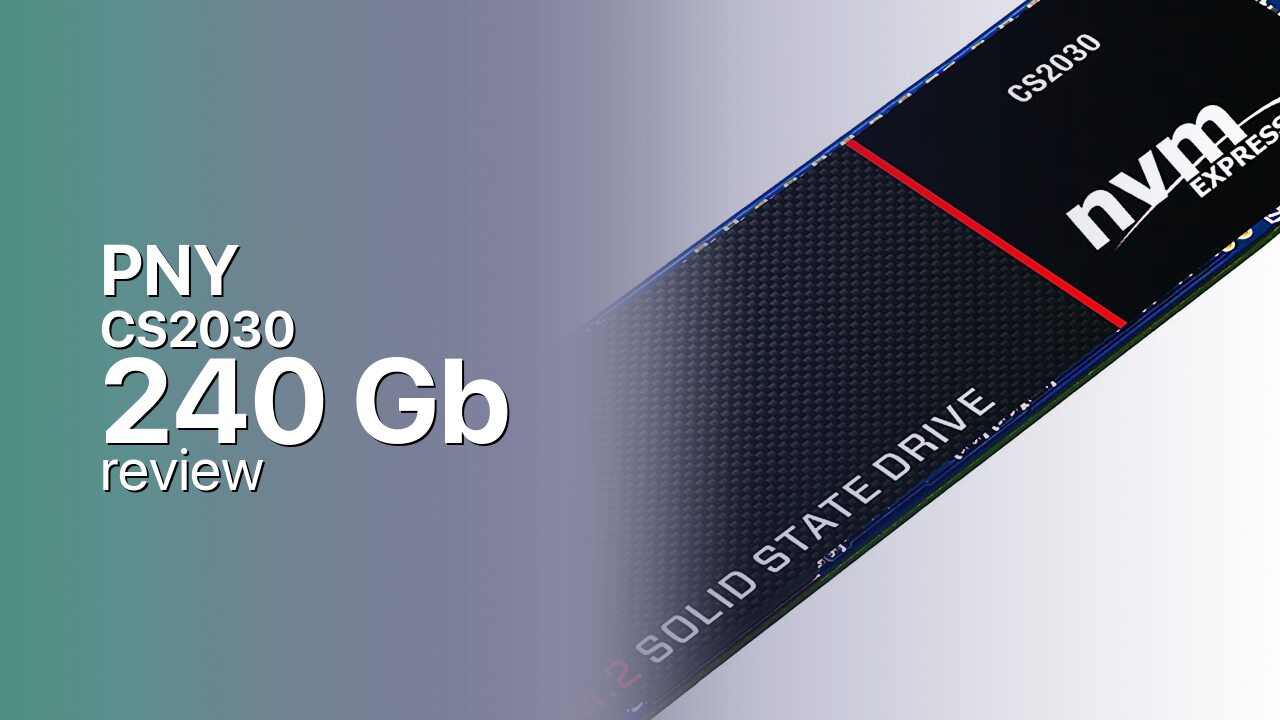
Under the M.2 2280 shroud, the PNY CS2030 240 GB pairs Phison's PS5007-E7 controller with four 64 GB Toshiba 15nm MLC NAND packages and a small Nanya DDR3 DRAM buffer. Independent teardowns at The SSD Review and HardwareCanucks both noted the double-sided PCB with empty pads for a second DRAM chip that PNY only populated on the 480 GB SKU. The interface is PCIe 3.0 x4 running NVMe 1.2 - the second-generation NVMe spec, well behind the PCIe 4.0 and PCIe 5.0 baselines that current drives target.
PNY shipped the CS2030 in only two capacities, 240 GB and 480 GB, both released in 2017. The 480 GB sibling pushes write throughput from 1,550 MB/s to roughly 1,750 MB/s and adds a second DRAM package; the 240 GB you see here is the slower, smaller-buffer entry point. PNY's current entry-tier NVMe lineup - the CS1030 (PCIe 3.0 DRAM-less with HMB) and the CS2130 and CS3030 series (PCIe 3.0 with DRAM) - has replaced this product outright, so the CS2030 is best treated as a legacy or new-old-stock purchase rather than a current product.
The drive fits any motherboard with an M.2 NVMe slot and any laptop accepting double-sided 2280 modules; thin laptops with single-sided-only slots will not seat the CS2030 cleanly because the PCB carries chips on both sides. No heatsink ships in the retail box, which is fine for a 3,000 MB/s-class drive that never produces the thermal load of a PCIe 4.0 flagship. If you are buying new in 2026, the segment is owned by the WD Blue SN570 250 GB, Samsung 970 EVO Plus 250 GB, and Crucial P3 Plus 500 GB - all faster than the CS2030, all using newer 3D TLC NAND rather than legacy planar MLC, and all available at lower price per gigabyte than the CS2030 commanded at launch.
Storage Comparisons:
CS2030 Performance & Benchmarks
Manufacturer-rated sequential figures on the 240 GB variant are 2,800 MB/s reads and 1,550 MB/s writes - typical of an early Phison E7 design and well below what even a budget PCIe 4.0 drive delivers in 2026. Independent reviewers consistently measured the CS2030 close to its rated reads in CrystalDiskMark and ATTO, with random performance landing near the rated 204,000 read and 250,000 write IOPS at high queue depths. Real-world responsiveness is fine for an OS or boot role: game level loads, application launches, and Photoshop scratch behaviour all feel snappy compared to a SATA SSD of the same vintage.
PNY CS2030 240 GB vs M.2 3.0 x 4 peers
Switch between sequential throughput and random IOPS to see how this drive stacks up against other M.2 3.0 x 4 SSDs in our database. The highlighted bar is the drive on this page — click any other bar to open that drive.
- ADATA SX 8800 Pro 512 GB: 3,500 MB/s read, 2,700 MB/s write
- ADATA SX 8800 Pro 1 TB: 3,500 MB/s read, 2,700 MB/s write
- ADATA XPG Spectrix S40G RGB 256 GB: 3,500 MB/s read, 3,000 MB/s write
- ADATA XPG Spectrix S40G RGB 512 GB: 3,500 MB/s read, 3,000 MB/s write
- PNY CS2030 240 GB (this drive): 2,800 MB/s read, 1,550 MB/s write
Where the 240 GB capacity hurts is sustained writing. Drives this small ship with a thin SLC pseudocache, and once that cache exhausts, writes drop sharply onto the underlying MLC. For large single-shot transfers - installing a 100 GB game library from an external SSD, dumping a video editing scratch folder, or restoring a system image - the 240 GB falls behind larger drives that have more spare blocks to act as cache. DirectStorage is not officially gated to PCIe 4.0 in Microsoft's specification, but the practical benefit on a PCIe 3.0 drive of this generation is negligible compared to a modern PCIe 4.0 NVMe. As a system disk for an older build it remains adequate; as a primary capture or workstation scratch disk it is not.
PNY CS2030 vs Competitors
See how the CS2030 stacks up against other M.2 3.0 x 4 drives in our database:
Compare with rival drives:
Endurance, TBW & Warranty
PNY backs the CS2030 with a three-year limited warranty. The company did not publish a TBW endurance figure for the 240 GB at launch and has not added one in the years since - KitGuru, The SSD Review and HardwareCanucks all noted the omission in their original reviews, and current PNY documentation still does not list a written endurance number. That gap is unusual for a 2017-era MLC drive: most contemporaries quoted figures in the 70-140 TBW range for 240 GB SKUs. The published MTBF rating is two million hours, which is a population statistic - it implies a low average failure rate across a large fleet, not a guaranteed service life for any single drive. RMA handling for PNY in North America goes direct to the manufacturer rather than through the retailer; international buyers should confirm regional channels before purchase. Without a stated TBW, plan backups conservatively and avoid using the drive as a heavy sustained-write target.
PNY CS2030 240 GB Specifications
| Category | Value |
|---|---|
| Capacity [?] | 240 GB |
| Interface [?] | M.2 3.0 x 4 |
| Controller [?] | Phison PS5007-E7 |
| Memory type [?] | Toshiba MLC |
| DRAM [?] | NANYA 256MB DDR3L |
| Read speed (MB/s) [?] | 2800 |
| Write speed (MB/s) [?] | 1550 |
| Read IOPS [?] | 204000 |
| Write IOPS [?] | 250000 |
| Endurance (TBW) [?] | 279 |
| MTBF (million hours) [?] | 2 |
| Warranty (years) [?] | 3 |
Verdict: Is the CS2030 Worth It in 2026?
The PNY CS2030 240 GB is a sensible upgrade only if you are replacing a SATA SSD or hard drive in an older laptop or desktop and can find the drive cheap on the used or clearance market. Anyone building or upgrading in 2026 should skip it: current entry NVMe drives such as the WD Blue SN570 250 GB or the Samsung 970 EVO Plus 250 GB cost less, write faster, run on newer 3D TLC NAND, and ship with published TBW ratings. The CS2030 is competent at what it was built to do - provide entry-level NVMe responsiveness on a PCIe 3.0 system - but the absence of a written endurance rating, the legacy planar MLC, and the discontinued status make it hard to recommend over any current alternative.
+ Pros
- 2,800 MB/s sequential reads on PCIe 3.0
- DRAM cache for steady random performance
- Toshiba 15nm MLC NAND, more durable than TLC
- Phison PS5007-E7 NVMe controller
- 3-year manufacturer warranty
- Standard M.2 2280 form factor
- Cons
- PCIe 3.0 only, two generations behind current drives
- No published TBW endurance rating
- Sequential writes capped at 1,550 MB/s
- Discontinued, superseded by CS2130 and CS3030
- Double-sided PCB does not fit thin laptops
Buy this or similar SSD Storage:
Video Review
The Best SSD 2020 - PNY CS2030 Review