PNY XLR8 CS3040 1TB Review — Mid-Range PCIe 4.0 NVMe SSD (2026)
Quick answer
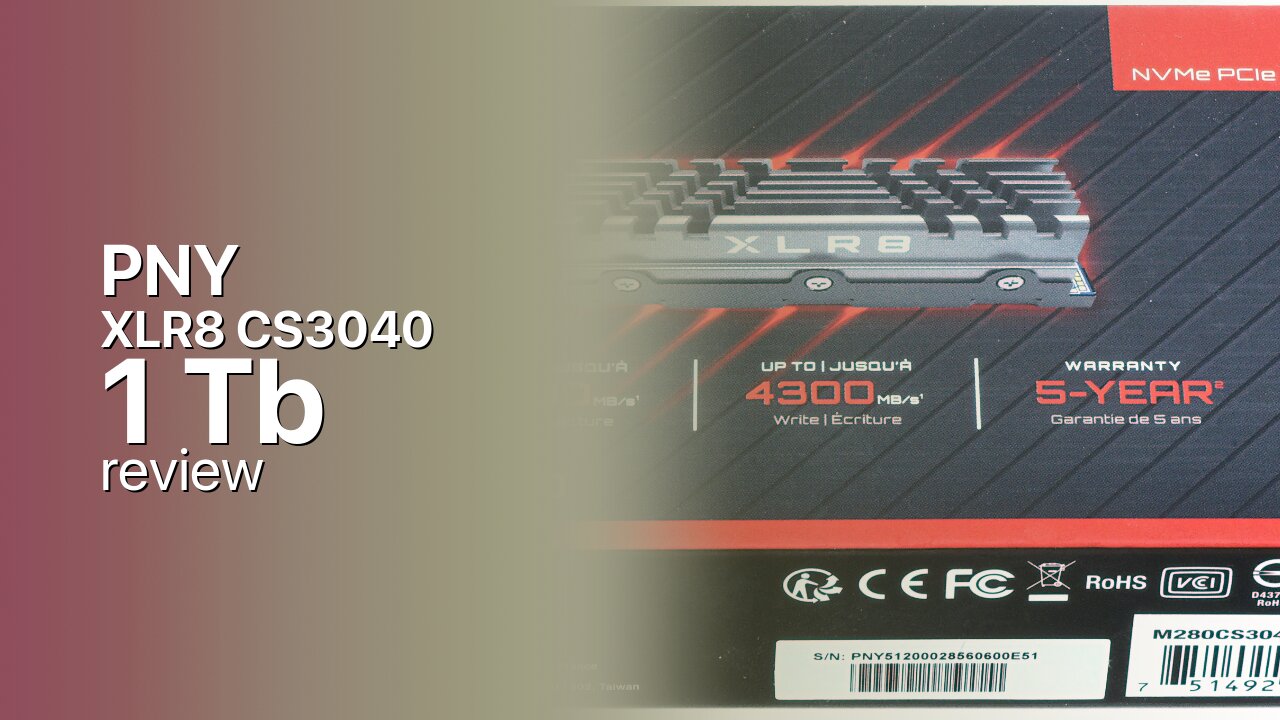
The PNY XLR8 CS3040 1TB is a well-rounded PCIe 4.0 NVMe SSD that delivers the Phison E16 platform's full capabilities — 5,600 MB/s reads, 4,300 MB/s writes, 1GB DRAM, and 1,800 TBW endurance.
Read: 5600 MB/s Write: 4300 MB/s Endurance: 1800 TBW Warranty: 5 years Interface: M.2 4.0 x 4
The PNY XLR8 CS3040 1TB is the sweet-spot capacity of PNY's Phison E16-powered PCIe 4.0 lineup, delivering the controller's full 4,300 MB/s write speed with generous 1,800 TBW endurance.
Controller & Memory
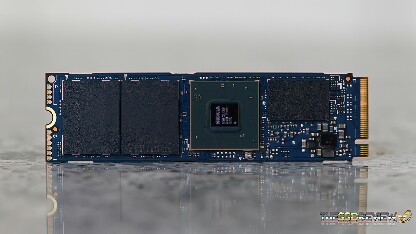
The PNY XLR8 CS3040 1TB uses the Phison PS5016-E16-32 controller — a quad-core PCIe 4.0 x4 design clocked at 733 MHz that was the first Gen4 NVMe platform to hit the consumer market. Toshiba BiCS4 96-layer 3D TLC NAND provides the flash medium, backed by 1GB of SK Hynix DDR4-2666 DRAM for the flash translation layer. The drive ships in an M.2 2280 form factor on a double-sided PCB and speaks NVMe 1.3.
Sequential performance is rated at up to 5,600 MB/s reads and 4,300 MB/s writes — the full Phison E16 platform speed. The 1TB capacity hits these numbers because it has enough NAND packages to saturate all four controller channels, unlike the 500GB model which writes at only 2,600 MB/s. The 1TB endurance rating is 1,800 TBW, double that of the 500GB variant.
The CS3040 family spans 500GB, 1TB, and 2TB. An optional heatsink version is branded for PS5 compatibility and listed on PNY's official PS5 compatibility page. The bare drive is double-sided, which may prevent installation in laptops that only accept single-sided M.2 modules.
Security features include TCG Opal 2.0, Pyrite, Sanitize, and Crypto Erase. LDPC error correction and end-to-end data path protection are also supported.
The CS3040 1TB competes directly with the Corsair MP600 1TB (identical Phison E16 reference design), the ADATA XPG Gammix S50 Lite 1TB, and the Seagate FireCuda 520 1TB. All three use the same controller and NAND generation, so real-world differentiation comes down to firmware tuning, SLC cache behavior, and thermal design.
Storage Comparisons:
XLR8 CS3040 Performance & Benchmarks
The PNY XLR8 CS3040 1TB is rated at up to 5,600 MB/s sequential reads and 4,300 MB/s sequential writes — the full Phison E16 platform specification. The 1TB capacity benefits from having enough NAND packages to feed all four of the controller's channels simultaneously, which is why it outpaces the 500GB model's 2,600 MB/s writes by a wide margin.
PNY XLR8 CS3040 1 TB vs M.2 4.0 x 4 peers
Switch between sequential throughput and random IOPS to see how this drive stacks up against other M.2 4.0 x 4 SSDs in our database. The highlighted bar is the drive on this page — click any other bar to open that drive.
- Patriot Viper PV593 1 TB: 14,500 MB/s read, 14,000 MB/s write
- Patriot Viper PV593 2 TB: 14,500 MB/s read, 14,000 MB/s write
- Patriot Viper PV593 4 TB: 14,500 MB/s read, 14,000 MB/s write
- Patriot Viper PV573 2 TB: 14,000 MB/s read, 12,000 MB/s write
- PNY XLR8 CS3040 1 TB (this drive): 5,600 MB/s read, 4,300 MB/s write
KitGuru's review of the 1TB CS3040 found that the drive closely tracks its rated numbers in CrystalDiskMark, with sequential reads landing around 5,400–5,500 MB/s and writes near 4,200–4,300 MB/s depending on queue depth. Random 4K performance is in line with other E16 drives — nothing exceptional, but entirely adequate for desktop and gaming workloads.
The drive uses a dynamic SLC cache that expands as needed for burst writes. Under sustained heavy writes, the cache eventually exhausts and write speeds fall to TLC direct-write levels. For everyday use — OS responsiveness, game loading, application launches — the cache is large enough that most users will never see it fill. Video editors and content creators doing sustained multi-hundred-gigabyte transfers should consider the 2TB model, which sustains higher throughput past the cache boundary thanks to its larger NAND pool.
Thermals are typical for a Phison E16 drive: the controller runs warm under load, and the included heatsink version or an aftermarket cooler is recommended for desktop builds where sustained transfers are expected.
PNY XLR8 CS3040 vs Competitors
See how the XLR8 CS3040 stacks up against other M.2 4.0 x 4 drives in our database:
Compare with rival drives:
Endurance, TBW & Warranty
PNY covers the XLR8 CS3040 1TB with a five-year limited warranty and a 1,800 TBW endurance rating. At 1,800 TBW, the 1TB drive can handle roughly 1,000 GB of writes per day over the full warranty period — far more than any typical consumer workload. At a realistic 40 GB per day, the TBW ceiling would not be reached for over 120 years, meaning the five-year time limit is the actual governing factor. The drive is rated for 2.0 million hours MTBF, a population-level statistic used across the industry. Warranty claims go through PNY's standard RMA process, typically handled via the retailer where the drive was purchased.
PNY XLR8 CS3040 1 TB Specifications
| Category | Value |
|---|---|
| Capacity [?] | 1 TB |
| Interface [?] | M.2 4.0 x 4 |
| Controller [?] | Phison PS5016-E16-32 |
| Memory type [?] | Toshiba 3D TLC |
| DRAM [?] | 1GB SK Hynix DDR4-2666 |
| Read speed (MB/s) [?] | 5600 |
| Write speed (MB/s) [?] | 4300 |
| Read IOPS [?] | 500000 |
| Write IOPS [?] | 750000 |
| Endurance (TBW) [?] | 1800 |
| MTBF (million hours) [?] | 2 |
| Warranty (years) [?] | 5 |
Verdict: Is the XLR8 CS3040 Worth It in 2026?
The PNY XLR8 CS3040 1TB is a well-rounded PCIe 4.0 NVMe SSD that delivers the Phison E16 platform's full capabilities — 5,600 MB/s reads, 4,300 MB/s writes, 1GB DRAM, and 1,800 TBW endurance. The 1TB capacity is the sweet spot, avoiding the write-speed penalty of the 500GB model while staying below the premium 2TB price. The double-sided PCB and E16 thermals are the main trade-offs. For desktop builds and PS5 upgrades with the optional heatsink, the CS3040 1TB is a competitive choice against the Corsair MP600 and FireCuda 520.
+ Pros
- 5,600 MB/s reads — full Phison E16 speed
- 4,300 MB/s writes — twice the 500GB model
- 1GB DRAM cache
- 1,800 TBW endurance rating
- 5-year warranty
- Optional PS5-compatible heatsink version
- Cons
- Double-sided PCB — may not fit thin laptop slots
- Phison E16 runs warm under sustained load
- No AES-256 hardware encryption
- Trails Phison E18 drives in write performance
Buy this or similar SSD Storage:
Video Review
PNY XLR8 m.2 SSD Review vs Samsung 970 Evo Plus+