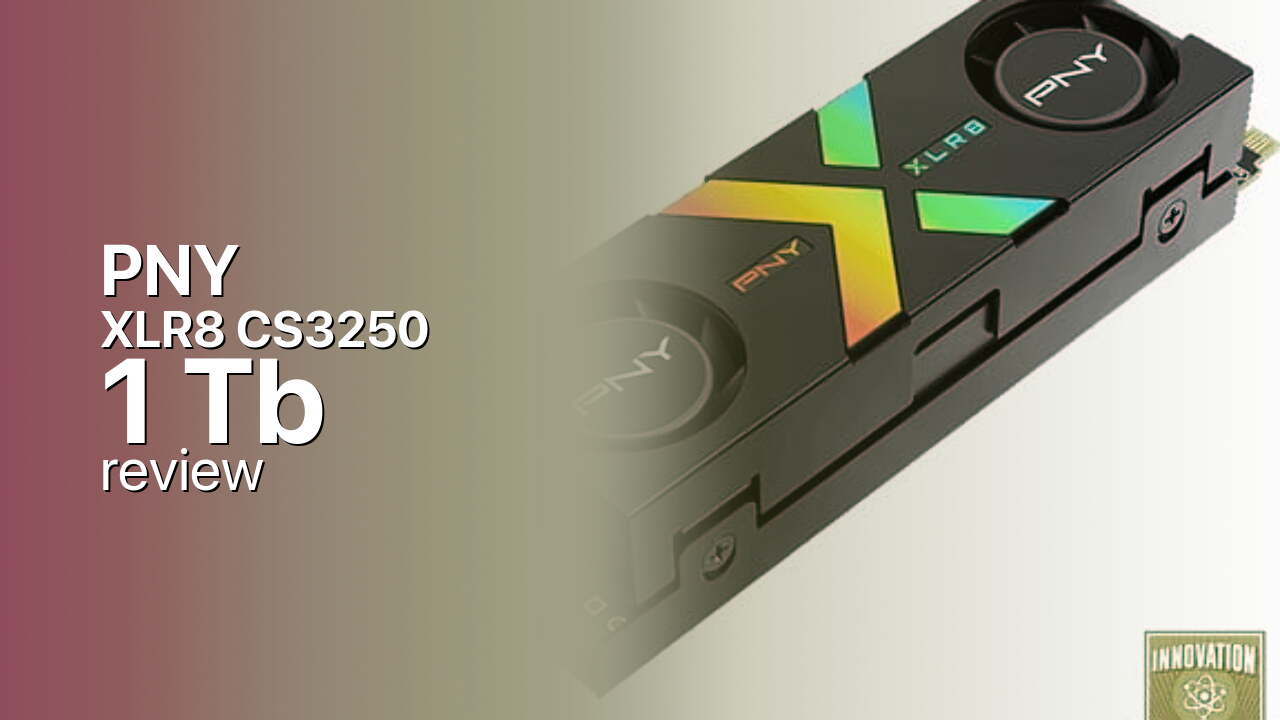
PNY XLR8 CS3250 1TB Review — PCIe 5.0 NVMe SSD (2026)
Quick answer
The PNY XLR8 CS3250 1TB suits builders on a Ryzen 7000/9000 or Intel 12th-gen or later platform who want to fully exploit a PCIe 5.0 M.2 slot without paying a heatsink premium — the thermal-coated controller and standard M.2 2280 form factor keep it versatile.
Read: 14900 MB/s Write: 13500 MB/s Endurance: 600 TBW Warranty: 5 years Interface: M.2 5.0 x 4
The PNY XLR8 CS3250 1TB is one of the first Phison E28-powered PCIe 5.0 SSDs to reach retail, delivering manufacturer-rated sequential reads of 14,900 MB/s in the standard M.2 2280 form factor.
Controller & Memory
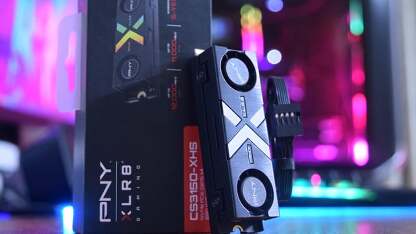
Inside the CS3250 sits Phison's E28 controller — the first widely available Gen5 NVMe controller, built on TSMC's 6nm node. The NAND is 3D 218-layer BiCS8 TLC flash, pairing well with a 2GB Hynix LPDDR4-4266 DRAM cache that keeps the controller's mapping table in fast on-board memory rather than relying solely on host RAM. The drive connects via PCIe 5.0 x4 (NVMe 2.0), operates in the M.2 2280 form factor, and ships without an integrated heatsink — a thermal coating on the controller helps manage heat, but active cooling is recommended in sustained-write workloads.
The CS3250 sits at the top of PNY's consumer SSD lineup and targets builders running a PCIe 5.0-capable platform: AMD Ryzen 7000 series, Ryzen 9000 series, and Intel 12th-gen or newer motherboards with an M.2 Gen5 slot. The 1TB model is the entry capacity in the range, with 2TB and 4TB SKUs offering higher write speeds (up to 14,000 MB/s on the 2TB). Buyers wanting maximum sequential throughput in the smallest footprint will find the heatsink-free design convenient for laptops and thin-and-light builds that expose an M.2 Gen5 slot, though thermal throttling under sustained loads is a real consideration without active airflow.
At the PCIe 5.0 tier the CS3250 competes directly with the Crucial T705 1TB, the Corsair MP700 Pro 1TB, and the Seagate FireCuda 540 1TB. All three are Phison E26- or E28-based Gen5 drives in the same performance class. The T705 ships with a heatsink option and has a well-established review record; the MP700 Pro is often priced similarly. The CS3250 differentiates itself with PNY's thermal-coated controller and the standard 5-year warranty backed by PNY's direct support.
Storage Comparisons:
XLR8 CS3250 Performance & Benchmarks
The PNY XLR8 CS3250 1TB is rated by the manufacturer at up to 14,900 MB/s sequential reads and 13,500 MB/s sequential writes — numbers that reflect the theoretical headroom of PCIe 5.0 x4, which provides roughly double the bandwidth ceiling of PCIe 4.0 x4. PNY has not published official random IOPS figures for this drive; independent benchmark testing at 4K Q32T16 depth shows roughly 1.4 million read IOPS and 820,000 write IOPS, though those figures are workload-dependent and will vary with queue depth and block size.
PNY XLR8 CS3250 1 TB vs M.2 5.0 x 4 peers
Switch between sequential throughput and random IOPS to see how this drive stacks up against other M.2 5.0 x 4 SSDs in our database. The highlighted bar is the drive on this page — click any other bar to open that drive.
- PNY XLR8 CS3250 1 TB (this drive): 14,900 MB/s read, 13,500 MB/s write
- Kioxia Exceria Pro G2 2 TB: 14,900 MB/s read, 13,400 MB/s write
- Kioxia Exceria Pro G2 4 TB: 14,900 MB/s read, 13,700 MB/s write
- PNY XLR8 CS3250 2 TB: 14,900 MB/s read, 14,000 MB/s write
- PNY XLR8 CS3250 4 TB: 14,900 MB/s read, 14,000 MB/s write
In practice, the step-up from a good PCIe 4.0 drive is most visible in large-file sequential transfers: video editors moving uncompressed 4K or 8K footage, game library copies, and DirectStorage-enabled titles that stream asset data directly from the drive to the GPU. For OS boot, application launch, and typical gaming loads, the difference over a flagship PCIe 4.0 SSD narrows considerably — the bottleneck shifts to software and memory latency rather than storage throughput. Like all high-density TLC SSDs, the CS3250 leverages an SLC write cache; once that cache fills under prolonged sequential writes the sustained throughput drops, though the large DRAM buffer helps minimise the impact compared to cache-less designs. Independent reviewers note that real-world game load times improve by several seconds over PCIe 4.0 equivalents, with the gap widening as DirectStorage adoption grows.
PNY XLR8 CS3250 vs Competitors
See how the XLR8 CS3250 stacks up against other M.2 5.0 x 4 drives in our database:
Compare with rival drives:
Endurance, TBW & Warranty
PNY backs the CS3250 with a 5-year limited warranty, consistent with the rest of its XLR8 NVMe lineup. The warranty is either time-based or TBW-limited, whichever comes first — PNY does not publicly list the exact TBW figure for the 1TB capacity in its current marketing materials, and independent sources report varying figures. At a typical consumer write workload of 20–40 GB per day, even the lower estimates cited by reviewers represent decades of practical use before endurance becomes relevant for mainstream buyers. The MTBF rating stands at 1.5 million hours, a population-level reliability figure that reflects PNY's confidence in the Phison E28 platform under normal operating conditions. Warranty service is handled through PNY directly; their lifetime technical support is included alongside the standard return process. The drive ships without a heatsink, which is relevant to warranty considerations — running without adequate airflow in a thermally constrained slot may affect long-term component health, even if it does not void the warranty per se.
PNY XLR8 CS3250 1 TB Specifications
| Category | Value |
|---|---|
| Capacity [?] | 1 TB |
| Interface [?] | M.2 5.0 x 4 |
| Controller [?] | Phison E28 |
| Memory type [?] | 3D 218-Layer TLC |
| DRAM [?] | Yes |
| Read speed (MB/s) [?] | 14900 |
| Write speed (MB/s) [?] | 13500 |
| Read IOPS [?] | n/a |
| Write IOPS [?] | n/a |
| Endurance (TBW) [?] | 600 |
| MTBF (million hours) [?] | 1.5 |
| Warranty (years) [?] | 5 |
Verdict: Is the XLR8 CS3250 Worth It in 2026?
The PNY XLR8 CS3250 1TB suits builders on a Ryzen 7000/9000 or Intel 12th-gen or later platform who want to fully exploit a PCIe 5.0 M.2 slot without paying a heatsink premium — the thermal-coated controller and standard M.2 2280 form factor keep it versatile. Buyers who run sustained heavy write workloads (video rendering, large backup jobs) should plan for active airflow or a third-party heatsink, since the drive ships bare and PCIe 5.0 controllers run warm under load. If the platform is PCIe 4.0, the Crucial T705 or WD Black SN850X deliver similar real-world responsiveness at lower cost and with more established review coverage. The CS3250 makes the most sense for users who have confirmed a Gen5 slot, prioritise sequential throughput, and want PNY's 5-year warranty safety net without paying extra for a bundled heatsink.
+ Pros
- 14,900 MB/s sequential reads on PCIe 5.0 x4
- Phison E28 controller on 6nm process
- 2GB Hynix LPDDR4 DRAM cache
- M.2 2280 form factor — no heatsink, fits most slots
- 5-year limited warranty with lifetime tech support
- MTBF rated at 1.5 million hours
- Cons
- No bundled heatsink — PCIe 5.0 controller runs hot under sustained load
- 1TB write speed (13,500 MB/s) trails the 2TB SKU (14,000 MB/s)
- PCIe 5.0 slot required — negligible gain over PCIe 4.0 for gaming alone
- PNY does not publish IOPS or TBW specs for the 1TB model
Buy this or similar SSD Storage:



Video Review
The PNY XLR8 CS3150 PCIe 5.0 SSD!