Lexar NQ790 4TB: Maximum Capacity on a Budget (2026)
Quick answer
The Lexar NQ790 4TB makes sense for budget-focused buyers who want maximum PCIe 4.0 capacity for a large game library, bulk media archive, or Mini PC storage, and don't regularly move huge continuous files.
Read: 7000 MB/s Write: 6000 MB/s Endurance: 2400 TBW Warranty: 5 years Interface: M.2 4.0 x 4
The Lexar NQ790 4TB tops out this budget QLC line with the most capacity and the highest endurance rating, at a price well below most TLC alternatives.
Controller & Memory
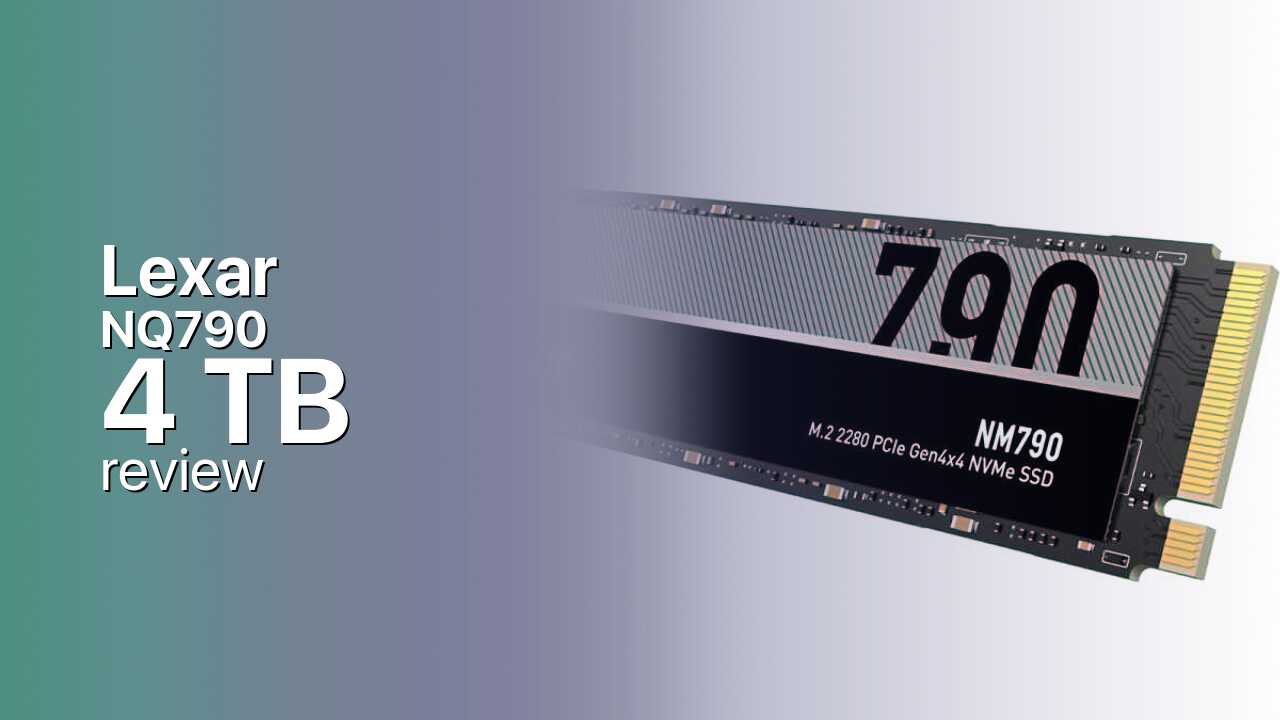
Inside the Lexar NQ790 4TB is a Maxio MAP1602 controller paired with Intel 144-layer QLC NAND, sold under Lexar's Longsys branding, and no dedicated DRAM chip; the drive leans on Host Memory Buffer (HMB) technology and dynamic SLC caching to keep performance up. It runs over a PCIe 4.0 x4 link in the standard M.2 2280 form factor, and its DRAM-less design keeps power draw moderate, which helps in compact or thermally constrained builds.
The NQ790 is Lexar's budget QLC counterpart to the TLC-based NM790, sharing a similar look and price bracket but trading NAND type for a lower cost per gigabyte. It ships in 512 GB, 1 TB, 2 TB, and 4 TB capacities; this 4 TB model shares the same 7,000 MB/s read and 6,000 MB/s write ratings as the 1 TB and 2 TB versions, while the smaller 512 GB variant is noticeably slower on writes at just 2,900 MB/s.
The NQ790 4TB fits laptops, Mini PCs, and the PlayStation 5's M.2 slot without a heatsink required, though good airflow helps under sustained load, and its capacity makes it one of the more affordable routes to 4 TB of PCIe 4.0 storage. Lexar's own NM790 is the closest in-house alternative if you want TLC NAND and higher endurance at a higher price; outside the family, the WD Black SN770 and Crucial P3 compete in a similar budget PCIe 4.0 tier.
Storage Comparisons:
NQ790 Performance & Benchmarks
The 4 TB Lexar NQ790 is rated for up to 7,000 MB/s sequential reads and 6,000 MB/s sequential writes, with up to 800,000 IOPS on random reads and 600,000 IOPS on random writes, matching the 1 TB and 2 TB models exactly. Independent testing of this drive family has generally matched or exceeded those rated numbers in burst transfers, and everyday responsiveness, booting, launching apps, general file work, feels snappy.
Lexar NQ790 4 TB vs M.2 4.0 x 4 peers
Switch between sequential throughput and random IOPS to see how this drive stacks up against other M.2 4.0 x 4 SSDs in our database. The highlighted bar is the drive on this page — click any other bar to open that drive.
- Patriot Viper PV593 1 TB: 14,500 MB/s read, 14,000 MB/s write
- Patriot Viper PV593 2 TB: 14,500 MB/s read, 14,000 MB/s write
- Patriot Viper PV593 4 TB: 14,500 MB/s read, 14,000 MB/s write
- Patriot Viper PV573 2 TB: 14,000 MB/s read, 12,000 MB/s write
- Lexar NQ790 4 TB (this drive): 7,000 MB/s read, 6,000 MB/s write
The QLC NAND is the key trade-off: the NQ790 relies more heavily on its dynamic SLC cache to sustain peak write speed than a comparable TLC drive would, and once that cache is exhausted on a large continuous transfer, write speed drops more sharply than it would on the TLC-based NM790. At 4 TB the cache is the largest in the range, so this capacity can absorb bigger sustained transfers, large game libraries, bulk archives, before any slowdown becomes noticeable. For typical use, gaming, OS tasks, general file work, this rarely matters.
Lexar NQ790 vs Competitors
See how the NQ790 stacks up against other M.2 4.0 x 4 drives in our database:
Compare with rival drives:
Endurance, TBW & Warranty
Lexar rates the 4 TB NQ790 at 2,400 TBW, the highest endurance figure in the range, and backs it with a 5-year limited warranty. At a realistic 20-30 GB per day write workload, 2,400 TBW works out to several centuries before the drive reaches its rated endurance limit, far beyond the warranty period and the practical lifespan of the rest of the PC around it. QLC NAND inherently has lower per-cell endurance than TLC, which is reflected in the NQ790's lower TBW rating relative to the TLC-based NM790 at the same capacity, though 2,400 TBW is still far more than mainstream users will ever write. Warranty service runs through Lexar's regional RMA process, so keep your purchase receipt on hand.
Lexar NQ790 4 TB Specifications
| Category | Value |
|---|---|
| Capacity [?] | 4 TB |
| Interface [?] | M.2 4.0 x 4 |
| Controller [?] | Maxiotech MAP-1602A |
| Memory type [?] | Intel 144L QLC |
| DRAM [?] | No |
| Read speed (MB/s) [?] | 7000 |
| Write speed (MB/s) [?] | 6000 |
| Read IOPS [?] | 800000 |
| Write IOPS [?] | 600000 |
| Endurance (TBW) [?] | 2400 |
| MTBF (million hours) [?] | 2000000 |
| Warranty (years) [?] | 5 |
Verdict: Is the NQ790 Worth It in 2026?
The Lexar NQ790 4TB makes sense for budget-focused buyers who want maximum PCIe 4.0 capacity for a large game library, bulk media archive, or Mini PC storage, and don't regularly move huge continuous files. Buyers doing sustained heavy writes, like large video exports or bulk data transfers, should look at Lexar's own TLC-based NM790 instead, which holds its write speed longer once any SLC cache empties. The WD Black SN770 is another reasonable alternative if QLC specifically is a dealbreaker. Overall, the NQ790 4TB is one of the more affordable ways to get 4 TB of PCIe 4.0 NVMe storage, as long as you understand the QLC trade-off going in.
+ Pros
- 2,400 TBW endurance, the best in the range
- One of the more affordable 4TB PCIe 4.0 options
- 5-year manufacturer warranty
- 7,000 MB/s reads at a budget price
- PS5-compatible M.2 2280 form factor
- Cons
- QLC NAND slows sharply after cache exhaustion
- Lower endurance than the TLC-based NM790
- No DRAM cache
- Not suited to sustained heavy write workloads
Buy this or similar SSD Storage:



Video Review
Lexar NM790 M 2 SSD Review - A Single Sided 4tb SSD perfect for your Laptop!