Lexar NQ710 1TB: Where the Budget Line Hits Its Stride (2026)
Quick answer
The Lexar NQ710 1TB makes sense for budget buyers who want a real capacity and speed step up from the 500 GB model without paying flagship prices; it's a solid fit for a laptop upgrade, Mini PC, or PS5 storage expansion.
Read: 5000 MB/s Write: 3300 MB/s Endurance: 340 TBW Warranty: 3 years Interface: M.2 4.0 x 4
The Lexar NQ710 1TB reaches the full 5,000 MB/s read ceiling of this budget PCIe 4.0 line while nearly doubling the 500 GB model's write speed.
Controller & Memory
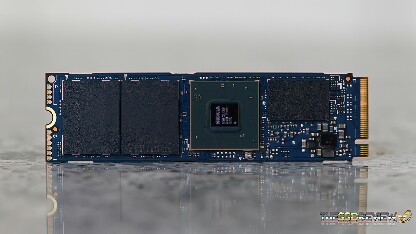
Inside the Lexar NQ710 1TB is a Maxio MAP1602 controller paired with Micron 176-layer QLC NAND and no dedicated DRAM chip, a DRAM-less design that keeps costs down. It runs over a PCIe 4.0 x4 link in the standard M.2 2280 form factor, weighing just 6 grams, and Lexar rates it for operation between 0°C and 70°C.
The NQ710 sits below Lexar's own NQ790 in the budget QLC stack, with a lower speed ceiling (5,000 MB/s peak versus the NQ790's 7,000 MB/s) and a shorter 3-year warranty rather than 5 years. It ships in 500 GB, 1 TB, and 2 TB capacities; this 1 TB model already reaches the line's full 5,000 MB/s read speed and jumps to 3,300 MB/s writes, nearly double the 500 GB model's 1,700 MB/s, since more NAND dies let the controller write in greater parallel. The 2 TB model pushes write speed further to 4,000 MB/s.
The NQ710 1TB fits laptops, Mini PCs, and the PlayStation 5's M.2 slot without a heatsink required. Lexar's own NQ790 and NM790 are the natural in-house step-ups for more speed and endurance; outside the family, the Crucial P3 and Kingston NV2 compete in a similar budget PCIe 4.0 tier.
Storage Comparisons:
NQ710 Performance & Benchmarks
The 1 TB Lexar NQ710 is rated for up to 5,000 MB/s sequential reads and 3,300 MB/s sequential writes, with random reads around 780,000 IOPS at queue depth 32. That's the full read ceiling of the range and a substantial step up in write speed from the 500 GB model, though the 2 TB capacity still edges ahead further with a 4,000 MB/s write rating.
Lexar NQ710 1 TB vs M.2 4.0 x 4 peers
Switch between sequential throughput and random IOPS to see how this drive stacks up against other M.2 4.0 x 4 SSDs in our database. The highlighted bar is the drive on this page — click any other bar to open that drive.
- Patriot Viper PV593 1 TB: 14,500 MB/s read, 14,000 MB/s write
- Patriot Viper PV593 2 TB: 14,500 MB/s read, 14,000 MB/s write
- Patriot Viper PV593 4 TB: 14,500 MB/s read, 14,000 MB/s write
- Patriot Viper PV573 2 TB: 14,000 MB/s read, 12,000 MB/s write
- Lexar NQ710 1 TB (this drive): 5,000 MB/s read, 3,300 MB/s write
Being a QLC drive, the NQ710 leans on SLC caching to hit its rated sequential-write number; sustained transfers that exceed the cache fall back toward the NAND's native write speed. The 1 TB model's cache is meaningfully larger than the 500 GB's, so it holds its peak write speed over a bigger share of any large transfer before slowing. For everyday tasks, booting Windows, loading games, general file work, read speed and random IOPS matter more than sustained sequential writes, and there it performs solidly for a budget drive. Independent testing of this line has generally matched or exceeded Lexar's rated sequential figures in short bursts.
Lexar NQ710 vs Competitors
See how the NQ710 stacks up against other M.2 4.0 x 4 drives in our database:
Compare with rival drives:
Endurance, TBW & Warranty
Lexar rates the 1 TB NQ710 at 340 TBW and backs it with a 3-year limited warranty, shorter than the 5-year coverage on the pricier NQ790 line. At a realistic 20-30 GB per day write workload, 340 TBW works out to roughly 31-46 years before the drive reaches its rated endurance limit, well beyond the warranty period for typical use. QLC NAND has inherently lower per-cell endurance than TLC, which shows up in this line's more modest TBW figures relative to Lexar's TLC-based NM-series. Warranty service runs through Lexar's regional RMA process, so keep your purchase receipt on hand.
Lexar NQ710 1 TB Specifications
| Category | Value |
|---|---|
| Capacity [?] | 1 TB |
| Interface [?] | M.2 4.0 x 4 |
| Controller [?] | Maxio MAP1602 |
| Memory type [?] | Micron 176L QLC |
| DRAM [?] | No |
| Read speed (MB/s) [?] | 5000 |
| Write speed (MB/s) [?] | 3300 |
| Read IOPS [?] | 780000 |
| Write IOPS [?] | 580000 |
| Endurance (TBW) [?] | 340 |
| MTBF (million hours) [?] | 1500000 |
| Warranty (years) [?] | 3 |
Verdict: Is the NQ710 Worth It in 2026?
The Lexar NQ710 1TB makes sense for budget buyers who want a real capacity and speed step up from the 500 GB model without paying flagship prices; it's a solid fit for a laptop upgrade, Mini PC, or PS5 storage expansion. Buyers who move very large files constantly, like sustained video work, should still consider Lexar's own NQ790 or a TLC-equipped drive instead, since the NQ710's write speed and warranty both trail those options. If a longer warranty matters more than price, the Crucial P3 is worth comparing at a similar tier. Overall, 1 TB is where this budget line starts to feel genuinely usable, at only a modest price step up from the 500 GB model.
+ Pros
- 3,300 MB/s writes, nearly double the 500GB model
- 5,000 MB/s sequential reads on PCIe 4.0
- 340 TBW endurance for the price
- Compact single-sided M.2 2280 fits laptops and PS5
- 3-year manufacturer warranty
- Cons
- Write speed still trails the 2TB model
- QLC NAND slows after SLC cache exhaustion
- No DRAM cache, relies on host RAM
- Shorter warranty than Lexar's pricier NQ790 line
Buy this or similar SSD Storage:



Video Review
Lexar NM710 SSD 1TB Review | Blazing Fast Storage!