Intel 665p 2 TB — High-Capacity QLC NVMe with DRAM (2026)
Quick answer
The Intel 665p 2 TB is the QLC drive that makes the strongest case for QLC as a viable consumer technology.
Read: 2000 MB/s Write: 2000 MB/s Endurance: 600 TBW Warranty: 5 years Interface: M.2 3.0 x 4
Intel's 665p 2 TB pairs a DRAM-equipped SM2263EN controller with 96-layer QLC NAND and 600 TBW endurance — one of the best-value 2 TB NVMe drives of the PCIe 3.0 era for game libraries and everyday storage.
Controller & Memory
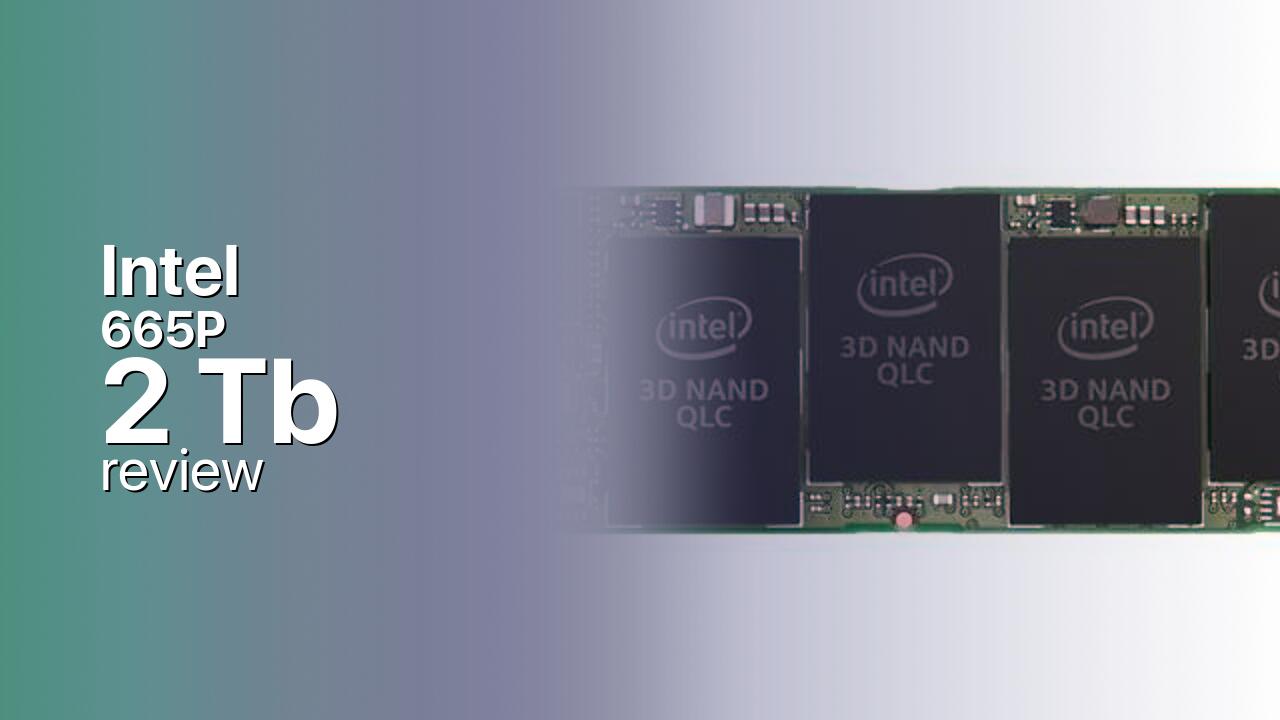
The Intel 665p is built on the Silicon Motion SM2263EN, a 4-channel PCIe 3.0 x4 controller with a dedicated DRAM cache, paired with Intel's 96-layer 3D QLC NAND. The 2 TB variant doubles both the NAND capacity and the DRAM cache to 2 GB of DDR3, following the standard 1 MB per 1 GB ratio. QLC NAND stores 4 bits per cell, trading raw write speed and endurance for density and cost — Intel compensates with a large dynamic SLC write cache that can consume up to roughly 600 GB of free space on the 2 TB model, buffering consumer writes at full 2,000 MB/s speed until the cache fills.
The 2 TB capacity is where QLC economics shine brightest. The cost-per-gigabyte advantage over TLC is most pronounced at higher capacities, and the larger total NAND pool means the SLC cache is proportionally larger and less likely to be exhausted in everyday use. Intel also offered 512 GB and 1 TB variants; the 2 TB model carries a 600 TBW endurance rating — double the 1 TB's 300 TBW. The drive uses a single-sided M.2 2280 form factor despite the higher capacity, fitting in thin laptops and ultrabooks without clearance issues.
At launch, the 665p 2 TB competed against TLC alternatives like the WD Blue SN550 2 TB (DRAM-less), the Crucial P5 2 TB (faster but pricier), and the Samsung 970 EVO Plus 2 TB (significantly faster and significantly more expensive). The 665p's pitch was straightforward: TLC-class everyday responsiveness thanks to DRAM, 2 TB of QLC storage for less than most 2 TB TLC drives, and Intel's 5-year warranty. In 2026, it remains a solid budget bulk-storage option for a PCIe 3.0 system — ideal for a large game library, media collection, or secondary drive where the QLC write ceiling is rarely encountered.
Storage Comparisons:
665P Performance & Benchmarks
Intel rates the 665p 2 TB at 2,000 MB/s sequential reads and 2,000 MB/s sequential writes, with random performance of 250,000 IOPS read and write. These figures are identical to the 1 TB variant and are modest by PCIe 3.0 x4 standards — TLC drives in this class typically reach 3,000–3,500 MB/s reads. The 665p's real-world advantage is its massive dynamic SLC cache: the 2 TB model can allocate up to roughly 600 GB of free capacity as a high-speed write buffer, meaning almost all consumer write operations — game installs, file transfers, media ingestion — complete at full speed without ever touching the native QLC write rate.
Intel 665P 2 TB vs M.2 3.0 x 4 peers
Switch between sequential throughput and random IOPS to see how this drive stacks up against other M.2 3.0 x 4 SSDs in our database. The highlighted bar is the drive on this page — click any other bar to open that drive.
- ADATA SX 8800 Pro 512 GB: 3,500 MB/s read, 2,700 MB/s write
- ADATA SX 8800 Pro 1 TB: 3,500 MB/s read, 2,700 MB/s write
- ADATA XPG Spectrix S40G RGB 256 GB: 3,500 MB/s read, 3,000 MB/s write
- ADATA XPG Spectrix S40G RGB 512 GB: 3,500 MB/s read, 3,000 MB/s write
- Intel 665P 2 TB (this drive): 2,000 MB/s read, 2,000 MB/s write
When the SLC cache does fill — which requires a sustained write of hundreds of gigabytes in one go — speeds drop to the native QLC rate of approximately 100–150 MB/s. For a drive primarily used for game storage, media files, and general desktop workloads, this scenario is rare. The 2 TB capacity also means the drive is less likely to be operated near full, which helps the dynamic cache algorithm allocate more SLC space. The DRAM cache keeps random read latency competitive with TLC drives at low queue depths, so boot times and application launches feel snappy. Content creators who regularly ingest large video files or run sustained write workloads should note the QLC write cliff and consider a TLC alternative.
Intel 665P vs Competitors
See how the 665P stacks up against other M.2 3.0 x 4 drives in our database:
Compare with rival drives:
Endurance, TBW & Warranty
Intel backs the 665p 2 TB with a 5-year limited warranty and rates endurance at 600 TBW — double the 1 TB variant's 300 TBW. At a typical consumer workload of 30 GB per day (reflecting the 2 TB drive's role as a primary storage device), the endurance rating translates to roughly 55 years of use. Even at 100 GB per day — a heavy write workload — the drive would last over 16 years. The 600 TBW figure is competitive with entry-level TLC drives at this capacity and, combined with the 5-year warranty, makes the 665p one of the more reassuring QLC purchases. Intel's warranty service includes advance replacement and cross-shipping in many regions. For a drive primarily used for game storage and media, endurance is unlikely to be a practical concern within or well beyond the warranty period.
Intel 665P 2 TB Specifications
| Category | Value |
|---|---|
| Capacity [?] | 2 TB |
| Interface [?] | M.2 3.0 x 4 |
| Controller [?] | Silicon Motion SM2263EN |
| Memory type [?] | Intel 96L 3D QLC |
| DRAM [?] | DDR3L |
| Read speed (MB/s) [?] | 2000 |
| Write speed (MB/s) [?] | 2000 |
| Read IOPS [?] | 250000 |
| Write IOPS [?] | 250000 |
| Endurance (TBW) [?] | 600 |
| MTBF (million hours) [?] | 1200000 |
| Warranty (years) [?] | 5 |
Verdict: Is the 665P Worth It in 2026?
The Intel 665p 2 TB is the QLC drive that makes the strongest case for QLC as a viable consumer technology. The 2 TB capacity provides enough SLC cache headroom that most users will never encounter the QLC write cliff, and the DRAM-equipped SM2263EN controller delivers everyday responsiveness that feels closer to a mid-range TLC drive than a budget QLC one. Buy it if you need affordable 2 TB NVMe storage for a PCIe 3.0 system and your workload is typical — games, media, documents, applications. The 600 TBW endurance and 5-year warranty remove most of the anxiety around QLC longevity. Skip it if you regularly write large files — video editors, data hoarders, and anyone running sustained write workloads will hit the QLC wall and should buy TLC. Skip it also if your system supports PCIe 4.0, where modern 2 TB TLC drives offer vastly more bandwidth. For the right use case, the 665p 2 TB remains one of the most sensibly engineered QLC SSDs Intel ever shipped.
+ Pros
- DRAM-equipped SM2263EN controller — rare for QLC drives
- 2 GB DDR3 DRAM cache for low-latency random I/O
- Dynamic SLC cache up to ~600 GB absorbs burst writes
- 600 TBW endurance — competitive with entry-level TLC at 2 TB
- 5-year warranty — among the longest in the consumer SSD market
- Single-sided M.2 2280 despite 2 TB capacity
- Cons
- Write speed drops to ~100 MB/s after SLC cache exhausts
- 2,000 MB/s reads trail PCIe 3.0 x4 TLC drives significantly
- QLC NAND — lower native endurance than TLC alternatives
- No PCIe 4.0 support — not PS5 compatible
- No hardware encryption support
Buy this or similar SSD Storage:



Video Review
How SSD Technology Keeps Getting WORSE! - Intel 660p Review