Seagate BarraCuda 510 256GB - PCIe 3.0 NVMe SSD Review (2026)
Quick answer
The Seagate BarraCuda 510 256 GB is a credible legacy pick for PCIe 3.0 system boot drive upgrades where Seagate's brand support and global warranty channel matter.
Read: 3400 MB/s Write: 2100 MB/s Endurance: 160 TBW Warranty: 5 years Interface: M.2 3.0 x 4
The Seagate BarraCuda 510 256GB is a 2019-era Phison E12 PCIe 3.0 NVMe with Seagate branding - 3,400 MB/s reads, Toshiba 64-layer BiCS3 TLC NAND, 512 MB DRAM, and a five-year warranty at boot-drive capacity.
Controller & Memory
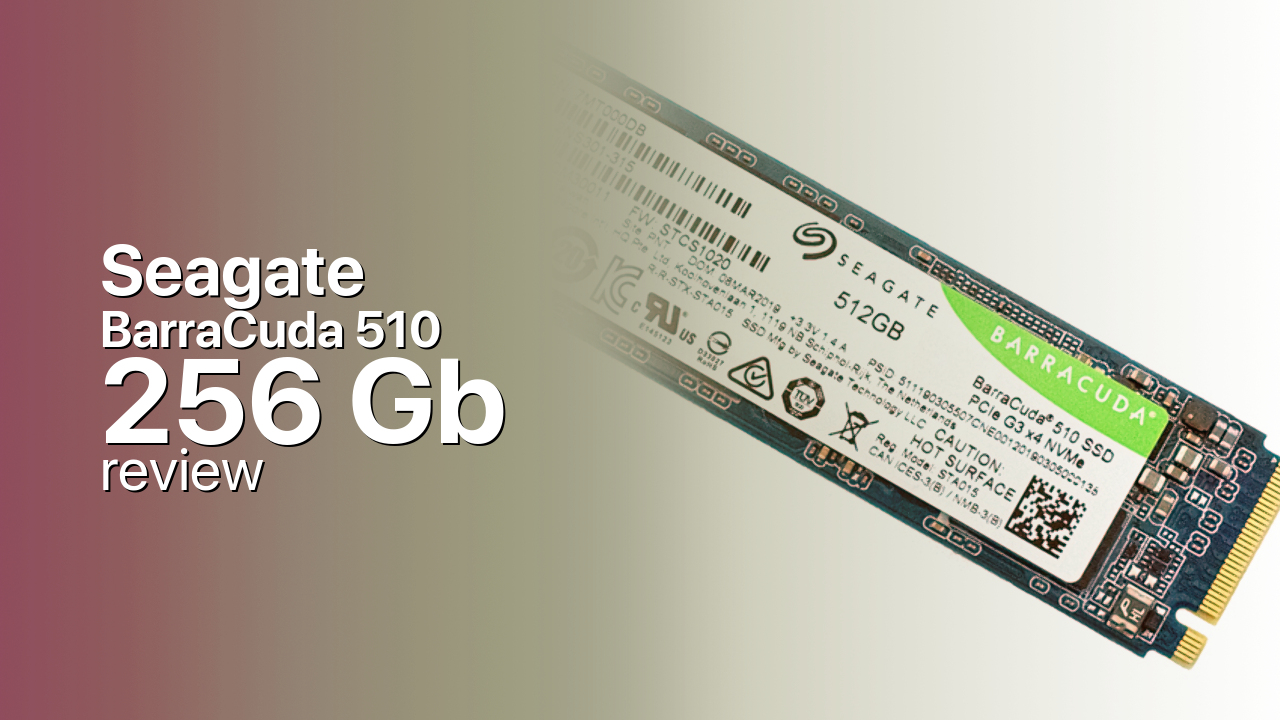
The Seagate BarraCuda 510 256 GB pairs Phison's PS5012-E12 eight-channel PCIe 3.0 controller with two packages of Toshiba 64-layer BiCS3 3D TLC NAND and a 512 MB SK Hynix DDR4 DRAM cache. The E12 platform is the same silicon that drove the Sabrent Rocket NVMe, Corsair MP510, and Silicon Power P34A80 - mature, well-characterised, and known for stable PCIe 3.0 line-rate performance. Seagate's twist on the platform is the BarraCuda consumer-tier brand and the SeaTools utility for monitoring and firmware management. The PCB is M.2 2280-S2 (single-sided), which fits any modern motherboard or laptop M.2 bay.
Seagate ships the BarraCuda 510 in 250 GB, 500 GB, and 1 TB capacities. The 256 GB SKU on this page is the entry boot-drive option in the line, intended for users replacing an older SATA SSD or hard drive in a 2017-2020 system. Sequential read performance hits the same peak as larger siblings, but writes drop to 2,100 MB/s (versus 3,200 MB/s on the 1 TB) because the E12 has only two NAND dies to fan across at this capacity. The BarraCuda branding sits below Seagate's FireCuda 510 line in the consumer hierarchy - the FireCuda variants carry longer warranty, higher endurance, and bundled Rescue data recovery service.
The BarraCuda 510 256 GB targets buyers replacing an older boot drive on a PCIe 3.0 system who want a name-brand NVMe with Seagate's global retail and warranty footprint. Direct rivals at this capacity were the Samsung 970 EVO 250 GB (faster, better software, similar price), the WD Black SN750 250 GB (better sustained writes, similar tier), and the Crucial P5 250 GB (DRAM-equipped competitor). Within that field the BarraCuda was the value Seagate pick - reasonable speeds, slightly weaker sustained writes, brand familiarity.
Storage Comparisons:
BarraCuda 510 Performance & Benchmarks
Manufacturer ratings for the BarraCuda 510 256 GB land at 3,400 MB/s sequential reads and 2,100 MB/s sequential writes, with random performance up to 350,000 read and 530,000 write IOPS at high queue depths per Seagate's published spec line. The peak read rating sits near the PCIe 3.0 x4 interface ceiling. Independent reviewers at Tom's Hardware and StorageReview consistently measured CrystalDiskMark sequential reads within a few percent of the rating, with random performance landing close to the rated IOPS at high queue depths.
Seagate BarraCuda 510 256 GB vs M.2 3.0 x 4 peers
Switch between sequential throughput and random IOPS to see how this drive stacks up against other M.2 3.0 x 4 SSDs in our database. The highlighted bar is the drive on this page — click any other bar to open that drive.
- ADATA SX 8800 Pro 512 GB: 3,500 MB/s read, 2,700 MB/s write
- ADATA SX 8800 Pro 1 TB: 3,500 MB/s read, 2,700 MB/s write
- ADATA XPG Spectrix S40G RGB 256 GB: 3,500 MB/s read, 3,000 MB/s write
- ADATA XPG Spectrix S40G RGB 512 GB: 3,500 MB/s read, 3,000 MB/s write
- Seagate BarraCuda 510 256 GB (this drive): 3,400 MB/s read, 2,100 MB/s write
Sustained writes show the platform's limitation at this capacity. With only 256 GB of NAND, the drive holds peak SLC-cached writes for roughly 25-40 GB of continuous transfer before the cache exhausts and writes drop into TLC direct-write territory around 500-700 MB/s. For boot, application, and gaming workloads at this capacity that profile is invisible because the workloads do not produce sustained writes at this scale. The drive runs cool thanks to the mature E12 platform and modest 64-layer NAND density. DirectStorage operates at PCIe 3.0 speeds well below current PCIe 4.0 alternatives - this is not a DirectStorage-optimised drive for 2026 gaming.
Seagate BarraCuda 510 vs Competitors
See how the BarraCuda 510 stacks up against other M.2 3.0 x 4 drives in our database:
Compare with rival drives:
Endurance, TBW & Warranty
Seagate backs the BarraCuda 510 256 GB with a five-year limited warranty and a 160 TBW endurance budget per the official spec sheet. At a typical 10-20 GB/day desktop write workload that budget lasts roughly 22-44 years, well past the warranty period and any realistic service life. The endurance scales linearly across the line at 640 TBW per terabyte of capacity, which is competitive with contemporary Samsung 970 EVO and WD Black SN750 figures. The published MTBF is 1.8 million hours, a population statistic across a fleet rather than a per-drive promise. Seagate handles consumer RMA directly through seagate.com's support portal with serial-number registration - the process is global and well-established, one of the smoother consumer SSD support experiences in the market. The BarraCuda 510 also benefits from Seagate's SeaTools utility for monitoring and firmware updates, though no bundled data-recovery service like the higher-tier FireCuda Rescue program.
Seagate BarraCuda 510 256 GB Specifications
| Category | Value |
|---|---|
| Capacity [?] | 256 GB |
| Interface [?] | M.2 3.0 x 4 |
| Controller [?] | Phison E12 |
| Memory type [?] | Toshiba 64-L TLC |
| DRAM [?] | SK Hynix 512MB DDR4 |
| Read speed (MB/s) [?] | 3400 |
| Write speed (MB/s) [?] | 2100 |
| Read IOPS [?] | 350000 |
| Write IOPS [?] | 530000 |
| Endurance (TBW) [?] | 160 |
| MTBF (million hours) [?] | 1.8 |
| Warranty (years) [?] | 5 |
Verdict: Is the BarraCuda 510 Worth It in 2026?
The Seagate BarraCuda 510 256 GB is a credible legacy pick for PCIe 3.0 system boot drive upgrades where Seagate's brand support and global warranty channel matter. Anyone building or upgrading on a current platform should look at the WD Black SN770 500 GB or Crucial P3 Plus 500 GB instead - both PCIe 4.0 designs at slightly higher capacity with materially better performance for similar or lower retail prices. Skip the BarraCuda 510 if you need a primary storage drive for games or media; 256 GB is genuinely too small for modern game libraries. As a 2019-era PCIe 3.0 boot drive at 256 GB the BarraCuda 510 aged reasonably and remains usable, but loses on every spec line to current alternatives.
+ Pros
- 3,400 MB/s sequential reads near PCIe 3.0 ceiling
- 512 MB SK Hynix DDR4 DRAM cache
- Phison PS5012-E12 controller with mature firmware
- 5-year warranty with Seagate global RMA support
- 1.8 million-hour MTBF rating
- SeaTools utility for monitoring and firmware updates
- Cons
- 256 GB capacity too small for modern game libraries
- PCIe 3.0 only, two generations behind current drives
- Sequential writes capped at 2,100 MB/s on 256 GB tier
- Discontinued, superseded by FireCuda 530
- No bundled data recovery service like FireCuda Rescue
Buy this or similar SSD Storage:
Video Review
Seagate 512GB BarraCuda 510 NVMe M.2 SSD Unboxing w/Benchmarks ZP512CM30011