Crucial P5 250GB NVMe SSD Review (2026)
Quick answer
The Crucial P5 250 GB is a tough sell at its original pricing.
Read: 3400 MB/s Write: 1400 MB/s Endurance: 150 TBW Warranty: 5 years Interface: M.2 3.0 x 4
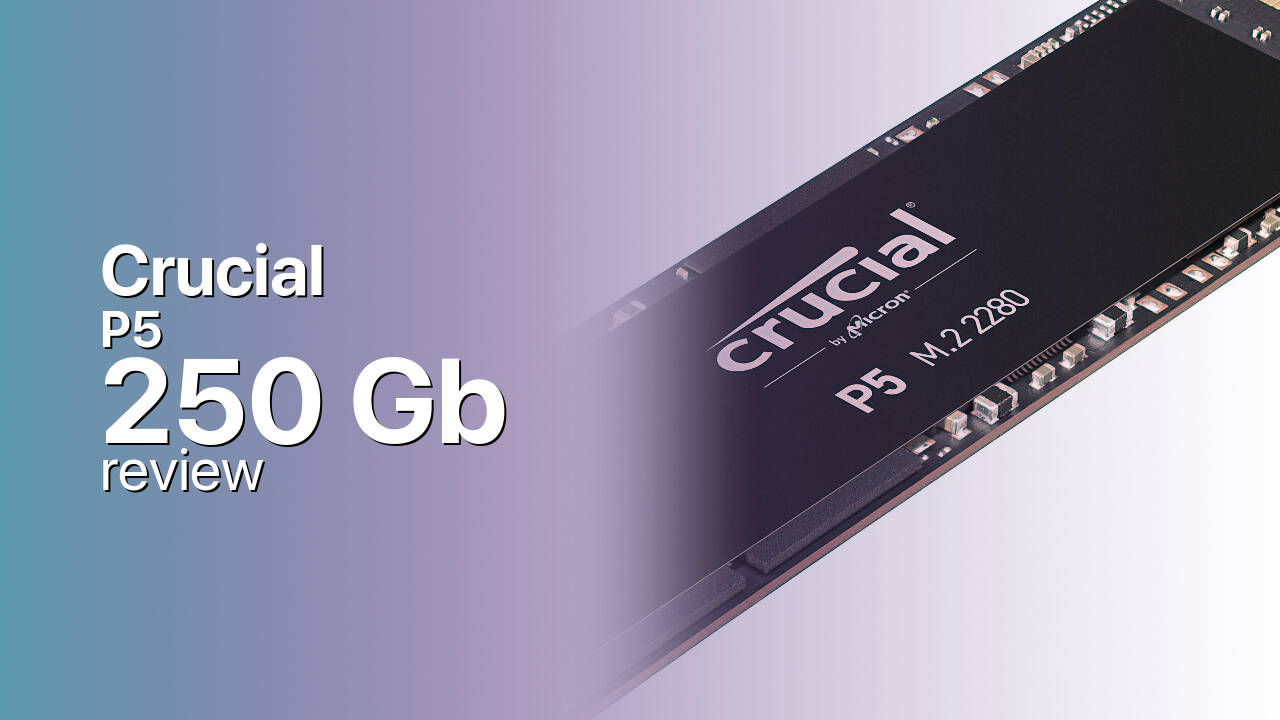
The Crucial P5 250 GB is the entry capacity of Crucial's first enthusiast NVMe line, pairing a proprietary six-core controller with Micron TLC and hardware encryption at PCIe 3.0 speeds.
Controller & Memory
The P5 features Crucial's first custom NVMe controller -- a six-core design with dual Arm Cortex-R5 CPUs, four Cortex-M3 co-processors, and eight NAND channels. It is paired with LPDDR4 DRAM for the flash translation layer. The 250 GB capacity uses Micron's older 64-layer TLC NAND with four virtual planes per die, while the 1 TB and 2 TB models use the newer 96-layer TLC.
The 250 GB is the runt of the P5 litter, with rated writes of only 1,400 MB/s versus 3,000 MB/s on the 500 GB and larger capacities. This is a dramatic performance cliff caused by fewer NAND dies for parallel writes. The drive is single-sided M.2 2280 at all capacities, compatible with laptops and desktops. The P5 includes hardware AES 256-bit encryption (TCG Opal 2.0, IEEE 1667, eDrive), a feature missing from most WD and Samsung drives in this price range.
Competitors at this capacity include the Samsung 970 EVO Plus and WD Black SN750. The P5 runs warm under load -- Tom's Hardware noted this as its primary weakness -- and its read performance does not lead the PCIe 3.0 class.
Storage Comparisons:
P5 Performance & Benchmarks
Crucial rates the 250 GB P5 for up to 3,400 MB/s sequential reads and 1,400 MB/s sequential writes over PCIe 3.0 x4. Random IOPS for the 250 GB model are not officially published, but they are significantly lower than the 1 TB model's 430K/500K rated IOPS due to reduced NAND parallelism.
Crucial P5 250 GB vs M.2 3.0 x 4 peers
Switch between sequential throughput and random IOPS to see how this drive stacks up against other M.2 3.0 x 4 SSDs in our database. The highlighted bar is the drive on this page — click any other bar to open that drive.
- ADATA SX 8800 Pro 512 GB: 3,500 MB/s read, 2,700 MB/s write
- ADATA SX 8800 Pro 1 TB: 3,500 MB/s read, 2,700 MB/s write
- ADATA XPG Spectrix S40G RGB 256 GB: 3,500 MB/s read, 3,000 MB/s write
- ADATA XPG Spectrix S40G RGB 512 GB: 3,500 MB/s read, 3,000 MB/s write
- Crucial P5 250 GB (this drive): 3,400 MB/s read, 1,400 MB/s write
The P5 uses Crucial's Dynamic Write Acceleration (SLC caching), which differs from most competitors: it retains portions of OS and user data in the SLC cache for faster read access, rather than aggressively flushing to TLC. The cache also adjusts its size based on both used capacity and current workload. Independent reviewers found this approach clever but noted the P5 does not lead the performance charts in most benchmarks.
Tom's Hardware highlighted the P5's thermal behavior as a concern -- the controller runs hot under load, with Adaptive Thermal Protection throttling performance when NAND temperatures exceed 70 degrees Celsius. A motherboard M.2 heatsink is advisable.
Crucial P5 vs Competitors
See how the P5 stacks up against other M.2 3.0 x 4 drives in our database:
Compare with rival drives:
Endurance, TBW & Warranty
Crucial rates the 250 GB P5 for 150 TBW of write endurance under a five-year limited warranty. At a light consumer workload of 8 GB per day, 150 TBW translates to roughly 50 years of use. The drive includes RAIN (Redundant Array of Independent NAND) parity protection at a 32:1 ratio, multi-step LDPC error correction, and integrated power loss immunity. Crucial overprovisions the P5 by approximately 9%. The 150 TBW is the lowest in the P5 lineup, scaling to 300 TBW at 500 GB, 600 TBW at 1 TB, and 1,200 TBW at 2 TB.
Crucial P5 250 GB Specifications
| Category | Value |
|---|---|
| Capacity [?] | 250 GB |
| Interface [?] | M.2 3.0 x 4 |
| Controller [?] | Micron DMO1B2 |
| Memory type [?] | Micron TLC |
| DRAM [?] | LPDDR4 DRAM |
| Read speed (MB/s) [?] | 3400 |
| Write speed (MB/s) [?] | 1400 |
| Read IOPS [?] | 210000 |
| Write IOPS [?] | 355000 |
| Endurance (TBW) [?] | 150 |
| MTBF (million hours) [?] | 1.5 |
| Warranty (years) [?] | 5 |
Verdict: Is the P5 Worth It in 2026?
The Crucial P5 250 GB is a tough sell at its original pricing. Its 1,400 MB/s write speed is less than half the 500 GB model's 3,000 MB/s, and the 64-layer TLC NAND is older than what ships in the larger capacities. The hardware encryption is a genuine differentiator, but builders who do not need BitLocker or eDrive support should consider the WD Black SN750 or Samsung 970 EVO Plus for better all-around performance at 250 GB. The P5 makes more sense starting at the 500 GB capacity, where writes jump to 3,000 MB/s and the price-per-GB improves.
+ Pros
- Hardware AES 256-bit encryption (TCG Opal 2.0)
- 3,400 MB/s sequential reads
- LPDDR4 DRAM cache
- Single-sided M.2 2280
- Five-year warranty
- RAIN parity data protection
- Cons
- 1,400 MB/s writes, less than half the 500GB model
- Uses older 64L TLC (not 96L)
- Runs hot under load
- Read performance trails Samsung 970 EVO Plus
- Only 150 TBW endurance
Buy this or similar SSD Storage:



Video Review
Crucial P5 1TB - NVMe M.2 SSD Review