Silicon Power P34A60 256GB DRAM-Less NVMe SSD Review (2026)
Quick answer
The Silicon Power P34A60 256GB is a straightforward budget NVMe boot drive that delivers 2,200 MB/s reads — roughly four times faster than SATA — at a price point that undercuts DRAM-equipped alternatives.
Read: 2200 MB/s Write: 1600 MB/s Endurance: 150 TBW Warranty: 5 years Interface: M.2 3.0 x 4
The Silicon Power P34A60 256GB is a budget DRAM-less PCIe 3.0 NVMe SSD built on the Silicon Motion SM2263XT controller and Intel TLC NAND, offering 2,200 MB/s reads at the lowest price tier.
Controller & Memory
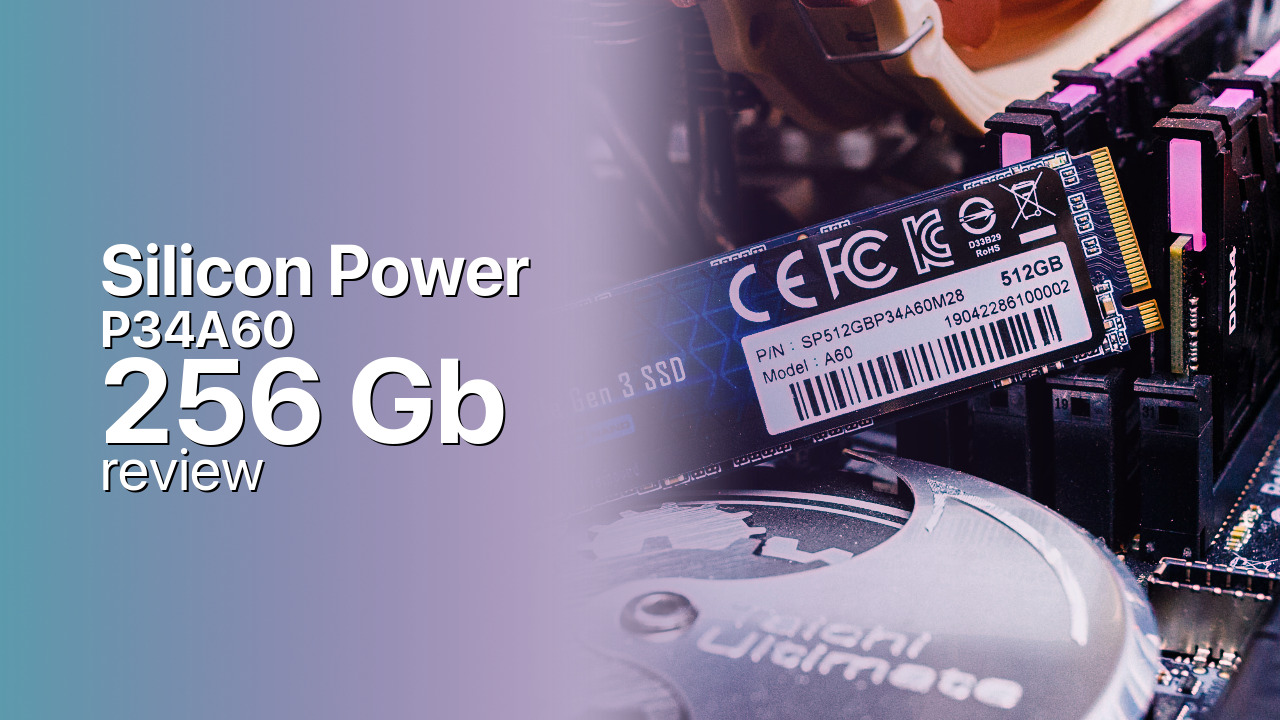
The P34A60 uses the Silicon Motion SM2263XT controller — a cost-optimized, DRAM-less design that relies on Host Memory Buffer (HMB) to borrow a small amount of system RAM for the flash translation layer. The controller is paired with Intel 3D TLC NAND. Because there is no on-board DRAM, the P34A60 is physically single-sided and lower-power than DRAM-equipped drives, which benefits laptop battery life and slim-form-factor compatibility.
Silicon Power rates the 256GB model at 2,200 MB/s sequential reads and 1,600 MB/s sequential writes. These numbers are lower than DRAM-equipped PCIe 3.0 drives like the P34A80 (3,200/3,000 MB/s), reflecting the SM2263XT's cost-saving architecture. The P34A60 range also includes 512GB and 1TB capacities, with the larger models offering the same peak speeds but larger SLC caches and better sustained write performance.
At 256GB and 150 TBW, the P34A60 targets budget builders who need a basic NVMe boot drive — faster than SATA, cheaper than DRAM-equipped NVMe. Competitors include the Kingston NV2 250GB and the Team MP33 256GB, both also DRAM-less designs.
Storage Comparisons:
P34A60 Performance & Benchmarks
The P34A60 256GB is rated for 2,200 MB/s sequential reads and 1,600 MB/s sequential writes. These are the entry-level speeds for PCIe 3.0 NVMe — faster than SATA SSDs (550 MB/s ceiling) but well below DRAM-equipped NVMe drives that hit 3,200 MB/s. The DRAM-less architecture means the controller relies on HMB (Host Memory Buffer) for mapping data, which adds a small latency penalty on random IO operations.
Silicon Power P34A60 256 GB vs M.2 3.0 x 4 peers
Switch between sequential throughput and random IOPS to see how this drive stacks up against other M.2 3.0 x 4 SSDs in our database. The highlighted bar is the drive on this page — click any other bar to open that drive.
- ADATA SX 8800 Pro 512 GB: 3,500 MB/s read, 2,700 MB/s write
- ADATA SX 8800 Pro 1 TB: 3,500 MB/s read, 2,700 MB/s write
- ADATA XPG Spectrix S40G RGB 256 GB: 3,500 MB/s read, 3,000 MB/s write
- ADATA XPG Spectrix S40G RGB 512 GB: 3,500 MB/s read, 3,000 MB/s write
- Silicon Power P34A60 256 GB (this drive): 2,200 MB/s read, 1,600 MB/s write
Random performance is rated at 240K read IOPS and 250K write IOPS — adequate for a boot drive but below the 390K/450K figures of the DRAM-equipped P34A80. In real-world desktop use — OS boot, application launches, web browsing — the P34A60 feels noticeably faster than a SATA SSD but may feel slightly less responsive than a DRAM-equipped NVMe drive under heavy multitasking. For gaming, read speed is the primary factor and 2,200 MB/s provides ample headroom. The 256GB capacity limits the drive to OS and a few applications.
Silicon Power P34A60 vs Competitors
See how the P34A60 stacks up against other M.2 3.0 x 4 drives in our database:
Compare with rival drives:
Endurance, TBW & Warranty
Silicon Power rates the P34A60 256GB at 150 TBW with a five-year limited warranty. At a typical boot-drive workload of 10–15 GB per day, the endurance budget covers 27 to 41 years. The drive includes LDPC error correction and end-to-end data protection. Warranty service is handled through the retailer or Silicon Power's direct RMA process.
Silicon Power P34A60 256 GB Specifications
| Category | Value |
|---|---|
| Capacity [?] | 256 GB |
| Interface [?] | M.2 3.0 x 4 |
| Controller [?] | Silicon Motion 2263XT |
| Memory type [?] | Intel 3D TLC |
| DRAM [?] | HMB |
| Read speed (MB/s) [?] | 2200 |
| Write speed (MB/s) [?] | 1600 |
| Read IOPS [?] | 240000 |
| Write IOPS [?] | 250000 |
| Endurance (TBW) [?] | 150 |
| MTBF (million hours) [?] | 2000000 |
| Warranty (years) [?] | 5 |
Verdict: Is the P34A60 Worth It in 2026?
The Silicon Power P34A60 256GB is a straightforward budget NVMe boot drive that delivers 2,200 MB/s reads — roughly four times faster than SATA — at a price point that undercuts DRAM-equipped alternatives. The DRAM-less design and lower write speeds are acceptable trade-offs for a read-heavy boot drive. The limitation is capacity: 256GB is tight for anything beyond the OS and a few applications. Budget builders who can stretch to the 512GB model gain more usable space and a larger SLC cache. Those who want consistent write performance should consider the DRAM-equipped Silicon Power P34A80 instead. For the price, the P34A60 256GB does exactly what it promises.
+ Pros
- 2,200 MB/s reads — four times faster than SATA
- Single-sided M.2 2280 fits all laptops and desktops
- Low power draw benefits laptop battery life
- Intel TLC NAND with LDPC error correction
- Budget-friendly pricing
- Cons
- DRAM-less — relies on Host Memory Buffer
- 1,600 MB/s writes, lower than DRAM-equipped NVMe
- 256GB fills quickly beyond OS use
- 240K/250K IOPS — entry-level random performance
- SM2263XT controller is slower than Phison E12 alternatives
Buy this or similar SSD Storage:



Video Review
Silicon Power P34A60 M.2 NVMe Review and Installation! CHEAP & AMAZING PERFORMANCE!