Kingston A2000 256GB NVMe SSD Review (2026)
Quick answer
The Kingston A2000 256GB is a budget NVMe SSD that delivers a meaningful speed upgrade over SATA at a similar price point.
Read: 2200 MB/s Write: 2000 MB/s Endurance: 150 TBW Warranty: 5 years Interface: M.2 3.0 x 4
The Kingston A2000 256GB is an entry-level NVMe SSD that pairs the Silicon Motion SM2263 controller with Toshiba 3D TLC NAND, targeting budget builders who want NVMe speeds at a price competitive with SATA SSDs.
Controller & Memory
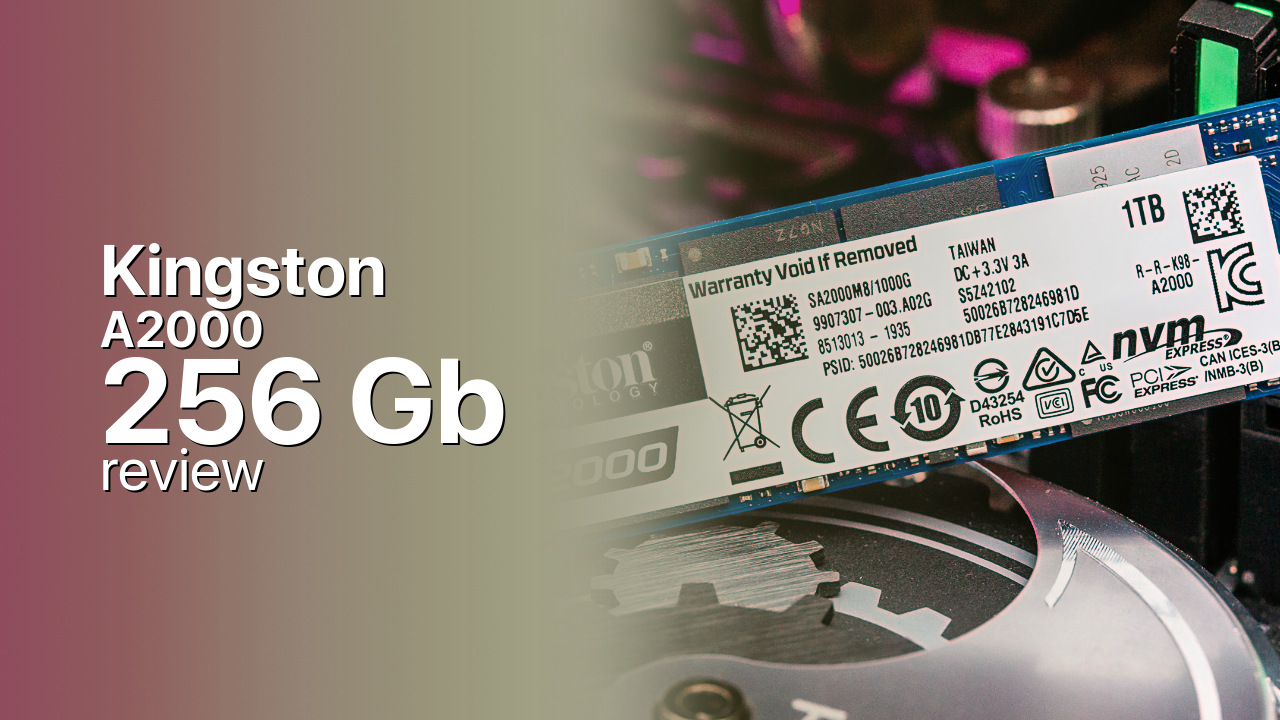
Inside the A2000 256 GB is the Silicon Motion SM2263 4-channel controller paired with Toshiba (Kioxia) BiCS 3D TLC NAND flash. A DDR4 DRAM chip handles the flash translation layer. The drive is an M.2 2280 on PCIe 3.0 x4.
The 256 GB model reads at up to 2,200 MB/s but writes at only 1,600 MB/s, lower than the 2,000 MB/s the 512 GB and 1 TB models achieve. This is a typical small-capacity limitation caused by fewer NAND dies. Endurance is rated at 150 TBW over a 5-year warranty.
The A2000 series also comes in 512 GB and 1 TB. It competes with other budget NVMe drives like the Crucial P2, WD Blue SN550, and Intel 660P. The A2000\'s differentiator is hardware encryption support (XTS-AES 256, TCG Opal, eDrive), which is rare at this price point. The SM2263 controller is a 4-channel design that balances cost and performance for the mainstream market.
Storage Comparisons:
A2000 Performance & Benchmarks
The A2000 256 GB delivers 2,200 MB/s reads and 1,600 MB/s writes, which is a significant step up from SATA SSDs (typically 550 MB/s) but well below the PCIe 3.0 x4 ceiling. The 4-channel SM2263 controller is a budget-oriented design that does not reach the throughput of 8-channel controllers like the SM2262EN in the KC2500.
Kingston A2000 256 GB vs M.2 3.0 x 4 peers
Switch between sequential throughput and random IOPS to see how this drive stacks up against other M.2 3.0 x 4 SSDs in our database. The highlighted bar is the drive on this page — click any other bar to open that drive.
- ADATA SX 8800 Pro 512 GB: 3,500 MB/s read, 2,700 MB/s write
- ADATA SX 8800 Pro 1 TB: 3,500 MB/s read, 2,700 MB/s write
- ADATA XPG Spectrix S40G RGB 256 GB: 3,500 MB/s read, 3,000 MB/s write
- ADATA XPG Spectrix S40G RGB 512 GB: 3,500 MB/s read, 3,000 MB/s write
- Kingston A2000 256 GB (this drive): 2,200 MB/s read, 2,000 MB/s write
Random IOPS are rated at 250,000 reads and 220,000 writes. These are competitive with other budget NVMe drives at this capacity. In everyday desktop use -- booting, app launches, web browsing -- the A2000 feels noticeably faster than any SATA SSD and indistinguishable from more expensive NVMe drives.
The write speed limitation becomes apparent during large-file transfers or game installations. For an OS drive that primarily reads, the 2,200 MB/s read speed is more than sufficient.
Kingston A2000 vs Competitors
See how the A2000 stacks up against other M.2 3.0 x 4 drives in our database:
Compare with rival drives:
Endurance, TBW & Warranty
Kingston rates the A2000 256 GB at 150 TBW over its 5-year warranty, which equals roughly 82 GB of writes per day. At 0.3 drive writes per day, this matches the mainstream TLC endurance standard. The 2 million hour MTBF is a population reliability estimate. Kingston provides a 5-year limited warranty with free technical support.
Kingston A2000 256 GB Specifications
| Category | Value |
|---|---|
| Capacity [?] | 256 GB |
| Interface [?] | M.2 3.0 x 4 |
| Controller [?] | Silicon Motion SM2263 |
| Memory type [?] | Toshiba 3D TLC |
| DRAM [?] | DDR4 |
| Read speed (MB/s) [?] | 2200 |
| Write speed (MB/s) [?] | 2000 |
| Read IOPS [?] | 250000 |
| Write IOPS [?] | 220000 |
| Endurance (TBW) [?] | 150 |
| MTBF (million hours) [?] | 2 |
| Warranty (years) [?] | 5 |
Verdict: Is the A2000 Worth It in 2026?
The Kingston A2000 256GB is a budget NVMe SSD that delivers a meaningful speed upgrade over SATA at a similar price point. It is best suited as a boot drive for a budget build, paired with a larger secondary drive for game storage. The hardware encryption support is a bonus for business or security-conscious users. For anyone who can stretch the budget, the 512 GB model offers higher write speeds and double the capacity for a modest price increase.
+ Pros
- 2,200 MB/s sequential reads, faster than SATA
- XTS-AES 256-bit hardware encryption
- TCG Opal 2.0 and eDrive support
- DRAM cache (DDR4)
- 5-year warranty with free tech support
- Low cost for NVMe performance
- Cons
- 1,600 MB/s writes, below the 512 GB model
- SM2263 4-channel controller limits peak speed
- Only 256 GB capacity
- PCIe 3.0 only, no PCIe 4.0
Buy this or similar SSD Storage:
Video Review
NVMe Speeds at SATA Pricing? - Kingston A2000 NVMe SSD Review