Silicon Power XPower XD80 512GB Review — The Balanced Middle Child (2026)
Quick answer
The Silicon Power XPower XD80 512GB is the sensible pick inside its own family for a boot drive with breathing room: full Gen3 read speed, a mid-tier 2,300 MB/s write rating, 400 TBW of endurance and a factory heatsink that reviewers found genuinely effective.
Read: 3400 MB/s Write: 2300 MB/s Endurance: 400 TBW Warranty: 5 years Interface: M.2 3.0 x 4
The Silicon Power XPower XD80 512GB sits mid-line: 3,400 MB/s reads, 2,300 MB/s writes, 400 TBW endurance and a fitted aluminum heatsink on a five-year warranty.
Controller & Memory
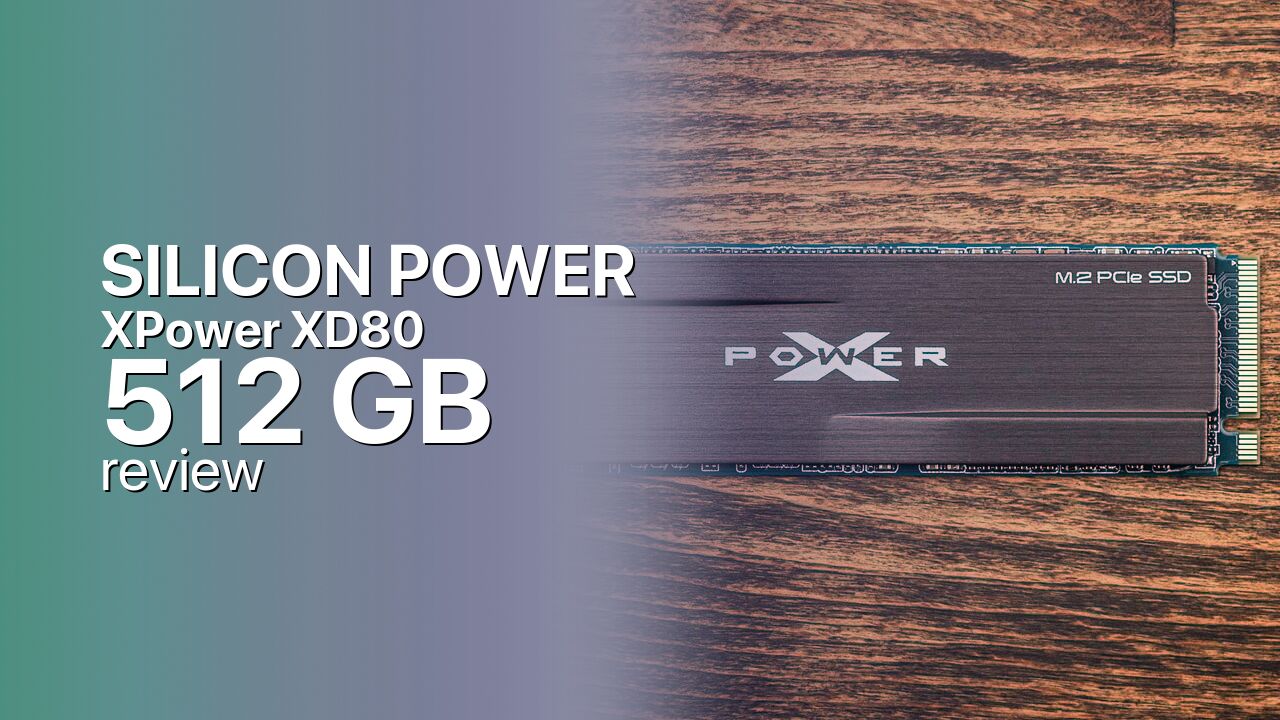
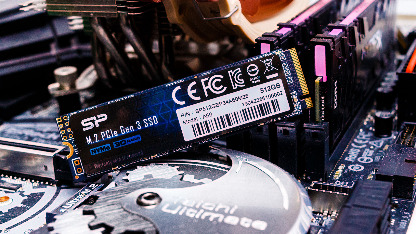
The Silicon Power XPower XD80 512GB carries the same platform as the rest of the XPower line — Phison's PS5012-E12S controller, Kioxia 96-layer TLC, a DDR3L DRAM cache and a pseudo-SLC write buffer behind a PCIe 3.0 x4 NVMe 1.3 interface — but its ratings sit deliberately between the family's extremes. Silicon Power rates this capacity at 3,400 MB/s sequential reads and 2,300 MB/s writes: full read parity with the 1TB and 2TB models, three-quarters of their write speed, and roughly double the write rating of the 256GB entry model. The aluminum heatsink is fitted at the factory on every capacity, with Silicon Power crediting it for up to 20 percent lower temperatures, and the single-sided 2280 PCB is standard — though the fitted cooler adds height that tight laptop bays may not clear.
Positioning is where this capacity earns its keep. A 512 GB drive today is a boot disk with headroom: an operating system, applications and one or two large games coexist comfortably, and the 2,300 MB/s write rating handles installs and batch copies without the 256GB model's constraint. Era rivals at this capacity were the Samsung 970 EVO Plus 500GB, WD Black SN750 500GB and Crucial P5 500GB — all faster writers sold bare, without cooling of their own. PlayStation 5 upgraders should still look away, since Sony's program asks for PCIe 4.0 drives, and buyers filling 1 TB-class libraries should compare the XD80 1TB, which unlocks the full 3,400/3,000 rating set and 800 TBW endurance on the identical platform.
Storage Comparisons:
XPower XD80 Performance & Benchmarks
Silicon Power rates the 512GB XD80 at 3,400 MB/s sequential reads and 2,300 MB/s writes; its own spec tables omit random-IOPS ratings, with TechPowerUp's database listing 290K random reads and 510K random writes for this capacity. Reads define everyday use: this is the full Gen3-tier number, so boot times and game loading are indistinguishable from the 1TB and 2TB models. Writes land in the middle of the family — comfortably above the 256GB's 1,100 MB/s for installs and large copies, below the 3,000 MB/s the bigger models sustain while their pseudo-SLC caches are absorbing the burst. Under very long sustained transfers the cache eventually gives way and throughput settles to native TLC rates; independent testing of the 2TB sibling measured around 1 GB/s in that state.
SILICON POWER XPower XD80 512 GB vs M.2 3.0 x 4 peers
Switch between sequential throughput and random IOPS to see how this drive stacks up against other M.2 3.0 x 4 SSDs in our database. The highlighted bar is the drive on this page — click any other bar to open that drive.
- ADATA SX 8800 Pro 512 GB: 3,500 MB/s read, 2,700 MB/s write
- ADATA SX 8800 Pro 1 TB: 3,500 MB/s read, 2,700 MB/s write
- ADATA XPG Spectrix S40G RGB 256 GB: 3,500 MB/s read, 3,000 MB/s write
- ADATA XPG Spectrix S40G RGB 512 GB: 3,500 MB/s read, 3,000 MB/s write
- SILICON POWER XPower XD80 512 GB (this drive): 3,400 MB/s read, 2,300 MB/s write
Cooling is the family's signature. Guru3D's Golden Award review of the 2TB XD80 and Nikktech's equally positive verdict both noted the heatsink making a measurable difference under load, and the same thermal headroom applies at 512 GB. For a drive that will live under a discrete GPU or in a compact case, that margin matters more in daily use than a few hundred MB/s of burst write.
SILICON POWER XPower XD80 vs Competitors
See how the XPower XD80 stacks up against other M.2 3.0 x 4 drives in our database:
Compare with rival drives:
Endurance, TBW & Warranty
Silicon Power's official TBW document rates the 512GB XD80 at 400 TBW under a five-year limited warranty, with the usual whichever-comes-first clause. The endurance ladder scales cleanly across the line — 200 TBW at 256 GB, 400 TBW here, 800 TBW at 1 TB and 1,600 TBW at 2 TB — matching TechPowerUp's spec database; launch-era reviews quoted an earlier datasheet table with higher figures, so published numbers vary by revision. At 20 GB of writes per day, 400 TBW stretches past half a century, so the five-year term is the practical limit in any desktop workload. The series carries a 2,000,000-hour MTBF rating — a population statistic rather than a promise about any individual drive — and SP ToolBox provides firmware updates and health monitoring.
SILICON POWER XPower XD80 512 GB Specifications
| Category | Value |
|---|---|
| Capacity [?] | 512 GB |
| Interface [?] | M.2 3.0 x 4 |
| Controller [?] | Phison PS5012-E12S 8 Channel |
| Memory type [?] | Kioxia 96-L TLC |
| DRAM [?] | Yes |
| Read speed (MB/s) [?] | 3400 |
| Write speed (MB/s) [?] | 2300 |
| Read IOPS [?] | 290000 |
| Write IOPS [?] | 510000 |
| Endurance (TBW) [?] | 400 |
| MTBF (million hours) [?] | 2000000 |
| Warranty (years) [?] | 5 |
Verdict: Is the XPower XD80 Worth It in 2026?
The Silicon Power XPower XD80 512GB is the sensible pick inside its own family for a boot drive with breathing room: full Gen3 read speed, a mid-tier 2,300 MB/s write rating, 400 TBW of endurance and a factory heatsink that reviewers found genuinely effective. Skip it if the drive will hold a full game library — the XD80 1TB unlocks the complete 3,400/3,000 rating set on the same platform — or if a PlayStation 5 is the destination, since Sony asks for PCIe 4.0. Against the Samsung 970 EVO Plus 500GB, this drive trades some write speed for the fitted heatsink and the higher endurance rating. As a set-and-forget system disk for a Gen3 PC, it is an easy call.
+ Pros
- 3,400 MB/s reads — full Gen3-tier rating
- 400 TBW endurance rating
- Five-year limited warranty
- Factory aluminum heatsink
- DDR3L DRAM cache with SLC buffering
- Same platform as the 1TB and 2TB models
- Cons
- Writes rated 2,300 MB/s, below the 1TB and 2TB
- PCIe 3.0 only — not a PS5 candidate
- IOPS rating absent from SP's own spec tables
- 512 GB fills up quickly with modern games
- Attached heatsink complicates secondary cooling
Buy this or similar SSD Storage:
Video Review
NVMe M.2 XD80