Silicon Power XPower XD80 256GB Review — Small Drive, Big Endurance (2026)
Quick answer
The Silicon Power XPower XD80 256GB makes sense as a boot drive for an older desktop or a SATA-era PC being revived — a cool-running Gen3 drive with a heatsink already fitted and an endurance rating that outclasses its capacity.
Read: 3100 MB/s Write: 1100 MB/s Endurance: 200 TBW Warranty: 5 years Interface: M.2 3.0 x 4
The Silicon Power XPower XD80 256GB trades write speed for stamina — 3,100 MB/s reads, 200 TBW of endurance and a built-in aluminum heatsink on a five-year warranty.
Controller & Memory
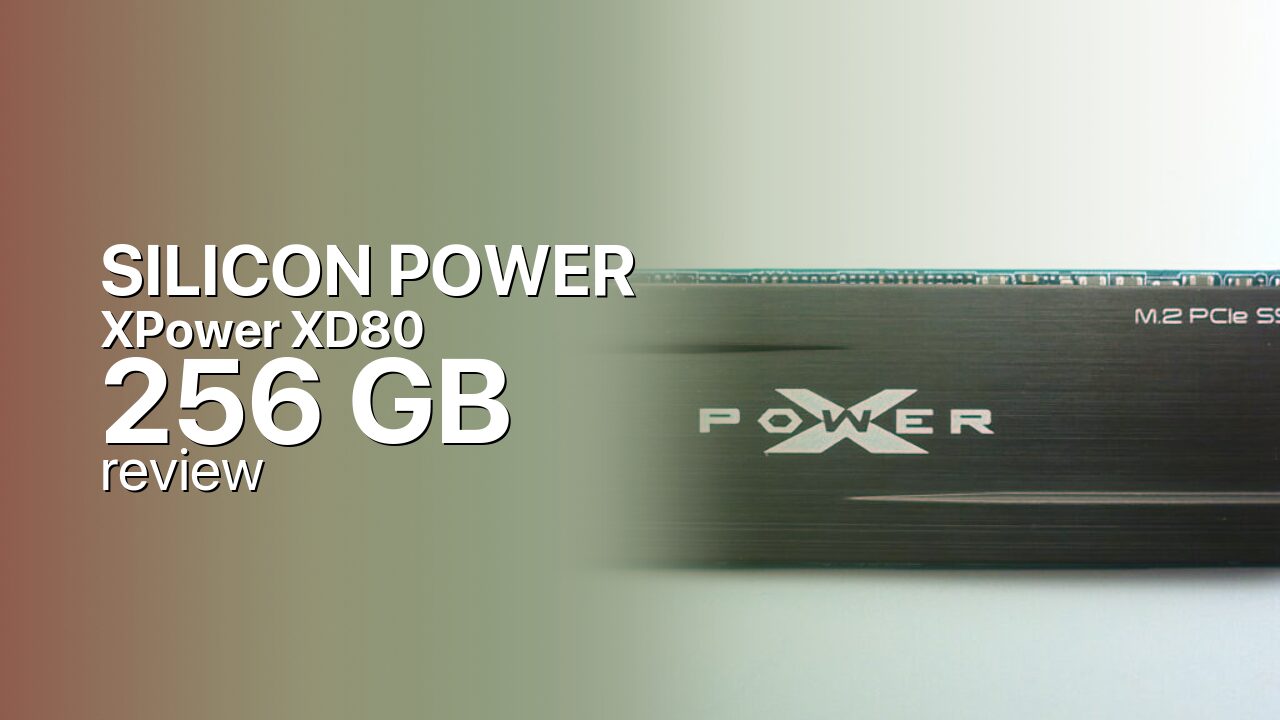
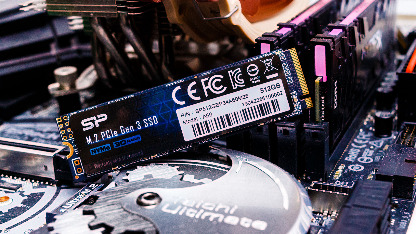
The Silicon Power XPower XD80 256GB is the entry point of SP's XPower gaming line: a PCIe 3.0 x4 NVMe drive built on Phison's PS5012-E12S controller, Kioxia 96-layer TLC NAND, a dedicated DDR3L DRAM cache and a pseudo-SLC write buffer. Unlike most rival drives, every XD80 ships with an aluminum heatsink already attached — Silicon Power credits it with up to 20 percent lower temperatures — and the single-sided 2280 PCB keeps the footprint slim. The ratings that matter at this specific capacity are 3,100 MB/s sequential reads and 1,100 MB/s writes over NVMe 1.3: the 256GB model is the only family member whose write rating falls below 2,000 MB/s, while the 512GB model is rated 3,400/2,300 and the 1TB and 2TB reach the full 3,400/3,000.
That write rating defines the buyer. As a boot-and-applications disk for an older desktop, an office PC, or a SATA-era machine being revived, the XD80 256GB behaves like any competent Gen3 drive — reads sit near the interface's practical ceiling, installs and updates land quickly, and the fitted heatsink keeps throttling a non-issue even in airflow-starved cases. As a game library or editing scratch disk, 256 GB and 1,100 MB/s writes are real limits. Era rivals included the Samsung 970 EVO Plus and WD Black SN750, both faster writers at this capacity but sold without cooling, while the Crucial P5 played the same bracket. Buyers who need more space should compare the XD80 512GB first — it doubles endurance and more than doubles the write rating — and PlayStation 5 upgraders should look elsewhere entirely, since Sony's program asks for PCIe 4.0 drives.
Storage Comparisons:
XPower XD80 Performance & Benchmarks
Silicon Power rates the 256GB XD80 at 3,100 MB/s sequential reads and 1,100 MB/s writes; its own spec tables omit random-IOPS ratings, with TechPowerUp's database listing 180K random reads and 240K random writes for this capacity. Reads carry the experience: 3,100 MB/s sits close to the practical PCIe 3.0 ceiling, so boot times, game loading and application launches are indistinguishable from the family's faster members. Writes are the compromise. With fewer NAND packages to spread data across, the pseudo-SLC cache at this capacity is small, and long sustained transfers drop well below the 3,000 MB/s the 1TB and 2TB models sustain — standard behavior for small-capacity drives, and largely invisible in boot-and-office duty.
SILICON POWER XPower XD80 256 GB vs M.2 3.0 x 4 peers
Switch between sequential throughput and random IOPS to see how this drive stacks up against other M.2 3.0 x 4 SSDs in our database. The highlighted bar is the drive on this page — click any other bar to open that drive.
- ADATA SX 8800 Pro 512 GB: 3,500 MB/s read, 2,700 MB/s write
- ADATA SX 8800 Pro 1 TB: 3,500 MB/s read, 2,700 MB/s write
- ADATA XPG Spectrix S40G RGB 256 GB: 3,500 MB/s read, 3,000 MB/s write
- ADATA XPG Spectrix S40G RGB 512 GB: 3,500 MB/s read, 3,000 MB/s write
- SILICON POWER XPower XD80 256 GB (this drive): 3,100 MB/s read, 1,100 MB/s write
The platform itself has a solid independent record: Guru3D's 2TB review earned the site's Golden Award, Nikktech matched it, and both found performance on par with the Gen3 tier while the heatsink made a measurable difference under sustained load. That testing validates the controller, NAND and cooling — at 256 GB, the ceiling is simply the smaller NAND budget, not the hardware around it.
SILICON POWER XPower XD80 vs Competitors
See how the XPower XD80 stacks up against other M.2 3.0 x 4 drives in our database:
Compare with rival drives:
Endurance, TBW & Warranty
Endurance is the 256GB XD80's quiet strength: Silicon Power's official TBW document rates it at 200 TBW, a figure more generous than most 256 GB drives ever receive, and it scales up the range — 400 TBW at 512 GB, 800 TBW at 1 TB and 1,600 TBW at 2 TB. The warranty runs five years, ending at whichever limit arrives first; launch-era reviews quoted an earlier datasheet table with higher figures, so published numbers vary by revision. At a modest 20 GB written per day, 200 TBW represents roughly twenty-seven years of use, making the five-year term the practical limit. Silicon Power rates the series at 2,000,000 hours MTBF — a population statistic, not a per-drive promise — and ships the SP ToolBox utility for firmware and health monitoring.
SILICON POWER XPower XD80 256 GB Specifications
| Category | Value |
|---|---|
| Capacity [?] | 256 GB |
| Interface [?] | M.2 3.0 x 4 |
| Controller [?] | Phison PS5012-E12S 8 Channel |
| Memory type [?] | Kioxia 96-L TLC |
| DRAM [?] | Yes |
| Read speed (MB/s) [?] | 3100 |
| Write speed (MB/s) [?] | 1100 |
| Read IOPS [?] | 180000 |
| Write IOPS [?] | 240000 |
| Endurance (TBW) [?] | 200 |
| MTBF (million hours) [?] | 2000000 |
| Warranty (years) [?] | 5 |
Verdict: Is the XPower XD80 Worth It in 2026?
The Silicon Power XPower XD80 256GB makes sense as a boot drive for an older desktop or a SATA-era PC being revived — a cool-running Gen3 drive with a heatsink already fitted and an endurance rating that outclasses its capacity. Skip it if large writes are part of the plan: 1,100 MB/s and 256 GB leave no room for game libraries or video work. The Samsung 970 EVO Plus at 250 GB writes faster if the heatsink is unnecessary, and the XD80 512GB doubles the space and more than doubles the write rating within the same family. As a set-and-forget system disk, it holds up well for buyers who never stress the write path.
+ Pros
- 3,100 MB/s rated sequential reads
- 200 TBW endurance rating
- Five-year limited warranty
- Aluminum heatsink fitted at the factory
- DDR3L DRAM cache with SLC buffering
- Single-sided 2280 PCB
- Cons
- Writes rated only 1,100 MB/s
- 256 GB limits game-library use
- PCIe 3.0 only — not a PS5 candidate
- IOPS rating absent from SP's own spec tables
- Attached heatsink complicates secondary cooling
Buy this or similar SSD Storage:
Video Review
Cheap with Mainstrem Performance SiliconPower XD80