Patriot Viper VPN110 2TB Review — Gen3 Muscle, Now End-of-Line (2026)
Quick answer
The Patriot Viper VPN110 2TB makes sense in exactly one scenario: a PCIe 3.0 system that needs a large, like-for-like library disk while old stock or used units are still findable.
Read: 3300 MB/s Write: 3000 MB/s Endurance: 1600 TBW Warranty: 5 years Interface: M.2 3.0 x 4
The Patriot Viper VPN110 2TB was the range-topper of Patriot's Gen3 gaming line — 3,300/3,000 MB/s ratings, 500K IOPS and 1,600 TBW endurance under a factory heatshield.
Controller & Memory
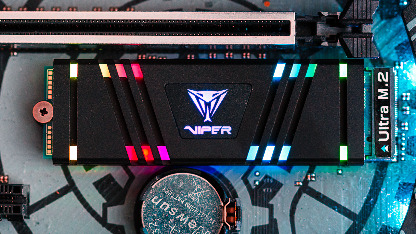
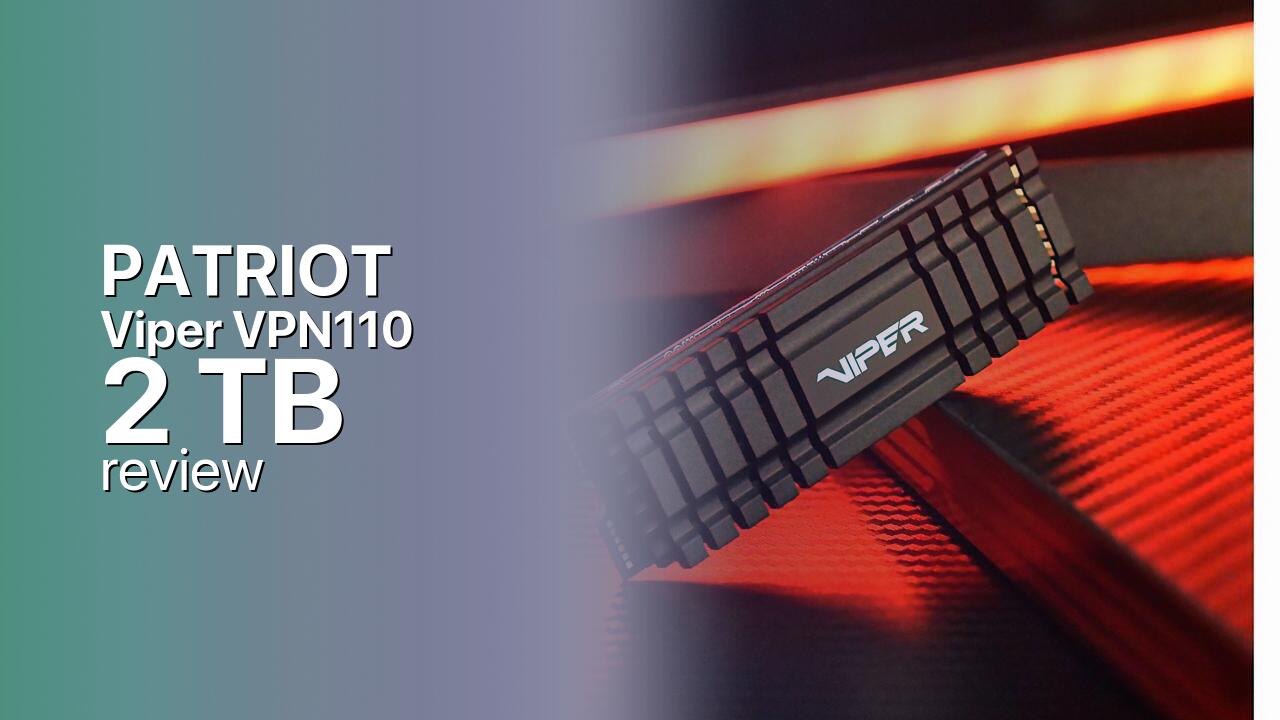
The Patriot Viper VPN110 2TB is the largest member of Patriot's Viper Gaming NVMe line: a PCIe 3.0 x4 NVMe 1.3 drive on Phison's E12S controller with Kioxia 3D TLC NAND, a DRAM cache sized to the capacity and a standard 2280 PCB. Cooling was engineered in rather than bolted on — a built-in aluminum heatshield with six thermal fins and a dedicated thermal sensor — and Patriot rated the flagship capacities at 3,300 MB/s sequential reads, 3,000 MB/s writes and up to 500K IOPS for 4K random reads and writes. The 2TB model also carries the line's highest endurance rating: 1,600 TBW, twice the 1TB model's 800 TBW, under Patriot's warranty terms.
Status is the deciding fact for a buyer today: Patriot lists every VPN110 part as discontinued, so this is a drive for leftover stock, refurbishers and the used market rather than a shopping list. Its natural audience is narrow and specific — owners of PCIe 3.0 platforms such as AMD's B450 and X470 boards or Intel's 400-series chipsets who want a two-terabyte game library disk matching the speed of the drive it replaces. In its day the VPN110 fought the Samsung 970 EVO Plus, ADATA XPG SX8200 Pro and WD Black SN750, and reviewers placed it a respectful step behind those class leaders while praising the cooling design. Patriot's Viper VP4300 family is the direct modern successor with PCIe 4.0 throughput and current NAND, and PlayStation 5 upgraders belong there anyway — Sony's program requires Gen4 drives.
Storage Comparisons:
Viper VPN110 Performance & Benchmarks
Patriot rated the VPN110 2TB at 3,300 MB/s sequential reads, 3,000 MB/s writes and up to 500K IOPS for 4K random reads and writes — the full rating set shared with the 1TB model. Hardware Asylum's review of the line found ATTO and CrystalDiskMark results running at the rated figures, describing a drive that was not the fastest in Patriot's own lineup but no slouch. Reads at 3,300 MB/s sit near the practical PCIe 3.0 ceiling: boot times, application launches and game loading are indistinguishable from faster-rated Gen3 drives, and the DRAM cache keeps random access steady when games and applications share the disk.
PATRIOT Viper VPN110 2 TB vs M.2 3.0 x 4 peers
Switch between sequential throughput and random IOPS to see how this drive stacks up against other M.2 3.0 x 4 SSDs in our database. The highlighted bar is the drive on this page — click any other bar to open that drive.
- ADATA SX 8800 Pro 512 GB: 3,500 MB/s read, 2,700 MB/s write
- ADATA SX 8800 Pro 1 TB: 3,500 MB/s read, 2,700 MB/s write
- ADATA XPG Spectrix S40G RGB 256 GB: 3,500 MB/s read, 3,000 MB/s write
- ADATA XPG Spectrix S40G RGB 512 GB: 3,500 MB/s read, 3,000 MB/s write
- PATRIOT Viper VPN110 2 TB (this drive): 3,300 MB/s read, 3,000 MB/s write
The endurance rating is where the 2TB model pulls away from its siblings: 1,600 TBW absorbs years of install-and-delete cycles without ever entering the conversation. Sustained-write behavior follows the era's Phison blueprint — a pseudo-SLC cache absorbs bursts at the rated speed, then throughput settles toward native TLC rates on very long transfers. Judged against current drives the numbers are dated, since PCIe 4.0 parts roughly double the sequential throughput, but on a Gen3-only board that headroom is unusable anyway; the honest comparison is with SATA, which this drive outruns several times over.
PATRIOT Viper VPN110 vs Competitors
See how the Viper VPN110 stacks up against other M.2 3.0 x 4 drives in our database:
Compare with rival drives:
Endurance, TBW & Warranty
Patriot's official warranty table lists the VPN110-2TBM28H at 1,600 TBW endurance with a five-year warranty, whichever arrives first — the top of the line's ladder, above the 1TB's 800 TBW and the 512GB's 400 TBW. Some retail listings and reviews from the drive's active years cite a three-year term; Patriot's own warranty documentation is the governing source, and it says five. At 20 GB of writes per day, 1,600 TBW represents roughly two centuries of service, so the warranty term is the practical limit by an enormous margin. Listings quote a 2,000,000-hour MTBF rating — a population statistic rather than a per-drive promise, and one Patriot itself does not publish for this model. As a discontinued product, claims run through Patriot's standard RMA process, with equivalent-value substitutions when exact replacements are gone.
PATRIOT Viper VPN110 2 TB Specifications
| Category | Value |
|---|---|
| Capacity [?] | 2 TB |
| Interface [?] | M.2 3.0 x 4 |
| Controller [?] | Phison E12S 4 Channel |
| Memory type [?] | Kioxia TLC |
| DRAM [?] | Yes |
| Read speed (MB/s) [?] | 3300 |
| Write speed (MB/s) [?] | 3000 |
| Read IOPS [?] | 500000 |
| Write IOPS [?] | 500000 |
| Endurance (TBW) [?] | 1600 |
| MTBF (million hours) [?] | 2000000 |
| Warranty (years) [?] | 5 |
Verdict: Is the Viper VPN110 Worth It in 2026?
The Patriot Viper VPN110 2TB makes sense in exactly one scenario: a PCIe 3.0 system that needs a large, like-for-like library disk while old stock or used units are still findable. For any new build, skip it — Patriot's own VP4300 family delivers Gen4 speed on current NAND, and the WD Black SN770 2TB is the safer capacity-matched default at this tier. As a closing chapter of the Gen3 era it aged well: the full 3,300/3,000 MB/s rating set, the finned heatshield and 1,600 TBW of endurance were thoughtful specs. But a discontinued drive is a niche purchase, not a plan — weight any purchase against how long a Gen3 system will realistically stay in service.
+ Pros
- 3,300/3,000 MB/s rated speeds
- 1,600 TBW endurance rating — line's highest
- 500K IOPS random read and write ratings
- Factory heatshield with six thermal fins
- Dedicated thermal sensor
- E12S platform AES-256 encryption support
- Cons
- Discontinued — remaining stock or used only
- PCIe 3.0 caps sequential throughput
- Fails PS5 requirements (Gen4 required)
- Heatshield adds height in tight slots
- Availability down to leftover stock
Buy this or similar SSD Storage:



Video Review
Elgato 4K60 Pro MK.2 + Dysk SSD Patriot Viper VPN110 1 TB M.2 - Unboxing