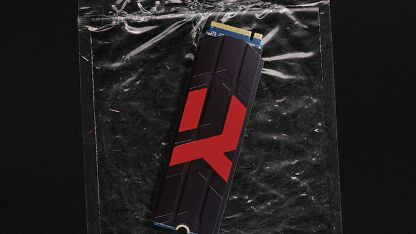
Team Group Cardea A440 Pro 2TB PCIe 4.0 NVMe SSD
The Team Group Cardea A440 Pro 2 TB is the sweet-spot capacity in this Phison E18 line-up — the smallest size that hits the full 7,400 MB/s read rating and the most balanced TBW-per-dollar of the series.
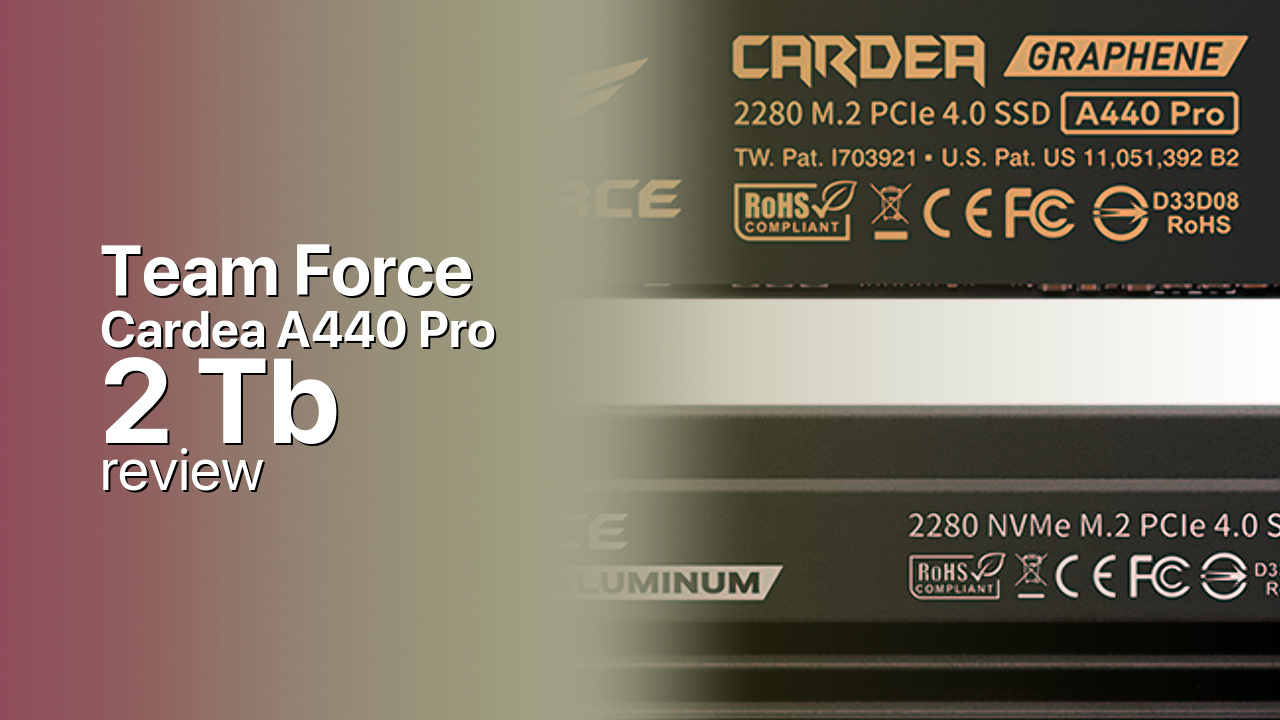
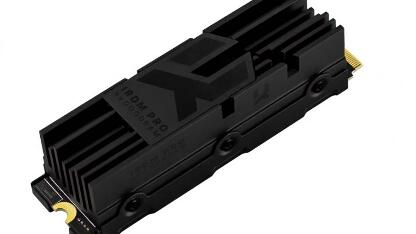
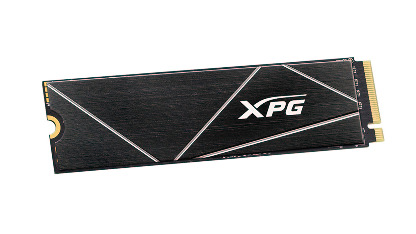
The 2 TB Cardea A440 Pro pairs the eight-channel Phison PS5018-E18 controller with eight pieces of Micron's B47R 176-layer 3D TLC NAND and two SK Hynix DDR4-2666 DRAM chips totalling 2 GB. The form factor is single-sided M.2 2280, and like the rest of the line the drive is sold in two flavours: a 3.7 mm graphene heat-spreader version for tight installs such as the PS5, and a much taller aluminium fin-type heatsink for desktops. Both ship from the factory with the cooling already attached.
Inside the A440 Pro line the 2 TB sits between the entry-level 1 TB (rated 7,200/6,000 MB/s, 700 TBW) and the flagship 4 TB (7,400/6,900 MB/s, 3,000 TBW). For most buyers it is the right pick — you get the full peak read figure without paying flagship money, and 1,400 TBW of endurance is plenty for gaming, creative work and OS duties on a single drive. The 2 TB also has twice the SLC write cache headroom of the 1 TB, so large transfers hold peak speed for longer before tailing off to native TLC.
In the broader market the 2 TB A440 Pro is up against the WD Black SN850X 2 TB, Samsung 990 Pro 2 TB, Crucial T500 2 TB and the Kingston KC3000 2 TB, the last of which uses the same Phison E18 platform and Micron B47R NAND. Against the Samsung and WD flagships the A440 Pro typically trades performance parity for a lower price; against the KC3000 the differences are largely cosmetic and reduce to which cooler design you prefer. For PS5 owners the graphene-cooler SKU is the version to buy — the aluminium version is much too tall to fit under the console's slot lid.
✅ Storage Comparisons:
🚀 Performance and benchmarks
Team Group rates the Cardea A440 Pro 2 TB at up to 7,400 MB/s sequential reads and up to 6,900 MB/s sequential writes over PCIe 4.0 x4, with up to 1,000,000 IOPS random read and write. That puts it within touching distance of every flagship PCIe 4.0 drive on the market and well past Sony's 5,500 MB/s PS5 recommendation. In day-to-day desktop use the perceptible benefits over a PCIe 3.0 drive show up as faster Windows boot, instant application launches, and snappy texture streaming in games that lean on DirectStorage.
Team Group Cardea A440 Pro 2 TB vs M.2 4.0 x 4 peers
Switch between sequential throughput and random IOPS to see how this drive stacks up against other M.2 4.0 x 4 SSDs in our database. The highlighted bar is the drive on this page — click any other bar to open that drive.
- PNY XLR8 CS3140 1 TB: 7,500 MB/s read, 5,650 MB/s write
- PNY XLR8 CS3140 2 TB: 7,500 MB/s read, 6,850 MB/s write
- Asgard AN4 512 GB: 7,500 MB/s read, 5,500 MB/s write
- Asgard AN4 1 TB: 7,500 MB/s read, 5,500 MB/s write
- Team Group Cardea A440 Pro 2 TB (this drive): 7,400 MB/s read, 6,900 MB/s write
As with every TLC-based NVMe drive, the A440 Pro 2 TB advertises peak figures that depend on a dynamic SLC write cache. Once that cache is filled the controller falls back to native TLC writes, and independent reviews of E18-based 2 TB drives consistently show sustained writes settling in the 1.5–2.5 GB/s range — still very respectable, but a long way below the 6,900 MB/s headline. The 2 TB has roughly twice the cache headroom of the 1 TB version, which means the practical impact of cache exhaustion only shows up on very large continuous transfers such as cloning a full game library, ingesting 4K footage, or seeding multi-hundred-gigabyte downloads. For everything most users actually do on a primary drive, the cache hides the drop entirely. Plan on either the aluminium heatsink SKU or an aftermarket cooler for sustained heavy workloads, as the bare graphene version will throttle.
🖥️ Endurance and warranty
Team Group rates the Cardea A440 Pro 2 TB at 1,400 TBW and backs it with a 5-year limited warranty that ends at whichever of the two limits arrives first. At a heavy creator workload of 80 GB of writes per day, 1,400 TBW would take roughly 48 years to exhaust; for a typical mixed desktop user closer to 20 GB per day it is effectively unreachable inside a human lifetime. That makes the warranty the practical limit for almost every buyer. Endurance scales with capacity across the line — the 1 TB carries 700 TBW, the 4 TB jumps to 3,000 TBW — so video editors and database users planning to push the drive should compare write-per-day budgets before choosing a size. MTBF is rated at three million hours, which is a fleet-level reliability statistic rather than a promise about any individual drive.
📊 Specs
| Category | Value |
|---|---|
| Capacity [?] | 2 TB |
| Interface [?] | M.2 4.0 x 4 |
| Controller [?] | Phison PS5018-E18 |
| Memory type [?] | Micron 3D TLC |
| DRAM [?] | SK Hynix DDR4 |
| Read speed (MB/s) [?] | 7400 |
| Write speed (MB/s) [?] | 6900 |
| Read IOPS [?] | 1000000 |
| Write IOPS [?] | 1000000 |
| Endurance (TBW) [?] | 1400 |
| MTBF (million hours) [?] | 3 |
| Warranty (years) [?] | 5 |
Conclusion
The Cardea A440 Pro 2 TB is the right buy for PC gamers, creators and small homelab users who want a flagship-class PCIe 4.0 drive at the 2 TB capacity without paying Samsung 990 Pro money. It is also the cheaper Phison E18 sibling to the Kingston KC3000 and Sabrent Rocket 4 Plus at the same size, with effectively identical performance. PS5 owners should buy the A440 Pro Special graphene version of this SKU rather than the aluminium-cooled one. Buyers chasing the absolute best sustained writes after the SLC cache empties — for example, professional video ingest — should look at the Seagate FireCuda 530 2 TB. For everyone else the A440 Pro 2 TB hits the right combination of speed, endurance and pricing.
+ Pros
- 7,400 MB/s reads and 6,900 MB/s writes on PCIe 4.0 x4
- Phison E18 with 2 GB SK Hynix DDR4 DRAM cache
- Micron 176-layer B47R 3D TLC NAND
- 1,400 TBW endurance and 5-year warranty
- Choice of graphene or aluminium heatsink at purchase
- Single-sided M.2 2280 PCB suits laptops and SFF builds
- Cons
- Aluminium heatsink version is too tall for the PS5 slot
- Sustained writes drop sharply after SLC cache fills
- No hardware encryption support
- Pricier than DRAM-less alternatives like the Lexar NM790
🛒 Buy this or similar SSD Storage:



✨ Video Review
TeamGroup T-Force Cardea A440 SSD Review & Benchmark - Bringing it's A Game