Team Group T-Force Cardea Liquid 256GB — PCIe 3.0 NVMe SSD Review (2026)
Quick answer
The Cardea Liquid 256 GB is a conversation piece first and a storage device second.
Read: 3400 MB/s Write: 3000 MB/s Endurance: 380 TBW Warranty: 3 years Interface: M.2 3.0 x 4
The Team Group T-Force Cardea Liquid 256 GB is a PCIe 3.0 NVMe drive marketed around an integrated liquid-cooling aesthetic that targets builders who want thermal flair in a compact M.2 form factor.
Controller & Memory
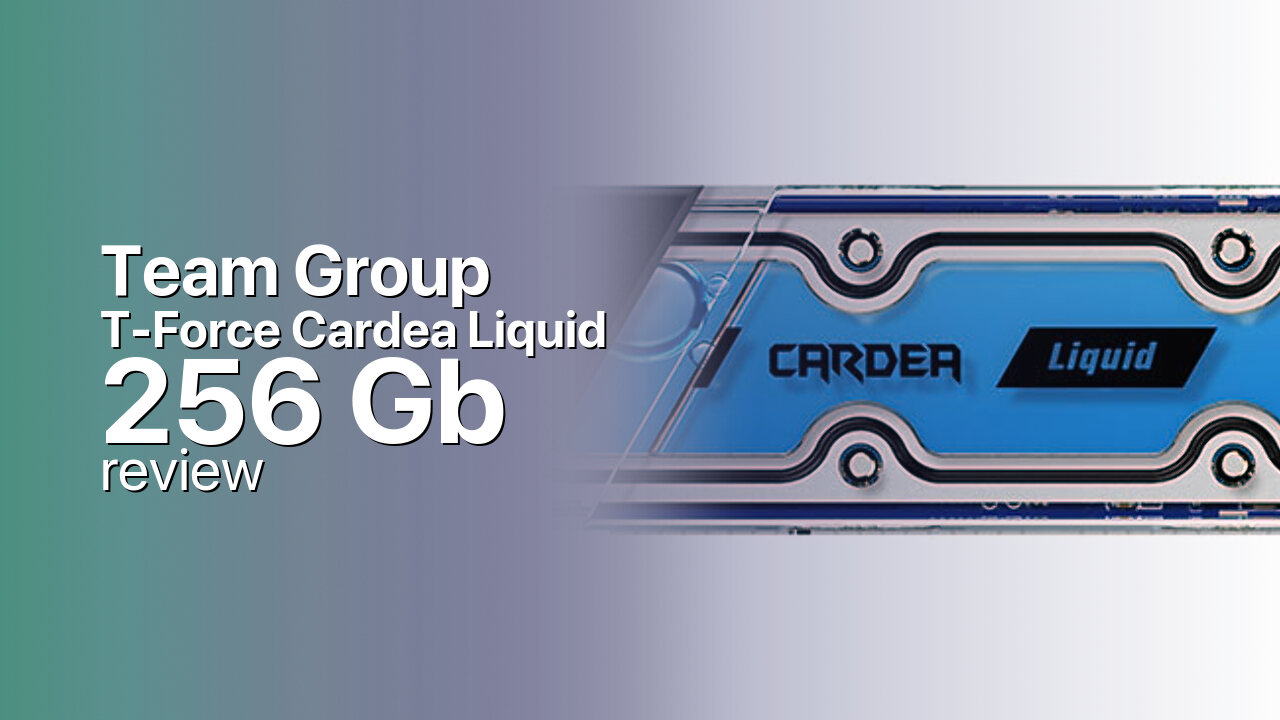
The Cardea Liquid is part of Team Group's T-Force gaming-focused product family, distinguished by a closed-loop liquid cooling module built directly onto the M.2 PCB — a rarity in the NVMe market where passive heatsinks or bare drives are the norm. Internally, the drive is built around the Phison PS5012-E12 controller paired with Toshiba 3D TLC NAND, an eight-channel PCIe 3.0 x4 platform that defined the high-performance Gen3 tier. The 256 GB capacity is the entry point of the Liquid lineup, sitting below the 512 GB and 1 TB variants, with rated sequential speeds of 3,400 MB/s read and 3,000 MB/s write.
The liquid cooling module is the defining feature: a sealed loop with a small pump and radiator that Team Group claims lowers operating temperatures compared to passive heatsinks, particularly in confined chassis where airflow cannot reach the M.2 slot. In practice, the cooling benefit is most relevant for sustained write workloads where controller temperatures dictate throttling behaviour, and less impactful for typical consumer use where NVMe drives spend most of their time at idle or handling short bursts of I/O. The trade-off is physical bulk — the Liquid's cooling assembly makes it thicker than a standard M.2 drive and incompatible with many laptop M.2 slots and some tightly packed desktop motherboards.
As a PCIe 3.0 drive in a market increasingly dominated by Gen4 options, the Cardea Liquid occupies a narrow niche: it is for builders who specifically want the liquid-cooling aesthetic and are working in a PCIe 3.0 platform where Gen4 capability is absent. Against conventional Phison E12 drives like the Sabrent Rocket or Silicon Power P34A80, the Liquid's unique cooling solution is its only differentiator — the underlying storage performance is identical across the E12 reference family.
Storage Comparisons:
T-Force Cardea Liquid Performance & Benchmarks
Team Group rates the 256 GB Cardea Liquid at 3,400 MB/s sequential reads and 3,000 MB/s sequential writes, figures that place it at the PCIe 3.0 x4 ceiling for reads and near it for writes. Random performance peaks at 450,000 IOPS read and 100,000 IOPS write — the read figure is competitive within the E12 platform, while the write IOPS are notably lower than the 400K–500K typical of 1 TB E12 drives, a consequence of reduced NAND parallelism at the 256 GB capacity.
Team Group T-Force Cardea Liquid 256 GB vs M.2 3.0 x 4 peers
Switch between sequential throughput and random IOPS to see how this drive stacks up against other M.2 3.0 x 4 SSDs in our database. The highlighted bar is the drive on this page — click any other bar to open that drive.
- ADATA SX 8800 Pro 512 GB: 3,500 MB/s read, 2,700 MB/s write
- ADATA SX 8800 Pro 1 TB: 3,500 MB/s read, 2,700 MB/s write
- ADATA XPG Spectrix S40G RGB 256 GB: 3,500 MB/s read, 3,000 MB/s write
- ADATA XPG Spectrix S40G RGB 512 GB: 3,500 MB/s read, 3,000 MB/s write
- Team Group T-Force Cardea Liquid 256 GB (this drive): 3,400 MB/s read, 3,000 MB/s write
The Phison E12's pseudo-SLC cache on the 256 GB model is proportionally smaller than on higher-capacity variants, absorbing roughly 20–30 GB of burst writes before transitioning to native TLC speeds. For a boot drive, this is sufficient — OS updates and application installs rarely exceed this threshold in a single operation. Sustained TLC write speeds settle around 500–600 MB/s, still well above any SATA SSD. The liquid cooler's impact on sustained performance is measurable but modest: independent testing of the E12 platform suggests controller throttling is rarely the bottleneck for a 256 GB drive, since the lower NAND parallelism caps throughput before thermal limits engage.
Team Group T-Force Cardea Liquid vs Competitors
See how the T-Force Cardea Liquid stacks up against other M.2 3.0 x 4 drives in our database:
Compare with rival drives:
Endurance, TBW & Warranty
Team Group covers the Cardea Liquid 256 GB with a three-year warranty, shorter than the five-year standard on most high-end Phison E12 drives. The endurance rating is 380 TBW, which at a typical 20 GB/day workload translates to roughly 52 years of consumer use — the endurance is not the limiting factor, but the shorter warranty period means Team Group's obligation expires sooner than competitors offering five-year coverage on the same E12 platform. The 512 GB and 1 TB Liquid variants carry 800 TBW and 1,600 TBW respectively, with the same three-year warranty term across the family.
Team Group T-Force Cardea Liquid 256 GB Specifications
| Category | Value |
|---|---|
| Capacity [?] | 256 GB |
| Interface [?] | M.2 3.0 x 4 |
| Controller [?] | Phison PS5012-E12 |
| Memory type [?] | Toshiba 3D TLC |
| DRAM [?] | Yes |
| Read speed (MB/s) [?] | 3400 |
| Write speed (MB/s) [?] | 3000 |
| Read IOPS [?] | 450000 |
| Write IOPS [?] | 100000 |
| Endurance (TBW) [?] | 380 |
| MTBF (million hours) [?] | 2 |
| Warranty (years) [?] | 3 |
Verdict: Is the T-Force Cardea Liquid Worth It in 2026?
The Cardea Liquid 256 GB is a conversation piece first and a storage device second. Its Phison E12 core delivers entirely competent PCIe 3.0 performance, but the same controller and NAND combination is available in cheaper, thinner, longer-warranty packages from half a dozen other brands. Buy it if the integrated liquid cooler aligns with a themed build where the M.2 slot is visible — and if your motherboard layout accommodates the extra height. For any other use case, a conventional E12 drive or a modern DRAM-equipped PCIe 4.0 budget drive will deliver equal or better performance with fewer physical constraints.
+ Pros
- 3,400 MB/s sequential reads — saturating PCIe 3.0 x4
- Integrated liquid cooling module — unique in the M.2 market
- Phison E12 controller with Toshiba 3D TLC NAND
- 380 TBW endurance — ample for a 256 GB boot drive
- Cons
- Liquid cooler adds bulk — incompatible with many laptops and tight builds
- 3-year warranty trails the 5-year standard on competing E12 drives
- 256 GB capacity limits practical use to OS and core applications
- Cooling advantage is marginal for typical consumer burst workloads
Buy this or similar SSD Storage:
Video Review
World's First Liquid M.2 NVMe ! The TEAM GROUP T-FORCE Cardea Liquid SSD