Transcend PCIe SSD 220S 256GB Review (2026)
Quick answer
Buy the Transcend PCIe SSD 220S 256 GB for a reliable NVMe boot drive for budget PC builds, laptop upgrades, or HTPC where MLC NAND and DRAM cache consistency matters.
Read: 1700 MB/s Write: 1500 MB/s Endurance: 400 TBW Warranty: 5 years Interface: M.2 3.0 x 4
The Transcend PCIe SSD 220S 256GB occupies an interesting niche as a budget PCIe 3.0 NVMe drive that uses MLC NAND, a flash type increasingly rare in consumer SSDs.
Controller & Memory
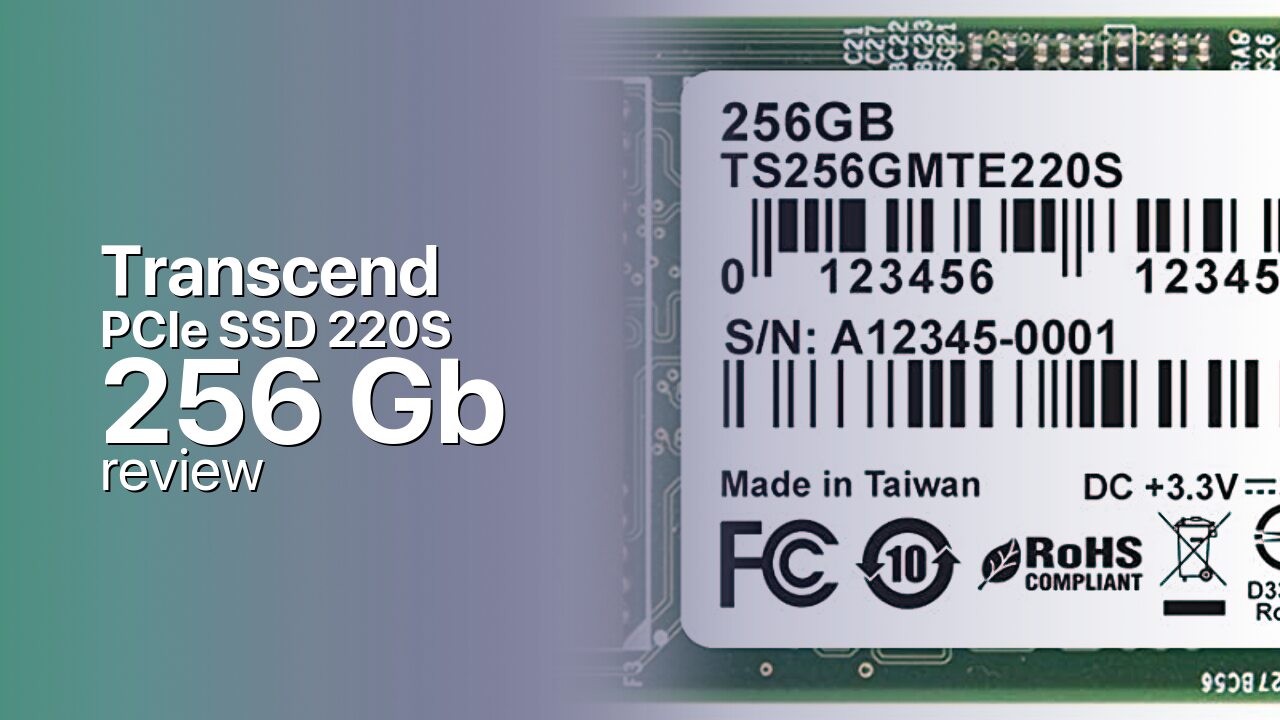
Inside the 220S you will find Silicon Motion SM2262EN controller paired with MLC NAND. The SM2262EN is a well-established eight-channel controller supporting NVMe 1.3, LDPC error correction, and eight NAND channels. This 256 GB capacity includes 512 MB of Samsung DDR3 DRAM for cache—a generous amount for this size. The drive uses standard M.2 2280 form factor, PCIe 3.0 x4 NVMe. Larger capacities (512 GB, 1 TB) use Micron 64-layer 3D TLC NAND with higher speeds. No heatsink included. Competitors include WD Blue SN580, Crucial P3 Plus, Kingston NV2. The Transcend MLC NAND and DRAM give it an advantage in write consistency over DRAM-less TLC/QLC alternatives.
Storage Comparisons:
PCIe SSD 220S Performance & Benchmarks
Transcend rates this 256 GB model for 1,700 MB/s sequential reads and 1,500 MB/s writes—notably lower than the 512 GB and 1 TB variants. This is roughly 2.5x SATA SSD read speed but less than half the 1 TB 220S achieves. Random 4K performance is not officially specified, but the SM2262EN controller typically delivers strong random I/O. Expect 40–60 MB/s random reads and 80–120 MB/s random writes based on controller track record. SLC caching provides decent burst performance, but the smaller NAND capacity limits cache size. Large file transfers will eventually exhaust the cache and drop to NAND-native speeds. For boot drive use, this is not a practical limitation. Compared to SATA, responsiveness improvements are tangible for OS boot, application launches, and game loading.
Transcend PCIe SSD 220S 256 GB vs M.2 3.0 x 4 peers
Switch between sequential throughput and random IOPS to see how this drive stacks up against other M.2 3.0 x 4 SSDs in our database. The highlighted bar is the drive on this page — click any other bar to open that drive.
- ADATA SX 8800 Pro 512 GB: 3,500 MB/s read, 2,700 MB/s write
- ADATA SX 8800 Pro 1 TB: 3,500 MB/s read, 2,700 MB/s write
- ADATA XPG Spectrix S40G RGB 256 GB: 3,500 MB/s read, 3,000 MB/s write
- ADATA XPG Spectrix S40G RGB 512 GB: 3,500 MB/s read, 3,000 MB/s write
- Transcend PCIe SSD 220S 256 GB (this drive): 1,700 MB/s read, 1,500 MB/s write
Transcend PCIe SSD 220S vs Competitors
See how the PCIe SSD 220S stacks up against other M.2 3.0 x 4 drives in our database:
Compare with rival drives:
Endurance, TBW & Warranty
Transcend specifies 400 TBW endurance for the 256 GB model—equivalent to writing 220 GB daily for five years. At 40 GB/day, this drive lasts nearly 27 years. The 5-year warranty is standard for mainstream SSDs, limited by time or TBW exhaustion. 400 TBW at 256 GB is a write endurance ratio of 1,563 full drive writes—respectable for MLC NAND and higher than TLC-based variants. MTBF is not specified. Warranty service goes through Transcend directly. Keep your purchase receipt.
Transcend PCIe SSD 220S 256 GB Specifications
| Category | Value |
|---|---|
| Capacity [?] | 256 GB |
| Interface [?] | M.2 3.0 x 4 |
| Controller [?] | Silicon Motion SM2262EN |
| Memory type [?] | MLC |
| DRAM [?] | Samsung 512MB DDR3 |
| Read speed (MB/s) [?] | 1700 |
| Write speed (MB/s) [?] | 1500 |
| Read IOPS [?] | 210000 |
| Write IOPS [?] | 290000 |
| Endurance (TBW) [?] | 400 |
| MTBF (million hours) [?] | 2000000 |
| Warranty (years) [?] | 5 |
Verdict: Is the PCIe SSD 220S Worth It in 2026?
Buy the Transcend PCIe SSD 220S 256 GB for a reliable NVMe boot drive for budget PC builds, laptop upgrades, or HTPC where MLC NAND and DRAM cache consistency matters. Skip it if you need maximum sequential throughput or are building a high-end gaming rig. Consider the WD Blue SN580 for DRAM-less designs at lower prices, or step up to the 512 GB 220S for significantly better sequential performance. For users prioritizing NAND longevity and write consistency over peak speed, this 256 GB model remains viable.
+ Pros
- MLC NAND offers higher write endurance than TLC/QLC
- 512 MB Samsung DDR3 DRAM cache—generous for 256 GB
- Silicon Motion SM2262EN controller is proven and reliable
- 400 TBW endurance is strong for this capacity
- 5-year warranty matches industry standards
- DRAM-backed design maintains consistent sustained performance
- Bare PCB fits thin laptops and compact M.2 slots
- Cons
- Sequential speeds (1,700/1,500 MB/s) lower than larger 220S capacities
- No included heatsink—may throttle without airflow
- Slower than newer PCIe 4.0 drives at similar price
- SLC cache size limited by 256 GB NAND capacity
- Random 4K performance not officially specified
Buy this or similar SSD Storage:



Video Review
Best Budget NVMe SSD? - Transcend MTE220S Review