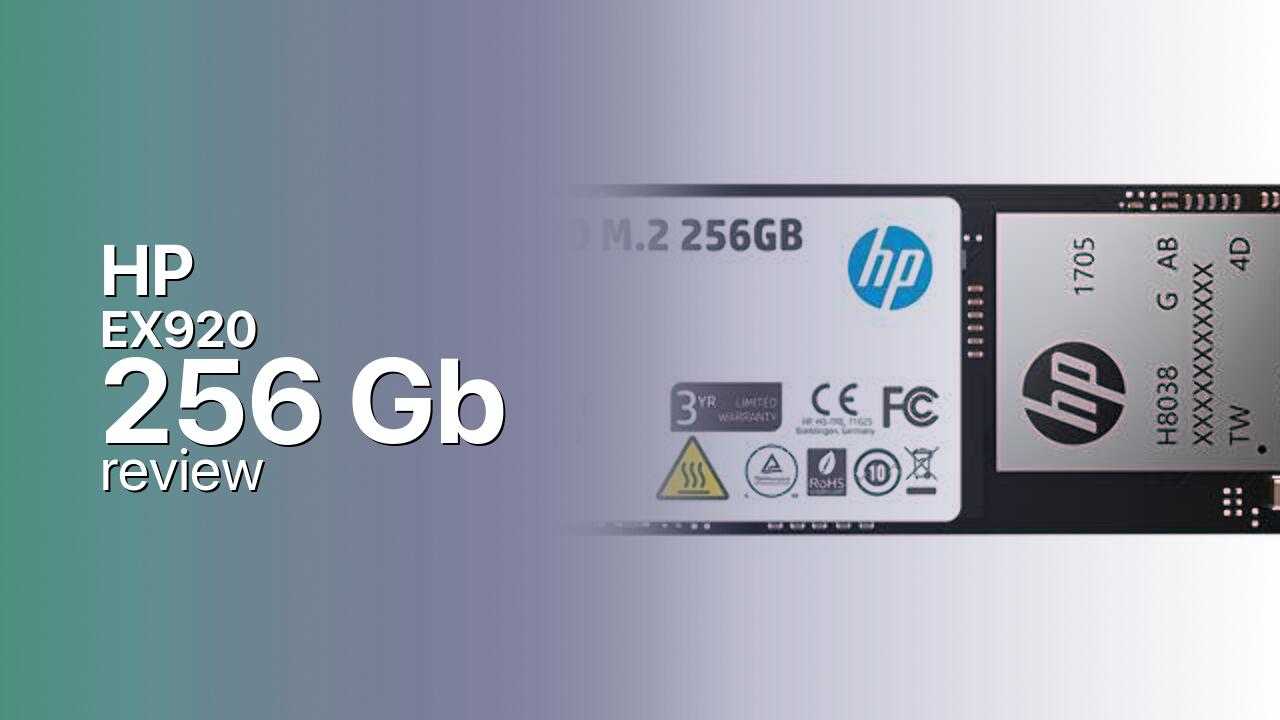
HP EX920 256GB — Mainstream PCIe 3.0 NVMe with Micron NAND (2026)
Quick answer
The HP EX920 256GB is a solid mainstream PCIe 3.0 NVMe SSD with the SM2262 controller and Micron 64-layer 3D TLC NAND.
Read: 3200 MB/s Write: 1200 MB/s Endurance: 160 TBW Warranty: 3 years Interface: M.2 3.0 x 4
The HP EX920 256GB is a mainstream PCIe 3.0 NVMe SSD that pairs the Silicon Motion SM2262 controller with Micron 64-layer 3D TLC NAND for solid mid-range performance.
Controller & Memory
The HP EX920 256GB is built around the Silicon Motion SM2262 controller, a well-regarded quad-core PCIe 3.0 x4 NVMe controller that supports dedicated DRAM cache. The NAND is Micron 64-layer 3D TLC — a proven, reliable choice that HP sourced directly from one of the major NAND manufacturers. The combination of SM2262 and Micron NAND was a popular pairing during the PCIe 3.0 era, appearing in drives from multiple brands.
The 256GB variant is rated at 3,200 MB/s sequential reads and 1,200 MB/s writes. The read speed is excellent for PCIe 3.0, using roughly 91 percent of the interface ceiling. The 1,200 MB/s write speed is typical for a 256GB capacity, where fewer NAND dies limit write parallelism. Random IOPS are not listed in the DB, but the SM2262 controller typically delivers strong stochastic performance.
The EX920 was HP's mainstream NVMe offering, positioned against the Samsung 970 EVO, WD Black SN750, and ADATA SX8200 Pro. It carries a 5-year warranty, matching these competitors. The EX920 series was well-received by reviewers for its combination of Micron NAND quality and competitive pricing.
The 256GB capacity makes the EX920 suitable as a boot drive or light gaming disk, though modern game libraries will outgrow this size. The DRAM cache gives it better random I/O performance than DRAM-less budget alternatives.
Storage Comparisons:
EX920 Performance & Benchmarks
The HP EX920 256GB is rated at up to 3,200 MB/s sequential reads and 1,200 MB/s writes. At 3,200 MB/s, the drive uses roughly 91 percent of the PCIe 3.0 x4 interface ceiling — an excellent showing that places it among the faster mid-range PCIe 3.0 drives. The 1,200 MB/s write speed is typical for a 256GB capacity, where fewer NAND dies constrain parallelism.
HP EX920 256 GB vs M.2 3.0 x 4 peers
Switch between sequential throughput and random IOPS to see how this drive stacks up against other M.2 3.0 x 4 SSDs in our database. The highlighted bar is the drive on this page — click any other bar to open that drive.
- ADATA SX 8800 Pro 512 GB: 3,500 MB/s read, 2,700 MB/s write
- ADATA SX 8800 Pro 1 TB: 3,500 MB/s read, 2,700 MB/s write
- ADATA XPG Spectrix S40G RGB 256 GB: 3,500 MB/s read, 3,000 MB/s write
- ADATA XPG Spectrix S40G RGB 512 GB: 3,500 MB/s read, 3,000 MB/s write
- HP EX920 256 GB (this drive): 3,200 MB/s read, 1,200 MB/s write
The SM2262 controller's quad-core architecture and DRAM cache support give the EX920 an advantage in mixed workloads over DRAM-less alternatives. The DRAM cache maintains the flash translation layer in fast memory, reducing latency on random reads and writes — the workloads that matter most for OS responsiveness and game loading. Independent reviews from Tom's Hardware and TweakTown praised the EX920 for its consistent performance across a range of workloads.
The SLC cache behavior follows the dynamic caching pattern common to SM2262-based drives. On a 256GB drive, the SLC cache will be moderate — perhaps 20-40 GB — meaning sustained writes beyond that threshold will drop to direct TLC speeds. For typical consumer use, the cache is more than sufficient. The Micron 64-layer TLC NAND provides good sustained write characteristics once the SLC cache is exhausted.
HP EX920 vs Competitors
See how the EX920 stacks up against other M.2 3.0 x 4 drives in our database:
Compare with rival drives:
Endurance, TBW & Warranty
The HP EX920 carries a 5-year warranty, matching mainstream competitors like the Samsung 970 EVO and WD Black SN750. The endurance rating (TBW) for the 256GB variant is not specified in the DB, but comparable drives in this class typically carry 150-200 TBW for 256GB. For context, the Samsung 970 EVO 256GB carries 150 TBW. At typical consumer write loads of 20-30 GB per day, a 256GB drive with ~150-200 TBW would last roughly 14-27 years before hitting the endurance limit — well beyond the 5-year warranty period.
HP EX920 256 GB Specifications
| Category | Value |
|---|---|
| Capacity [?] | 256 GB |
| Interface [?] | M.2 3.0 x 4 |
| Controller [?] | Silicon Motion SM2262 |
| Memory type [?] | Micron TLC |
| DRAM [?] | Nanya DDR3 |
| Read speed (MB/s) [?] | 3200 |
| Write speed (MB/s) [?] | 1200 |
| Read IOPS [?] | 350000 |
| Write IOPS [?] | 260000 |
| Endurance (TBW) [?] | 160 |
| MTBF (million hours) [?] | 2 |
| Warranty (years) [?] | 3 |
Verdict: Is the EX920 Worth It in 2026?
The HP EX920 256GB is a solid mainstream PCIe 3.0 NVMe SSD with the SM2262 controller and Micron 64-layer 3D TLC NAND. It delivers near-interface-ceiling read speeds and the benefit of a DRAM cache, backed by a 5-year warranty. The 256GB capacity is the limitation — it's fine for a boot drive but fills quickly with modern games. For the same money, the Samsung 970 EVO and WD Black SN750 offer comparable performance with more established brand recognition in the SSD market.
+ Pros
- SM2262 controller with DRAM cache support
- 3,200 MB/s reads near PCIe 3.0 x4 ceiling
- Micron 64-layer 3D TLC NAND (proven reliability)
- 5-year warranty matching mainstream competitors
- Well-reviewed by Tom's Hardware and TweakTown
- Cons
- 256GB capacity limiting for modern game libraries
- 1,200 MB/s writes lower than larger capacity variants
- HP's SSD brand less established than Samsung or WD
- No published TBW endurance for 256GB variant
- PCIe 3.0 — outpaced by PCIe 4.0 alternatives
Buy this or similar SSD Storage:



Video Review
HP EX920 M.2 NVME in Lian Li PC-011 Dynamic - Install & Review