ADATA XPG Legend 970 1TB: The Gen5 SSD With Its Own Fan (2026)
Quick answer
The ADATA XPG Legend 970 1 TB makes the most sense for an early Gen5 adopter on an AM5 or high-end Intel board whose M.2 slots lack solid cooling, since the self-contained fan solves the E26 platform's heat problem without any extra purchase.
Read: 9500 MB/s Write: 8500 MB/s Endurance: 700 TBW Warranty: 5 years Interface: M.2 5.0
The ADATA XPG Legend 970 1 TB tackles PCIe 5.0's heat problem with a built-in fan-cooled heatsink, pairing 9,500 MB/s rated reads with cooling no first-wave Gen5 rival included.
Controller & Memory
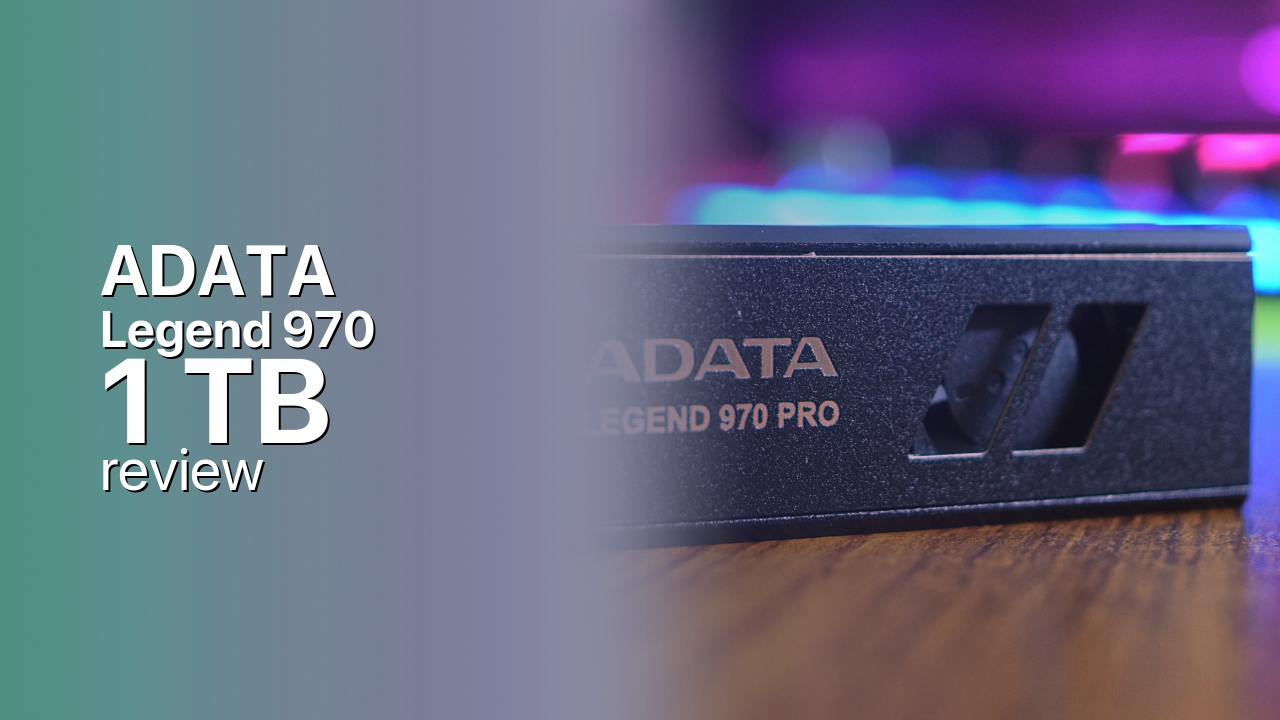
ADATA built its first consumer PCIe 5.0 SSD, the XPG Legend 970 1 TB, on the recipe nearly every first-wave Gen5 drive used: an 8-channel Phison PS5026-E26 controller, 232-layer Micron 3D TLC NAND, and a dedicated LPDDR4 DRAM cache for the mapping tables. What sets it apart is the cooling. ADATA preinstalls a double-layer aluminum heatsink with a built-in micro-fan, a patented active design the company rates at roughly 10 percent cooler than a comparable passive sink. The catch is practical: the fan draws power from a SATA connector, so one extra cable run is part of the install, and the assembled drive measures 80.6 x 24.2 x 17.9 mm, far taller than a bare M.2 2280 stick.
The series ships in 1 TB and 2 TB capacities, and the capacity choice genuinely matters here. The 1 TB model covered on this page is rated at 9,500 MB/s reads and 8,500 MB/s writes with 700 TBW of endurance, while the 2 TB doubles the endurance to 1,400 TBW and reaches the headline 10,000 MB/s in both directions. ADATA has since pushed the line forward with the Legend 970 Pro, which raises rated speeds further on the same Phison platform.
Compatibility planning is the other homework. Reaching Gen5 speeds requires a motherboard with a PCIe 5.0 x4 M.2 slot, which means an AMD AM5 board or a recent high-end Intel platform; in a Gen4 slot the drive works but is capped at roughly half its rated throughput. The height and the fan cable rule out laptops and consoles entirely. Direct rivals are the other Phison E26 drives of its generation: the Crucial T700, Seagate FireCuda 540, and Corsair MP700 share the same controller and NAND, but the Legend 970 is the only one of the group that brings its own active cooling rather than relying on a passive sink or the motherboard's M.2 shield.
Storage Comparisons:
Legend 970 Performance & Benchmarks
For the 1 TB capacity, ADATA rates the Legend 970 at up to 9,500 MB/s sequential reads and 8,500 MB/s sequential writes, with random performance up to 1,300,000 IOPS on reads and 1,400,000 IOPS on writes. Those are best-case figures, but independent testing of the series backs the sequential claims: KitGuru measured the 2 TB sibling slightly above its ratings in CrystalDiskMark, and StorageReview placed the drive first among Gen5 rivals in 64K sequential reads, slightly ahead of the Seagate FireCuda 540 on the same controller.
ADATA Legend 970 1 TB vs M.2 5.0 peers
Switch between sequential throughput and random IOPS to see how this drive stacks up against other M.2 5.0 SSDs in our database. The highlighted bar is the drive on this page — click any other bar to open that drive.
- Corsair MP700 Pro XT 1 TB: 14,900 MB/s read, 14,200 MB/s write
- Corsair MP700 Pro XT 2 TB: 14,900 MB/s read, 14,500 MB/s write
- Corsair MP700 Pro XT 4 TB: 14,900 MB/s read, 14,400 MB/s write
- Crucial T710 1 TB: 14,900 MB/s read, 13,800 MB/s write
- ADATA Legend 970 1 TB (this drive): 9,500 MB/s read, 8,500 MB/s write
In practice the jump from a good PCIe 4.0 drive is narrower than the spec sheet implies. Game loads and Windows boot are bound by small random reads, where a Gen5 drive feels much the same as a top Gen4 model such as the Samsung 990 Pro; the headroom shows up in large sequential work, moving raw 4K and 8K video, cloning game libraries, or feeding scratch-disk renders, where reads in the 9 GB/s class roughly double a Gen4 ceiling. Like every E26 drive, the Legend 970 writes into a fast pseudo-SLC cache first and slows once that cache is exhausted during very long transfers; StorageReview found sustained sequential writes were the drive's weakest discipline, landing mid-pack among Gen5 peers. For a boot-plus-games drive the cache limit is irrelevant, but anyone planning routine multi-hundred-gigabyte ingest should weigh the 2 TB model with its larger cache and faster write rating.
ADATA Legend 970 vs Competitors
See how the Legend 970 stacks up against other M.2 5.0 drives in our database:
Compare with rival drives:
Endurance, TBW & Warranty
ADATA covers the Legend 970 1 TB for five years or 700 TBW, whichever comes first. That endurance budget is standard for a 1 TB TLC drive of this class and is hard to exhaust on a desktop: at a heavy 50 GB of writes per day, 700 TBW works out to roughly 38 years of use, far beyond the warranty window and the platform's useful life. The 2 TB variant doubles the allowance to 1,400 TBW, worth knowing if the drive will serve as a video-capture or surveillance target. ADATA also rates the drive at 1,600,000 hours MTBF; treat that figure as a population-level reliability statistic, not a promise that any individual unit will run for 180 years. Earlier listings of this model sometimes mixed up the 2 TB endurance figure, so the 700 TBW rating above is the one confirmed for this exact capacity.
ADATA Legend 970 1 TB Specifications
| Category | Value |
|---|---|
| Capacity [?] | 1 TB |
| Interface [?] | M.2 5.0 |
| Controller [?] | Phison PS5026-E26 8 Channel |
| Memory type [?] | Micron 3D TLC |
| DRAM [?] | Yes |
| Read speed (MB/s) [?] | 9500 |
| Write speed (MB/s) [?] | 8500 |
| Read IOPS [?] | 1300000 |
| Write IOPS [?] | 1400000 |
| Endurance (TBW) [?] | 700 |
| MTBF (million hours) [?] | 1600000 |
| Warranty (years) [?] | 5 |
Verdict: Is the Legend 970 Worth It in 2026?
The ADATA XPG Legend 970 1 TB makes the most sense for an early Gen5 adopter on an AM5 or high-end Intel board whose M.2 slots lack solid cooling, since the self-contained fan solves the E26 platform's heat problem without any extra purchase. Skip it for a laptop or a PS5, where it physically cannot go, and for builds focused on gaming and general desktop use, where a strong PCIe 4.0 drive such as the WD Black SN850X delivers nearly the same feel. Within Gen5, the Crucial T700 is the obvious alternative on the same Phison E26 platform for builders who prefer passive or motherboard cooling and want to avoid the SATA fan cable. We rate the Legend 970 a competent, well-cooled first-generation Gen5 drive, with the caveat that the 2 TB version, not this 1 TB, is the one that hits the line's headline numbers.
+ Pros
- 9,500 MB/s rated sequential reads
- Preinstalled heatsink with active micro-fan
- 700 TBW endurance and 5-year warranty
- DRAM cache on the Phison E26 platform
- 232-layer Micron 3D TLC NAND
- Up to 1,400,000 random write IOPS
- Cons
- Writes drop to 8,500 MB/s on 1 TB
- Heatsink fan needs a SATA power cable
- 17.9 mm height rules out laptops and PS5
- Sustained writes trail rated burst speeds
- No capacities above 2 TB
Buy this or similar SSD Storage:
Video Review
ADATA Legend 970 SSD Review - Good Enough?