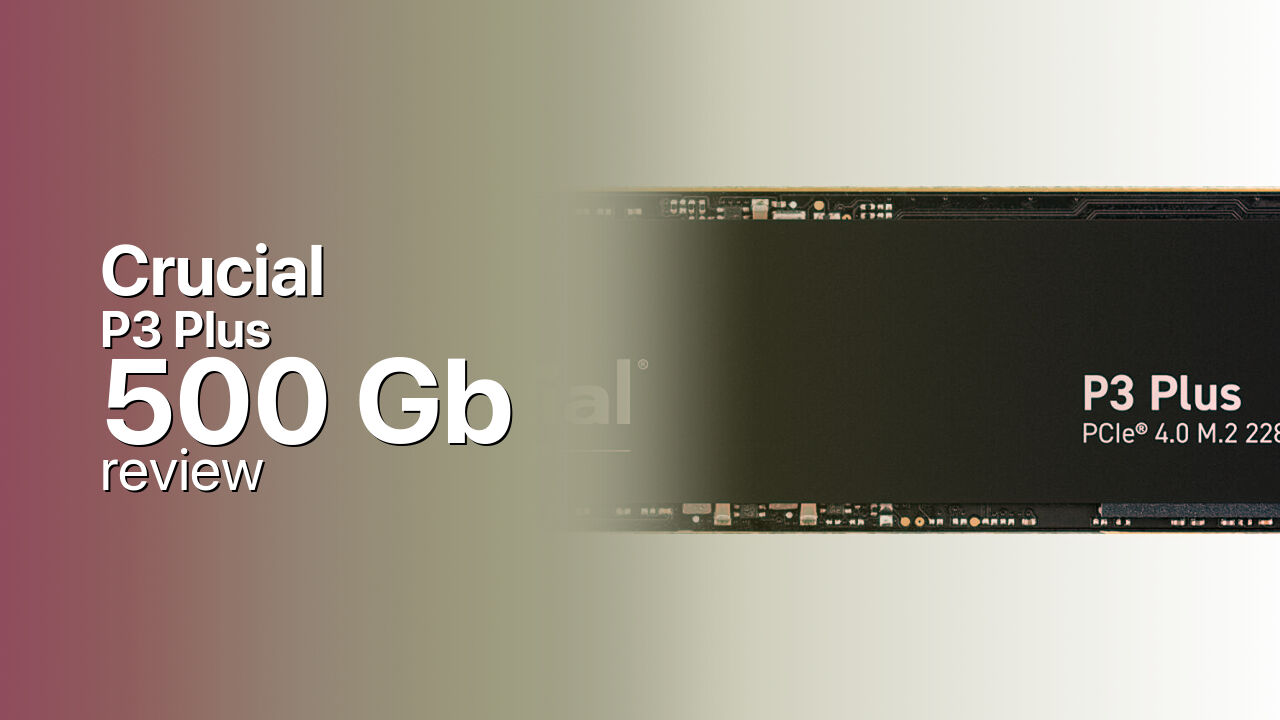
Crucial P3 Plus 500GB — Budget PCIe 4.0 NVMe SSD Review (2026)
Quick answer
The 500 GB Crucial P3 Plus is a competent boot drive for a budget desktop or a secondary-drive upgrade in a laptop, but it is not a general-purpose SSD.
Read: 4800 MB/s Write: 1900 MB/s Endurance: 110 TBW Warranty: 5 years Interface: M.2 4.0 x 4
The Crucial P3 Plus 500 GB is a DRAM-less QLC drive that brings PCIe 4.0 peak reads to the budget segment, sacrificing sustained write throughput in exchange for an accessible entry price.
Controller & Memory
The P3 Plus is built around the Phison E21T, a four-channel DRAM-less controller manufactured on a 12 nm process. Without an onboard DRAM cache, the drive relies on Host Memory Buffer (HMB) — borrowing up to 64 MB of system RAM for the flash translation layer — which keeps the bill of materials low but means random I/O latency depends partly on system memory bandwidth. Micron supplies the NAND: 176-layer QLC, the same generation used in Crucial's higher-tier drives but operating in a lower-cost, lower-endurance configuration here. The drive is a single-sided M.2 2280 design with no factory heatsink.
The 500 GB variant is the entry-level capacity in the P3 Plus family, sitting below the 1 TB, 2 TB, and 4 TB models. Capacity scaling is aggressive on this platform: the 500 GB model is rated for 1,900 MB/s sequential writes, well below the 4,100 MB/s on the 2 TB and 4 TB variants, because fewer NAND dies populate the E21T's four channels. TBW endurance drops to 110 TBW versus 800 TBW on the 4 TB flagship — a proportional scaling that reflects the smaller pool of flash cells to absorb writes. These trade-offs make the 500 GB P3 Plus strictly a light-duty OS and application drive.
In the budget PCIe 4.0 segment, the P3 Plus competes against the WD Blue SN580, Kingston NV2, and Silicon Power UD90 — all DRAM-less designs targeting the same buyer who wants PCIe 4.0 on the box but does not need workstation-class sustained throughput. Among these, the P3 Plus's QLC NAND gives it a capacity-per-dollar advantage at higher sizes, but at 500 GB the endurance and sustained write penalties of QLC are most visible. Buyers considering this drive for anything beyond an OS install should strongly evaluate the 1 TB P3 Plus or the TLC-based P5 Plus instead.
Storage Comparisons:
P3 Plus Performance & Benchmarks
Crucial rates the 500 GB P3 Plus at 4,700 MB/s sequential reads and 1,900 MB/s sequential writes — the read figure approaching the PCIe 4.0 saturation point for a four-channel controller, the write figure a direct consequence of QLC NAND with limited parallelism at this capacity. Random performance is modest: the Phison E21T at 500 GB delivers IOPS in the mid-six-figures, adequate for OS responsiveness but not competitive with DRAM-equipped TLC drives under mixed workloads.
Crucial P3 Plus 500 GB vs M.2 4.0 x 4 peers
Switch between sequential throughput and random IOPS to see how this drive stacks up against other M.2 4.0 x 4 SSDs in our database. The highlighted bar is the drive on this page — click any other bar to open that drive.
- Patriot Viper PV593 1 TB: 14,500 MB/s read, 14,000 MB/s write
- Patriot Viper PV593 2 TB: 14,500 MB/s read, 14,000 MB/s write
- Patriot Viper PV593 4 TB: 14,500 MB/s read, 14,000 MB/s write
- Patriot Viper PV573 2 TB: 14,000 MB/s read, 12,000 MB/s write
- Crucial P3 Plus 500 GB (this drive): 4,800 MB/s read, 1,900 MB/s write
The drive's pseudo-SLC cache behaves well in typical consumer burst scenarios, absorbing OS updates, application installs, and game downloads at near-rated speeds before the buffer fills. Once the cache exhausts — which happens sooner on the 500 GB model due to less total QLC to provision as SLC — native QLC write speeds settle around 100–150 MB/s, roughly on par with a spinning hard drive. For a boot drive, this is a non-issue: the OS rarely generates sustained sequential writes that exhaust the cache. Users planning to regularly transfer large files or ingest video footage should look at a TLC alternative, as the P3 Plus's post-cache write cliff is genuinely punishing for those workloads.
Crucial P3 Plus vs Competitors
See how the P3 Plus stacks up against other M.2 4.0 x 4 drives in our database:
Compare with rival drives:
Endurance, TBW & Warranty
Crucial backs the P3 Plus 500 GB with a five-year limited warranty, capped by a 110 TBW endurance rating. At a typical consumer write rate of 20 GB per day, that endurance budget lasts roughly 15 years — shorter than the TLC competition but still beyond the practical service life of a 500 GB OS drive. The 1 TB model doubles endurance to 220 TBW, the 2 TB reaches 440 TBW, and the 4 TB flagship carries 800 TBW. The 110 TBW figure reflects the write-amplification realities of QLC NAND: each cell stores four bits and wears faster under write stress than TLC, so Crucial sets a lower TBW ceiling to match the expected cell endurance. For workload reference, writing 110 TB is equivalent to completely overwriting the drive 220 times, or installing roughly 1,500 full-size AAA games over the warranty period.
Crucial P3 Plus 500 GB Specifications
| Category | Value |
|---|---|
| Capacity [?] | 500 GB |
| Interface [?] | M.2 4.0 x 4 |
| Controller [?] | Phison E21T |
| Memory type [?] | Micron QLC |
| DRAM [?] | (HMB) |
| Read speed (MB/s) [?] | 4800 |
| Write speed (MB/s) [?] | 1900 |
| Read IOPS [?] | 680000 |
| Write IOPS [?] | 800000 |
| Endurance (TBW) [?] | 110 |
| MTBF (million hours) [?] | 1500000 |
| Warranty (years) [?] | 5 |
Verdict: Is the P3 Plus Worth It in 2026?
The 500 GB Crucial P3 Plus is a competent boot drive for a budget desktop or a secondary-drive upgrade in a laptop, but it is not a general-purpose SSD. The QLC NAND and DRAM-less design impose real constraints — 1,900 MB/s sustained writes that drop to hard-drive speeds once the SLC cache fills, and 110 TBW endurance that discourages write-heavy use — and at this capacity those constraints are more visible than on the larger P3 Plus models. Buyers who will treat the drive as an OS-and-applications-only volume will find it fast enough, but anyone who regularly moves large files should spend the extra on the 1 TB P3 Plus or a TLC-based alternative like the WD Blue SN580. Among PCIe 4.0 budget drives, the P3 Plus is best understood as a value play that works within its limits rather than a flexible all-rounder.
+ Pros
- 4,700 MB/s sequential reads — PCIe 4.0 peak on a budget controller
- Single-sided M.2 2280 fits thin laptops and PS5 expansion bay
- 176-layer Micron QLC NAND on a modern 12 nm controller
- Five-year warranty backed by Micron, a tier-one NAND manufacturer
- Low idle power draw suitable for laptop battery life
- Cons
- 1,900 MB/s sequential writes — well below PCIe 4.0 TLC competitors
- Post-SLC-cache writes drop to ~100 MB/s, slower than a hard drive
- 110 TBW endurance — half the rating of comparable TLC 500 GB drives
- No DRAM cache — HMB borrows system RAM for the FTL
- QLC write-amplification penalty limits sustained write longevity
Buy this or similar SSD Storage:



Video Review
Fuel your system with GEN4 performance! Introducing the brand new Crucial P3 & P3 Plus SSD range!