Crucial P5 1TB PCIe 3.0 NVMe SSD (2026)
Quick answer
The Crucial P5 1 TB is a capable PCIe 3.0 NVMe SSD with a genuinely useful differentiator in hardware encryption.
Read: 3400 MB/s Write: 3000 MB/s Endurance: 600 TBW Warranty: 5 years Interface: M.2 3.0 x 4
The Crucial P5 1 TB is the capacity where this drive hits its stride -- 96-layer Micron TLC, 430K/500K random IOPS, hardware encryption, and 600 TBW endurance in a single-sided M.2 2280 module.
Controller & Memory
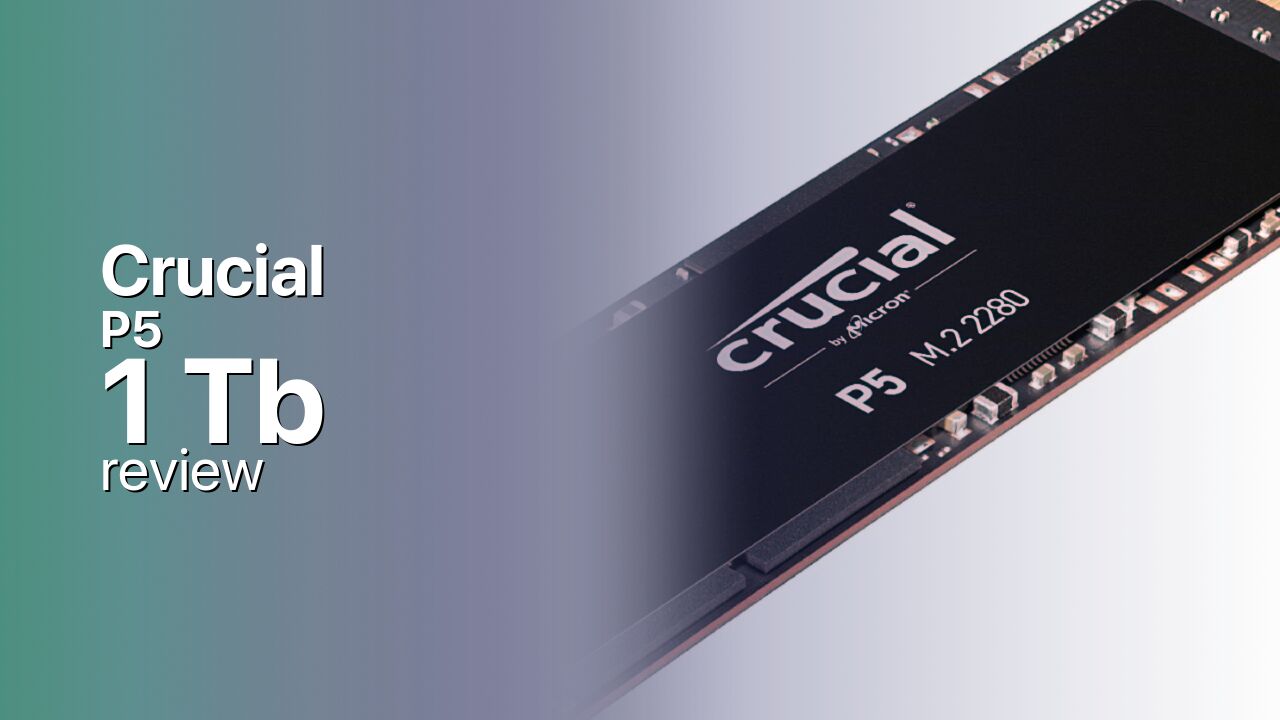
Crucial's P5 uses the company's first proprietary NVMe controller, featuring dual Arm Cortex-R5 cores, four Cortex-M3 co-processors for NAND management offloading, and eight NAND channels. The 1 TB model pairs this controller with Micron's newer 96-layer TLC NAND (512Gb dies, 16 dies across two packages) and a 1 GB Micron LPDDR4 DRAM chip. The smaller 250 GB and 500 GB models use older 64-layer TLC.
The 1 TB is the capacity that demonstrates the P5's full potential. Its 430K/500K random IOPS and 3,400/3,000 MB/s sequential speeds represent the peak of Crucial's PCIe 3.0 performance. Also available in 250 GB, 500 GB, and 2 TB capacities. All capacities are single-sided M.2 2280.
The P5 includes hardware AES 256-bit encryption (TCG Opal 2.0, IEEE 1667, eDrive) -- a feature that distinguishes it from most Samsung and WD drives. Competitors include the Samsung 970 EVO Plus and WD Black SN750. The P5's weakness is thermal management: the large 17x17mm controller generates significant heat under load, requiring a heatsink for sustained performance.
Storage Comparisons:
P5 Performance & Benchmarks
Crucial rates the 1 TB P5 for up to 3,400 MB/s sequential reads and 3,000 MB/s sequential writes over PCIe 3.0 x4, with 430,000 random read IOPS and 500,000 random write IOPS. These numbers are competitive at the top of the PCIe 3.0 class, though not consistently leading.
Crucial P5 1 TB vs M.2 3.0 x 4 peers
Switch between sequential throughput and random IOPS to see how this drive stacks up against other M.2 3.0 x 4 SSDs in our database. The highlighted bar is the drive on this page — click any other bar to open that drive.
- ADATA SX 8800 Pro 512 GB: 3,500 MB/s read, 2,700 MB/s write
- ADATA SX 8800 Pro 1 TB: 3,500 MB/s read, 2,700 MB/s write
- ADATA XPG Spectrix S40G RGB 256 GB: 3,500 MB/s read, 3,000 MB/s write
- ADATA XPG Spectrix S40G RGB 512 GB: 3,500 MB/s read, 3,000 MB/s write
- Crucial P5 1 TB (this drive): 3,400 MB/s read, 3,000 MB/s write
The P5's Dynamic Write Acceleration uses an intelligent SLC caching strategy that retains portions of OS and user data in the cache for read acceleration, adjusts cache size based on capacity usage and workload, and can remap the cache on the fly. Tom's Hardware found this approach effective but noted the P5 still posts "lower than average performance" relative to its pricing in some tests.
The controller's thermal profile is the P5's Achilles' heel. Adaptive Thermal Protection throttles when NAND temperatures exceed 70 degrees Celsius, and the drive shuts down near 85 degrees. Independent reviewers consistently report the P5 runs warm. A quality M.2 heatsink is essential for maintaining peak performance during sustained writes.
Crucial P5 vs Competitors
See how the P5 stacks up against other M.2 3.0 x 4 drives in our database:
Compare with rival drives:
Endurance, TBW & Warranty
Crucial rates the 1 TB P5 for 600 TBW of write endurance under a five-year limited warranty. At 30 GB of writes per day, 600 TBW translates to roughly 55 years of use. The P5 is overprovisioned by approximately 9% and includes RAIN parity protection (128:1 ratio at 2 TB, halving with each capacity reduction), multi-step LDPC error correction, and integrated power loss immunity. The drive supports S.M.A.R.T. monitoring through Crucial Storage Executive software.
Crucial P5 1 TB Specifications
| Category | Value |
|---|---|
| Capacity [?] | 1 TB |
| Interface [?] | M.2 3.0 x 4 |
| Controller [?] | Micron DMO1B2 |
| Memory type [?] | Micron TLC |
| DRAM [?] | LPDDR4 DRAM |
| Read speed (MB/s) [?] | 3400 |
| Write speed (MB/s) [?] | 3000 |
| Read IOPS [?] | 390000 |
| Write IOPS [?] | 500000 |
| Endurance (TBW) [?] | 600 |
| MTBF (million hours) [?] | 1.5 |
| Warranty (years) [?] | 5 |
Verdict: Is the P5 Worth It in 2026?
The Crucial P5 1 TB is a capable PCIe 3.0 NVMe SSD with a genuinely useful differentiator in hardware encryption. Users who need BitLocker with hardware acceleration or TCG Opal 2.0 compliance should shortlist the P5. For raw performance, the Samsung 970 EVO Plus and SK hynix Gold P31 outperform it in most benchmarks. The P5's thermal behavior is a persistent concern that requires a heatsink. At 1 TB with 600 TBW, it offers solid endurance for mixed gaming and productivity workloads.
+ Pros
- 3,400 MB/s reads, 3,000 MB/s writes
- 430K/500K random IOPS
- Hardware AES 256-bit encryption
- 96-layer Micron TLC on 1TB/2TB models
- LPDDR4 DRAM cache
- 600 TBW endurance
- RAIN parity data protection
- Cons
- Runs hot, requires a heatsink
- Lower than average performance for the price
- Thermal throttling at 70 degrees Celsius
- Read performance trails Samsung 970 EVO Plus
- No included heatsink
Buy this or similar SSD Storage:



Video Review
Crucial P5 1TB - NVMe M.2 SSD Review