Solidigm P41 Plus 1TB Review — A Cache-Tiered QLC PCIe 4.0 NVMe SSD (2026)
Quick answer
The Solidigm P41 Plus 1 TB is the endurance leader among budget QLC SSDs and one of the cheapest PCIe 4.0 1 TB drives from a tier-one-adjacent brand.
Read: 4125 MB/s Write: 2950 MB/s Endurance: 400 TBW Warranty: 5 years Interface: M.2 4.0 x 4
The Solidigm P41 Plus 1 TB brings the same Synergy cache-tiering architecture that made the 2 TB variant a standout QLC drive to a lower price point, though the smaller capacity pays a steeper penalty in write throughput.
Controller & Memory
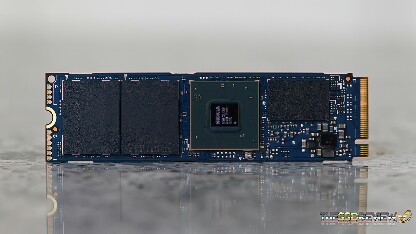
The Solidigm P41 Plus uses the Silicon Motion SM2269XT controller — a four-channel, DRAM-less PCIe 4.0 design — paired with Solidigm's own 144-layer 3D QLC NAND and no onboard DRAM. Instead of a dedicated buffer, the SM2269XT relies on Host Memory Buffer via NVMe 1.4, borrowing up to 64 MB of system RAM. Solidigm, the former Intel NAND and SSD division now owned by SK hynix, built the P41 Plus around its Synergy cache-tiering architecture: NAND cells dynamically transition between SLC and QLC states without an intermediate rewrite, reducing write amplification to roughly 1.1x versus the 2-to-3x typical of standard QLC drives, and frequently-accessed data is retained in fast pSLC mode as a read cache. The Synergy driver is Windows-only; Linux and macOS users get standard SSD behavior.
The 1 TB variant makes more compromises than the 2 TB. Sequential writes drop to 2,950 MB/s from the 2 TB's 3,325 MB/s — a consequence of fewer NAND dies to stripe writes across the SM2269XT's four channels. Endurance drops to 400 TBW from 800 TBW, which is proportionally correct but still double the Crucial P3 Plus 1 TB's 220 TBW, maintaining the P41 Plus's endurance advantage over competing QLC drives. The drive uses a single-sided M.2 2280 PCB and runs exceptionally cool — reviewers measured peak temperatures of 48 degrees Celsius under sustained load, well below any throttle threshold and ideal for laptops.
The P41 Plus competes in the crowded budget PCIe 4.0 segment against the Crucial P3 Plus (faster sequential, half the endurance), the WD Blue SN580 (TLC, better all-around, slightly pricier), and the Samsung 990 EVO (TLC, faster, significantly more expensive). The P41 Plus 1 TB typically undercuts them all on price, making it the value play among name-brand PCIe 4.0 drives. The 1 TB capacity is the practical sweet spot for most users — large enough for an OS plus a reasonable game library, cheap enough to compete with SATA SSDs on price.
Storage Comparisons:
P41 Plus Performance & Benchmarks
The Solidigm P41 Plus 1 TB is rated for 4,125 MB/s sequential reads and 2,950 MB/s sequential writes, with random performance of up to 390,000 IOPS reads and 540,000 IOPS writes. The write speed hit versus the 2 TB variant is significant — nearly 400 MB/s — and makes the 1 TB model a less compelling performer for write-heavy tasks. The SM2269XT's four-channel architecture simply runs out of parallelism at lower capacities more quickly than eight-channel controllers.
Solidigm P41 Plus 1 TB vs M.2 4.0 x 4 peers
Switch between sequential throughput and random IOPS to see how this drive stacks up against other M.2 4.0 x 4 SSDs in our database. The highlighted bar is the drive on this page — click any other bar to open that drive.
- Patriot Viper PV593 1 TB: 14,500 MB/s read, 14,000 MB/s write
- Patriot Viper PV593 2 TB: 14,500 MB/s read, 14,000 MB/s write
- Patriot Viper PV593 4 TB: 14,500 MB/s read, 14,000 MB/s write
- Patriot Viper PV573 2 TB: 14,000 MB/s read, 12,000 MB/s write
- Solidigm P41 Plus 1 TB (this drive): 4,125 MB/s read, 2,950 MB/s write
Real-world performance mirrors what we documented on the 2 TB variant, with the cache-tiering architecture providing a genuine game-load advantage. KitGuru's testing found the P41 Plus delivering some of the fastest Final Fantasy XIV load times in their test database, and PCMark 10 storage bandwidth of roughly 478 MB/s placed it competitively against mid-range TLC SSDs. The Synergy read cache — retaining frequently-accessed game assets in low-latency pSLC — is the technical explanation. However, the 1 TB's smaller total flash pool means the pSLC cache shrinks more aggressively as the drive fills, and a near-full 1 TB P41 Plus performs noticeably worse than a near-empty one.
Sustained writes after the pSLC cache exhausts drop to approximately 200 MB/s — the native QLC speed. On the 1 TB model, the cache exhausts sooner than on the 2 TB simply because there is less total NAND available for cache duty. For the PS5, the 4,125 MB/s read speed falls below Sony's 5,500 MB/s recommendation, though the drive fits physically and will work for PS4 game storage. Thermally, the P41 Plus is exceptional — 48 degrees Celsius peak under sustained load, making it one of the coolest-running PCIe 4.0 drives available.
Solidigm P41 Plus vs Competitors
See how the P41 Plus stacks up against other M.2 4.0 x 4 drives in our database:
Compare with rival drives:
Endurance, TBW & Warranty
Solidigm backs the P41 Plus 1 TB with a 5-year limited warranty and an endurance rating of 400 TBW. At 400 TBW, the drive can absorb approximately 219 GB of writes per day for the warranty period — more than sufficient for typical consumer use of 20 to 50 GB per day. The endurance rating is the P41 Plus's standout specification even at 1 TB: it is nearly double the Crucial P3 Plus 1 TB's 220 TBW, achieved through the Synergy cache-tiering architecture's reduced write amplification. The 512 GB variant carries 200 TBW, and the 2 TB variant 800 TBW. The MTBF is rated at 1.6 million hours. Solidigm provides the Solidigm Storage Tool, which includes the Synergy driver, for firmware updates and drive health monitoring. As an SK hynix subsidiary, Solidigm benefits from the parent company's warranty infrastructure and NAND supply chain.
Solidigm P41 Plus 1 TB Specifications
| Category | Value |
|---|---|
| Capacity [?] | 1 TB |
| Interface [?] | M.2 4.0 x 4 |
| Controller [?] | Silicon Motion SM2269XT |
| Memory type [?] | Solidigm 3D QLC |
| DRAM [?] | HMB |
| Read speed (MB/s) [?] | 4125 |
| Write speed (MB/s) [?] | 2950 |
| Read IOPS [?] | 390000 |
| Write IOPS [?] | 540000 |
| Endurance (TBW) [?] | 400 |
| MTBF (million hours) [?] | 1600000 |
| Warranty (years) [?] | 5 |
Verdict: Is the P41 Plus Worth It in 2026?
The Solidigm P41 Plus 1 TB is the endurance leader among budget QLC SSDs and one of the cheapest PCIe 4.0 1 TB drives from a tier-one-adjacent brand. The Synergy cache tiering is technically interesting and measurably benefits game load times and everyday snappiness, and the 400 TBW endurance rating is genuinely impressive for a QLC drive at this price. Buy it as a budget game library drive, a laptop storage upgrade, or a secondary SSD where capacity-per-dollar matters most. Skip it if your workload involves sustained writes — the 2,950 MB/s write ceiling and 200 MB/s post-cache speed are real limitations, and the WD Blue SN580 1 TB offers TLC NAND with better all-around performance for a small premium. The P41 Plus 1 TB is a smartly engineered drive that makes QLC work better than it has any right to; it is not, however, a substitute for TLC if your workload demands it.
+ Pros
- 400 TBW endurance — nearly double the Crucial P3 Plus at 1 TB
- Synergy cache-tiering architecture boosts game load times and reduces write amplification
- Extremely cool operation — peaks at 48°C, ideal for laptops
- Often the cheapest PCIe 4.0 1 TB drive from a reputable brand
- 5-year warranty backed by SK hynix subsidiary Solidigm
- Single-sided PCB fits thin laptops and ultrabooks
- Cons
- 1 TB write speed limited to 2,950 MB/s — noticeably slower than 2 TB variant
- QLC NAND: sustained writes drop to ~200 MB/s after pSLC cache fills
- DRAM-less HMB design — random I/O lags behind DRAM-equipped drives
- Performance degrades as drive fills — pSLC cache shrinks with lower free space
- Synergy cache-tiering driver is Windows-only
- Below PS5 recommended speed — console may flag drive
Buy this or similar SSD Storage:



Video Review
Introducing the P41 Plus SSD with Solidigm Synergy™ Software