4TB at PCIe 5.0 Speeds: Maximum Capacity Without Leaving the Fast Lane (2026)
Quick answer
The Crucial T705 4TB is the natural choice for buyers who need the largest fast NVMe storage available in the T705 lineup and want PCIe 5.0 performance without accepting PCIe 4.0 speeds.
Read: 14100 MB/s Write: 12600 MB/s Endurance: 2400 TBW Warranty: 5 years Interface: M.2 5.0
The Crucial T705 4TB delivers the highest storage capacity in the lineup alongside 14,100 MB/s sequential reads, positioning it as the choice for buyers who need large fast NVMe storage without stepping down to PCIe 4.0 speeds.
Controller & Memory
The 4TB T705 is the top-capacity option in Crucial's PCIe 5.0 lineup, and it reaches its position without the performance compromises that typically accompany maximum-capacity drives. Sequential reads are rated at 14,100 MB/s — 400 MB/s below the 2TB model's 14,500 MB/s, a 3 percent difference that is imperceptible outside a benchmark — while sequential writes reach 12,600 MB/s, close to the 2TB's 12,700 MB/s. The 4TB model trades fractionally lower peak sequential bandwidth for its much larger NAND pool and 2,400 TBW endurance.
The architecture is unchanged from the smaller T705 capacities. Phison's PS5026-E26 is the 8-channel PCIe 5.0 NVMe 2.0 controller used across the entire T705 family. Crucial's NAND of choice is Micron 232-layer B58R 3D TLC — a first-party selection, since Crucial is Micron's consumer brand, which eliminates the NAND sourcing variability found in drives that use NAND from multiple vendors across production runs. Dedicated DRAM is present on all T705 capacities, avoiding the Host Memory Buffer path that some lower-tier PCIe 5.0 drives rely on.
At 4TB, the NAND pool is proportionally large, which has two practical implications. First, the SLC write cache is large: sustained sequential writes are less likely to exhaust it in typical use than on the 1TB or 2TB models. Second, the 2,400 TBW endurance rating means the drive accommodates the most total data written of any T705 variant. Both factors favor workloads involving large and frequent writes over the drive's lifespan.
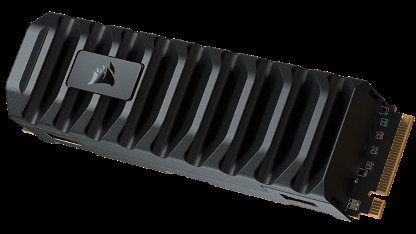
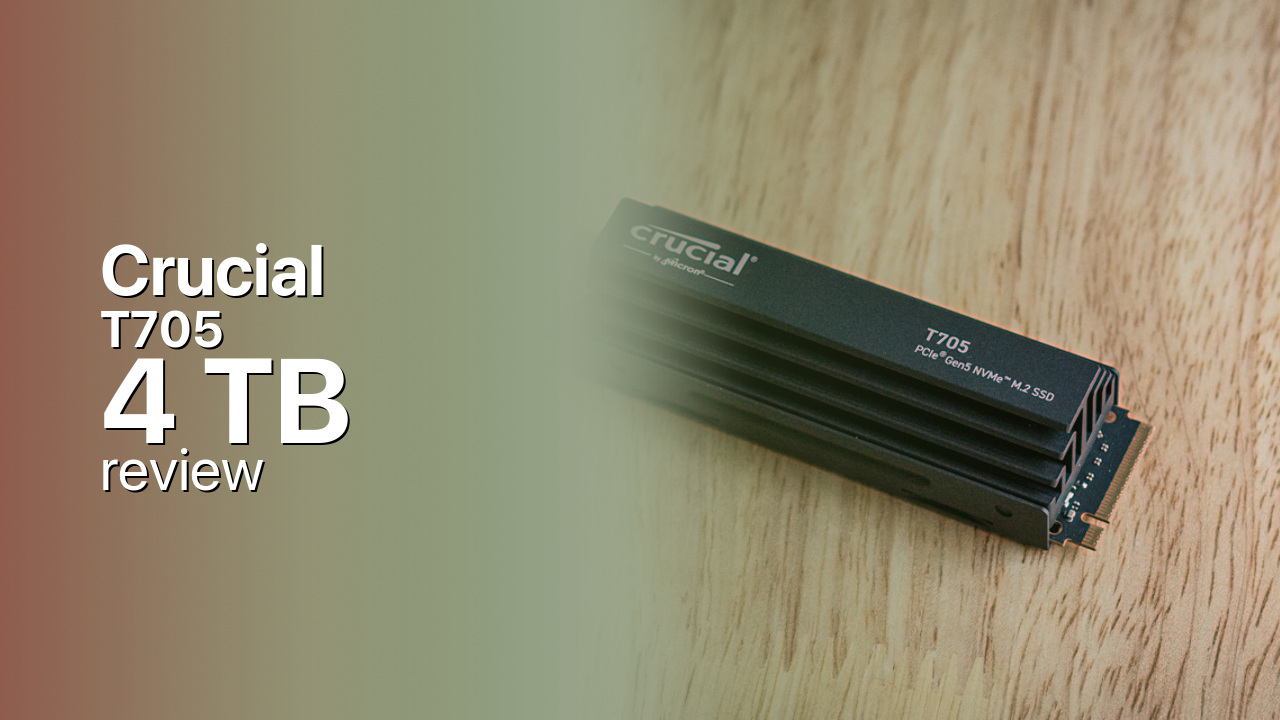
Crucial offers the 4TB T705 as a bare drive (CT4000T705SSD3) and a heatsink SKU (CT4000T705SSD5) with a copper-and-aluminum heatsink. PCIe 5.0 SSDs generate more heat than PCIe 4.0 drives under sustained load; for systems without a quality M.2 thermal solution, the heatsink SKU is the practical choice. The closest competitors at this capacity are the Corsair MP700 PRO SE 4TB — also Phison E26-based, rated at 14,000 MB/s reads and a higher 3,000 TBW — and the Seagate FireCuda 540 4TB. The WD Black SN850X 4TB and Samsung 990 Pro operate on PCIe 4.0 and are meaningfully slower.
Storage Comparisons:
T705 Performance & Benchmarks
Crucial rates the T705 4TB at 14,100 MB/s sequential reads and 12,600 MB/s sequential writes, with random performance at 1,500,000 read IOPS and 1,800,000 write IOPS at queue depth 32. These figures are confirmed by Amazon and Newegg product listings for the CT4000T705SSD5 heatsink SKU.
Crucial T705 4 TB vs M.2 5.0 peers
Switch between sequential throughput and random IOPS to see how this drive stacks up against other M.2 5.0 SSDs in our database. The highlighted bar is the drive on this page — click any other bar to open that drive.
- Corsair MP700 Pro XT 1 TB: 14,900 MB/s read, 14,200 MB/s write
- Corsair MP700 Pro XT 2 TB: 14,900 MB/s read, 14,500 MB/s write
- Corsair MP700 Pro XT 4 TB: 14,900 MB/s read, 14,400 MB/s write
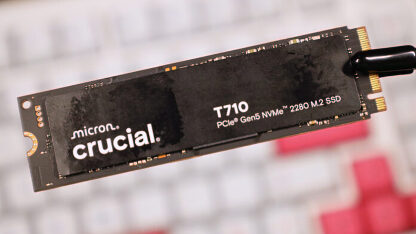
- Crucial T710 1 TB: 14,900 MB/s read, 13,800 MB/s write
- Crucial T705 4 TB (this drive): 14,100 MB/s read, 12,600 MB/s write
Compared to the 2TB model, sequential reads are 2.7 percent lower (14,100 vs 14,500 MB/s) and sequential writes are 0.8 percent lower (12,600 vs 12,700 MB/s). These differences are consistent with how multi-channel NVMe controllers distribute workloads across different die counts per channel. At 4TB, the NAND configuration favors capacity while maintaining performance within a few percent of the lineup's peak. In practice, the two drives are indistinguishable in sequential workloads.
Random IOPS at low queue depths are strong across all T705 capacities, with the dedicated DRAM cache providing consistent latency. The 4TB model's large NAND pool makes SLC cache exhaustion the least likely scenario in the lineup: a session would need to sustain writes of several hundred gigabytes to exit the SLC layer, at which point direct TLC write speeds apply — normal behavior for all TLC-based SSDs regardless of PCIe generation.
Full rated performance requires a PCIe 5.0 x4 M.2 slot, available on Intel 12th Gen and newer platforms with appropriate motherboard support, and AMD Ryzen 7000 series and newer. In a PCIe 4.0 slot the drive operates at PCIe 4.0 speeds — functional but well below the rated maximum.
Crucial T705 vs Competitors
See how the T705 stacks up against other M.2 5.0 drives in our database:
Compare with rival drives:
Endurance, TBW & Warranty
The Crucial T705 4TB is covered by a five-year limited warranty from the date of original purchase, with a 2,400 TBW endurance rating on the 4TB model. The warranty applies until the drive reaches 2,400 TBW or five years have passed — whichever comes first. At 2,400 TBW, the drive accommodates up to 480 TB written per year across the warranty period. A user writing 200 GB per day — a heavy content creation or development workload involving frequent large file writes — accumulates roughly 73 TB per year, reaching the TBW threshold in approximately 33 years. Even at 1 TB written per day, the 2,400 TBW budget lasts over six years. The five-year warranty expiration is the operative limit for the overwhelming majority of buyers. MTBF is rated at 2 million hours.
Crucial T705 4 TB Specifications
| Category | Value |
|---|---|
| Capacity [?] | 4 TB |
| Interface [?] | M.2 5.0 |
| Controller [?] | Phison PS5026-E26 8 channel |
| Memory type [?] | Micron 232-L B58R 3D TLC |
| DRAM [?] | Yes |
| Read speed (MB/s) [?] | 14100 |
| Write speed (MB/s) [?] | 12600 |
| Read IOPS [?] | 1500000 |
| Write IOPS [?] | 1800000 |
| Endurance (TBW) [?] | 2400 |
| MTBF (million hours) [?] | 2000000 |
| Warranty (years) [?] | 5 |
Verdict: Is the T705 Worth It in 2026?
The Crucial T705 4TB is the natural choice for buyers who need the largest fast NVMe storage available in the T705 lineup and want PCIe 5.0 performance without accepting PCIe 4.0 speeds. The 3 percent sequential read penalty versus the 2TB model is irrelevant in any real-world context. What matters is that 4TB of dedicated DRAM-cached NVMe storage is available at speeds that outpace every PCIe 4.0 alternative, with 2,400 TBW endurance and a five-year warranty.
Buyers who should choose the 2TB instead: those who do not need 4TB of storage and prefer the fractionally higher peak sequential speeds at a lower price. Those for whom the 4TB is the right call: content creators who fill storage quickly, developers with large project and container footprints, and users who want to run their entire game library and working storage from a single fast NVMe drive without running out of space.
+ Pros
- 14,100 MB/s sequential reads — within 3 percent of the lineup's peak, with the largest capacity available
- 12,600 MB/s sequential writes — matches the 2TB model closely despite the larger NAND pool
- 2,400 TBW endurance — the highest in the T705 lineup, appropriate for heavy and sustained write workloads
- Five-year warranty with MTBF of 2 million hours
- Phison PS5026-E26 8-channel controller with dedicated DRAM across all SKUs
- Large SLC write cache due to larger NAND pool — less likely to exhaust cache in typical sessions
- Cons
- Sequential reads (14,100 MB/s) are marginally lower than the 2TB model (14,500 MB/s) — a known trade-off at maximum capacity
- Requires a PCIe 5.0 x4 M.2 slot; PCIe 4.0 hosts deliver roughly half the rated sequential throughput
- Premium pricing over both smaller T705 variants and all PCIe 4.0 4TB alternatives
- PCIe 5.0 thermal output is higher than PCIe 4.0; a quality heatsink is necessary for sustained workloads
- Corsair MP700 PRO SE 4TB offers a higher TBW (3,000 vs 2,400) at similar sequential speeds — worth comparing at purchase time
Buy this or similar SSD Storage:



Video Review
Faster than a 9100 PRO? - Crucial T705 Gen5 NVMe SSD Review