Integral Ultima Pro X 512GB Review — the Range's Mainstream Pick (2026)
Quick answer
The Integral Ultima Pro X 512GB is the mainstream pick of the Version 2 range: flagship-matching 3,400 MB/s reads, unusually strong 2,400 MB/s writes for the size, and TCG Opal 2.0 encryption for corporate or privacy-minded buyers on Gen3 hardware.
Read: 3400 MB/s Write: 2400 MB/s Endurance: 350 TBW Warranty: 3 years Interface: M.2 3.0 x 4
The Integral Ultima Pro X 512GB pairs the fastest read rating of Integral's sub-1TB Gen3 capacities, 3,400 MB/s, with TCG Opal 2.0 encryption and 350 TBW of endurance.
Controller & Memory
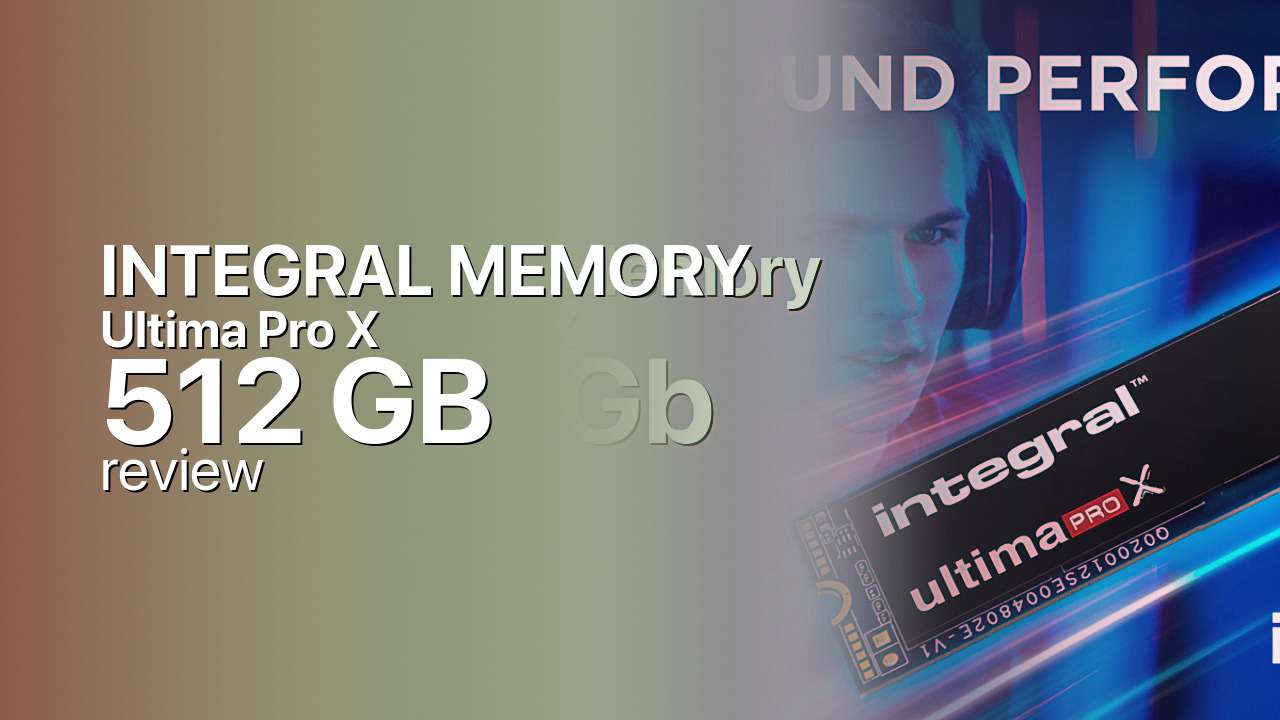
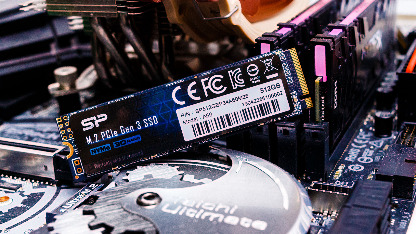
The Integral Ultima Pro X 512GB — part code INSSD512GM280NUPX2 in the Version 2 family — is the mainstream build of Integral's Gen3 NVMe line. The hardware is common to the whole range: Phison E12 controller with DRAM, 3D TLC NAND, PCIe 3.1 x4 under NVMe 1.3, and 256-bit AES hardware encryption with TCG Opal 2.0. Its datasheet ratings sit near the top of the family: 3,400 MB/s sequential reads — the fastest figure Integral assigns to any sub-1TB capacity — with 2,400 MB/s writes, 190K random reads, and 570K random writes. That write rating is unusually strong for the size: the 480 GB sibling manages 2,000 MB/s, and the 256 GB just 1,100 MB/s.
The family's datasheet habits are worth reading in full, because the 512GB carries its own oddity: a 350 TBW endurance rating, well below the 800 TBW of the smaller-numbered 480 GB variant. Integral publishes endurance per capacity, and the small round sizes (256 GB, 512 GB, 1 TB) consistently rate lower than their binary neighbours. Physically the drive is a double-sided M.2 2280 module within a 3.8 mm height, drawing up to 4.7 W reading and 5.1 W writing with a 200 mW idle rating.
Against the field at 500 GB: WD's DRAM-less Blue SN550 rates 2,400/1,750 MB/s and idles far lower, Crucial's P5 matches the 3,400 MB/s read with a faster 3,000 MB/s write ceiling, and Samsung's 970 EVO Plus 500GB sets the Gen3 benchmark at 3,500/3,300 MB/s. The Integral's case rests on its write-side strength for the size, Opal 2.0 encryption, and per-capacity documentation — with the caveat that remaining retail stock is mostly in discount channels now.
Storage Comparisons:
Ultima Pro X Performance & Benchmarks
Integral rates the 512GB at 3,400 MB/s sequential reads, 2,400 MB/s writes, and 190K/570K random read/write IOPS. The read figure matches the family's ceiling, so boot times, application launches, and game loading behave exactly as they would on the flagship capacities of a Gen3 system — the interface, not the capacity, is the constraint. The 2,400 MB/s write rating is the capacity's quiet strength: it clears the 480 GB sibling's 2,000 MB/s and doubles the 256 GB variant, which shows up in install times and batch file moves. The 570K random-write figure is the highest Integral publishes below 960 GB.
INTEGRAL MEMORY Ultima Pro X 512 GB vs M.2 3.0 x 4 peers
Switch between sequential throughput and random IOPS to see how this drive stacks up against other M.2 3.0 x 4 SSDs in our database. The highlighted bar is the drive on this page — click any other bar to open that drive.
- ADATA SX 8800 Pro 512 GB: 3,500 MB/s read, 2,700 MB/s write
- ADATA SX 8800 Pro 1 TB: 3,500 MB/s read, 2,700 MB/s write
- ADATA XPG Spectrix S40G RGB 256 GB: 3,500 MB/s read, 3,000 MB/s write
- ADATA XPG Spectrix S40G RGB 512 GB: 3,500 MB/s read, 3,000 MB/s write
- INTEGRAL MEMORY Ultima Pro X 512 GB (this drive): 3,400 MB/s read, 2,400 MB/s write
Burst and sustained behavior follow the E12 platform's usual pattern: a pseudo-SLC cache absorbs everyday writes, and sustained transfers settle to native TLC rates once it fills. On a 512 GB module the cache is moderate — large single-file copies eventually see the drop, while boot-and-games workloads never will. The 190K random-read rating sits well below the 960 GB variant's 500K, so heavily fragmented random access is where the bigger capacities justify themselves. Independent benchmark coverage of the family is limited to Cowcotland's early-2020 reviews of the 960 GB models, so these figures stand as manufacturer ratings rather than measured results.
INTEGRAL MEMORY Ultima Pro X vs Competitors
See how the Ultima Pro X stacks up against other M.2 3.0 x 4 drives in our database:
Compare with rival drives:
Endurance, TBW & Warranty
Integral covers the 512GB with the family's 3-year limited warranty or the TBW rating, whichever arrives first, and the datasheet assigns this capacity 350 TBW. At 20 GB of writes per day — ordinary boot-drive usage — that budget lasts about 48 years, so the 3-year term is the practical limit. The number worth knowing is the comparison: Integral's own endurance table rates the 480 GB variant at 800 TBW, more than double, and the 960 GB at 1,665 TBW. Buyers torn between the 512 GB and 480 GB parts should treat endurance as the tiebreaker. MTBF is rated at 1.8 million hours, a population statistic from JEDEC-methodology estimation rather than an individual lifespan guarantee. Claims are handled through Integral's UK support operation with proof of purchase.
INTEGRAL MEMORY Ultima Pro X 512 GB Specifications
| Category | Value |
|---|---|
| Capacity [?] | 512 GB |
| Interface [?] | M.2 3.0 x 4 |
| Controller [?] | Phison PS5012-E12 8 Channel |
| Memory type [?] | 3D TLC |
| DRAM [?] | Yes |
| Read speed (MB/s) [?] | 3400 |
| Write speed (MB/s) [?] | 2400 |
| Read IOPS [?] | 190000 |
| Write IOPS [?] | 570000 |
| Endurance (TBW) [?] | 350 |
| MTBF (million hours) [?] | 1800000 |
| Warranty (years) [?] | 3 |
Verdict: Is the Ultima Pro X Worth It in 2026?
The Integral Ultima Pro X 512GB is the mainstream pick of the Version 2 range: flagship-matching 3,400 MB/s reads, unusually strong 2,400 MB/s writes for the size, and TCG Opal 2.0 encryption for corporate or privacy-minded buyers on Gen3 hardware. Skip it if endurance tops the list — the 480 GB variant carries more than double the TBW rating — or on any PCIe 4.0 system, where a WD Black SN850X or Samsung 990 Pro is the contemporary answer. Against the WD Blue SN550 it trades idle power for a DRAM cache and faster writes; against the Crucial P5 it trades write speed for documented endurance and encryption. On a legacy Gen3 board, it earns its place.
+ Pros
- 3,400 MB/s reads, the family's ceiling
- 2,400 MB/s writes, strong for the size
- 570K random-write IOPS rating
- DRAM-backed Phison E12 platform
- TCG Opal 2.0 AES-256 hardware encryption
- 350 TBW endurance rating
- Cons
- 350 TBW is less than half the 480 GB rating
- 190K random reads trail the 960 GB variant
- 3-year warranty, shorter than many rivals
- No heatsink included
- Legacy product with limited retail stock
Buy this or similar SSD Storage:
Video Review
M.2 2230 NVME SSD GEN4 | Integral Memory