SK hynix Gold P31 2TB Review — The Efficient Gen3 Flagship (2026)
Quick answer
Buy the SK hynix Gold P31 2TB for a PCIe 3.0 system or a laptop where efficiency, heat, and battery life matter more than raw throughput — nothing in its generation matched its power discipline, and 1,200 TBW plus a 5-year warranty back it up.
Read: 3500 MB/s Write: 3200 MB/s Endurance: 1200 TBW Warranty: 5 years Interface: M.2 3.0 x 4
The SK hynix Gold P31 2TB is the efficiency benchmark of PCIe 3.0 — the first 128-layer NAND consumer SSD, and still one of the gentlest drives on a laptop's battery.
Controller & Memory
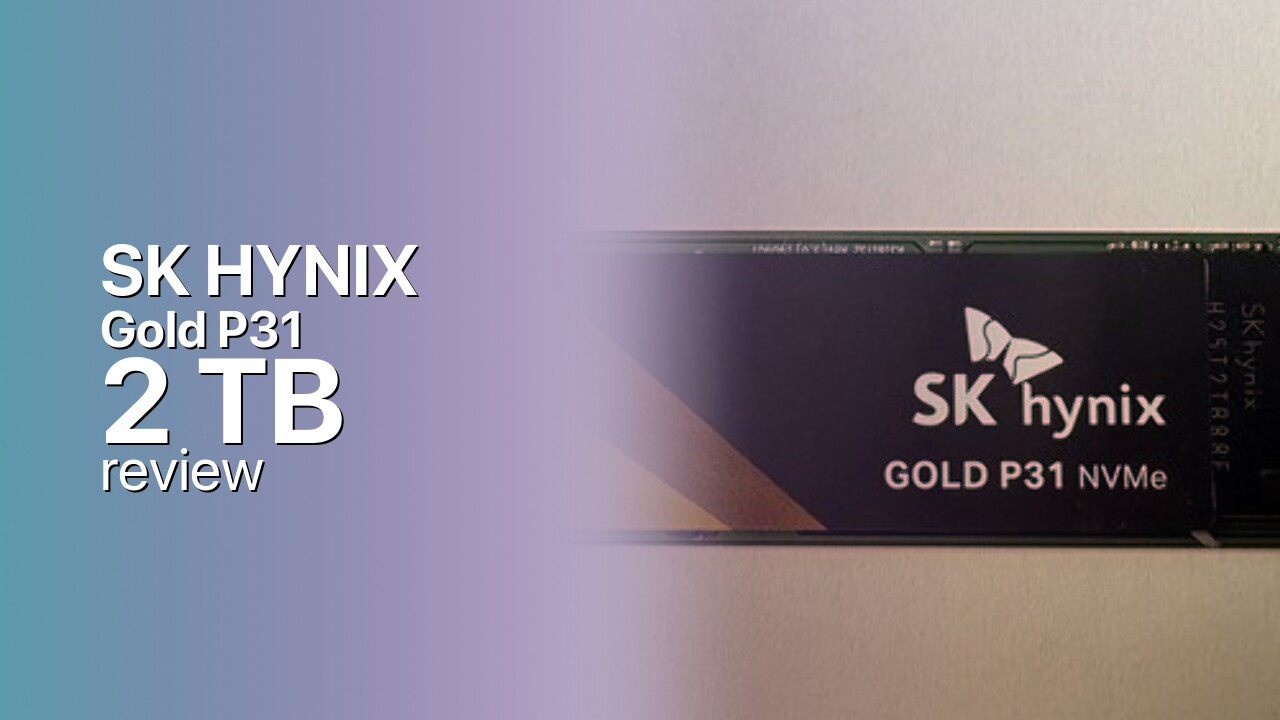
The SK hynix Gold P31 2TB is vertically integrated in the truest sense: SK hynix makes the 128-layer TLC NAND, the Cepheus controller, and the DRAM cache, then validates all three together. It was the first consumer NVMe SSD built on 128-layer NAND, and that node jump is the root of its signature trait — power draw low enough that reviewers found it using less power than many SATA SSDs while running at full PCIe 3.0 x4 speed. SK hynix quotes read latency of 90 microseconds and write latency of 45 microseconds, plus AES-256 hardware encryption and Device Sleep support.
The range runs 500 GB, 1 TB, and 2 TB with an identical 3,500 MB/s read rating; the 2 TB model writes at 3,200 MB/s — the 500 GB manages 3,100 — and carries 1,200 TBW of endurance under a 5-year warranty. Random ratings are 570K reads and 600K writes. The single-sided M.2 2280 PCB suits thin laptops, though no heatsink is included. Samsung's 970 EVO Plus is the obvious Gen3 rival, and StorageReview's 2 TB comparison found the two trading wins with the decision coming down to price; WD's Black SN750 played the same generation from the gaming angle.
As a 2021-era design still on sale, the P31 now serves two specific audiences: owners of PCIe 3.0 systems who want the generation's best efficiency, and laptop users for whom heat and battery life matter more than a 7,000 MB/s rating their machine cannot use. On a modern Gen4 board, value Gen4 drives undercut it on speed at similar money, so this capacity is best bought where Gen3 compatibility or efficiency is the point.
Storage Comparisons:
Gold P31 Performance & Benchmarks
SK hynix rates the 2 TB Gold P31 at 3,500 MB/s sequential reads, 3,200 MB/s writes, and 570K/600K IOPS random — right at the practical ceiling of PCIe 3.0, which only a handful of drives ever approached. StorageReview's testing recorded a 4K random-read peak of roughly 460,000 IOPS on this capacity, among the better results of its generation, and the 2 TB model traded benchmark wins with the 1 TB rather than trailing it badly.
SK HYNIX Gold P31 2 TB vs M.2 3.0 x 4 peers
Switch between sequential throughput and random IOPS to see how this drive stacks up against other M.2 3.0 x 4 SSDs in our database. The highlighted bar is the drive on this page — click any other bar to open that drive.
- SK HYNIX Gold P31 2 TB (this drive): 3,500 MB/s read, 3,200 MB/s write
- ADATA SX 8800 Pro 512 GB: 3,500 MB/s read, 2,700 MB/s write
- ADATA SX 8800 Pro 1 TB: 3,500 MB/s read, 2,700 MB/s write
- ADATA XPG Spectrix S40G RGB 256 GB: 3,500 MB/s read, 3,000 MB/s write
- ADATA XPG Spectrix S40G RGB 512 GB: 3,500 MB/s read, 3,000 MB/s write
The efficiency story is the real differentiator. SK hynix cites independent testing that found up to 434 percent better efficiency than comparable drives, and reviewers consistently described a drive that runs cool enough for passive laptop slots. The Hyperwrite cache absorbs burst writes; very long transfers settle below the 3,200 MB/s peak like every TLC drive, but at 2 TB the cache is rarely the bottleneck for boot-and-games duty. Against Gen4 drives the gap is real in synthetic numbers — 3,500 MB/s versus 7,000 MB/s-class reads — yet in game load times and desktop responsiveness the difference is close to imperceptible. For massive media transfers, a Gen4 drive wins; for everything else, the P31's efficiency buys quiet operation and battery life instead.
SK HYNIX Gold P31 vs Competitors
See how the Gold P31 stacks up against other M.2 3.0 x 4 drives in our database:
Compare with rival drives:
Endurance, TBW & Warranty
SK hynix backs the Gold P31 2TB with a 5-year warranty rated to 1,200 TBW — the 1 TB model carries 750 TBW per StorageReview's review. At a modest 20 GB of writes per day, the 2 TB budget stretches past 160 years, so the warranty term is the practical limit for typical desktop workloads. Reliability is specified at 1.5 million hours MTBF, a population statistic that describes expected failure rates across large fleets rather than a promise for any single drive. The drive also carries AES-256 encryption with TCG Pyrite 2.0 support for managed environments, and claims run through SK hynix's consumer support channels with proof of purchase. Either limit — five years or 1,200 TBW — ends the coverage, so constant heavy writers should size the margin accordingly.
SK HYNIX Gold P31 2 TB Specifications
| Category | Value |
|---|---|
| Capacity [?] | 2 TB |
| Interface [?] | M.2 3.0 x 4 |
| Controller [?] | SK Hynix Cepheus |
| Memory type [?] | SK Hynix 3D TLC |
| DRAM [?] | Yes |
| Read speed (MB/s) [?] | 3500 |
| Write speed (MB/s) [?] | 3200 |
| Read IOPS [?] | 570000 |
| Write IOPS [?] | 600000 |
| Endurance (TBW) [?] | 1200 |
| MTBF (million hours) [?] | 1500000 |
| Warranty (years) [?] | 5 |
Verdict: Is the Gold P31 Worth It in 2026?
Buy the SK hynix Gold P31 2TB for a PCIe 3.0 system or a laptop where efficiency, heat, and battery life matter more than raw throughput — nothing in its generation matched its power discipline, and 1,200 TBW plus a 5-year warranty back it up. Skip it on a modern Gen4 board, where faster drives cost similar money, or as a PS5 upgrade, because its 3,500 MB/s read rating sits well below Sony's 5,500 MB/s recommendation. The Samsung 970 EVO Plus is the alternative worth pricing first — StorageReview found the decision between them comes down to whichever costs less that week. As the efficiency benchmark of Gen3, though, the P31 2TB remains a smart, deliberate buy.
+ Pros
- 3,500/3,200 MB/s rated on PCIe 3.0 x4
- 570K/600K random IOPS rating
- 1,200 TBW endurance with 5-year warranty
- First consumer SSD built on 128-layer NAND
- Lowest power draw of its class, reviewer-measured
- Single-sided PCB with AES-256 encryption
- Cons
- Gen3 ceiling trails current Gen4 drives
- Below Sony's 5,500 MB/s PS5 read recommendation
- No heatsink included
- 2TB trails the 1TB in some StorageReview tests
- Priced against faster Gen4 drives today
Buy this or similar SSD Storage:
Video Review
SK Hynix Gold P31 NVMe SSD: More Hyjinx from Hynix?