Team Group Cardea IOPS 1TB: Endurance Ahead of Its Speed (2026)
Quick answer
The Team Group Cardea IOPS 1TB suits a specific buyer today: an owner of an older PCIe 3.0 desktop or laptop who wants a durable, DRAM-equipped NVMe with cooling hardware in the box and a 1,665 TBW endurance rating behind it.
Read: 3400 MB/s Write: 3000 MB/s Endurance: 1665 TBW Warranty: 5 years Interface: M.2 3.0 x 4
The Team Group Cardea IOPS 1TB trades headline speed for a 1,665 TBW endurance rating, dual heat spreaders and five years of coverage.
Controller & Memory
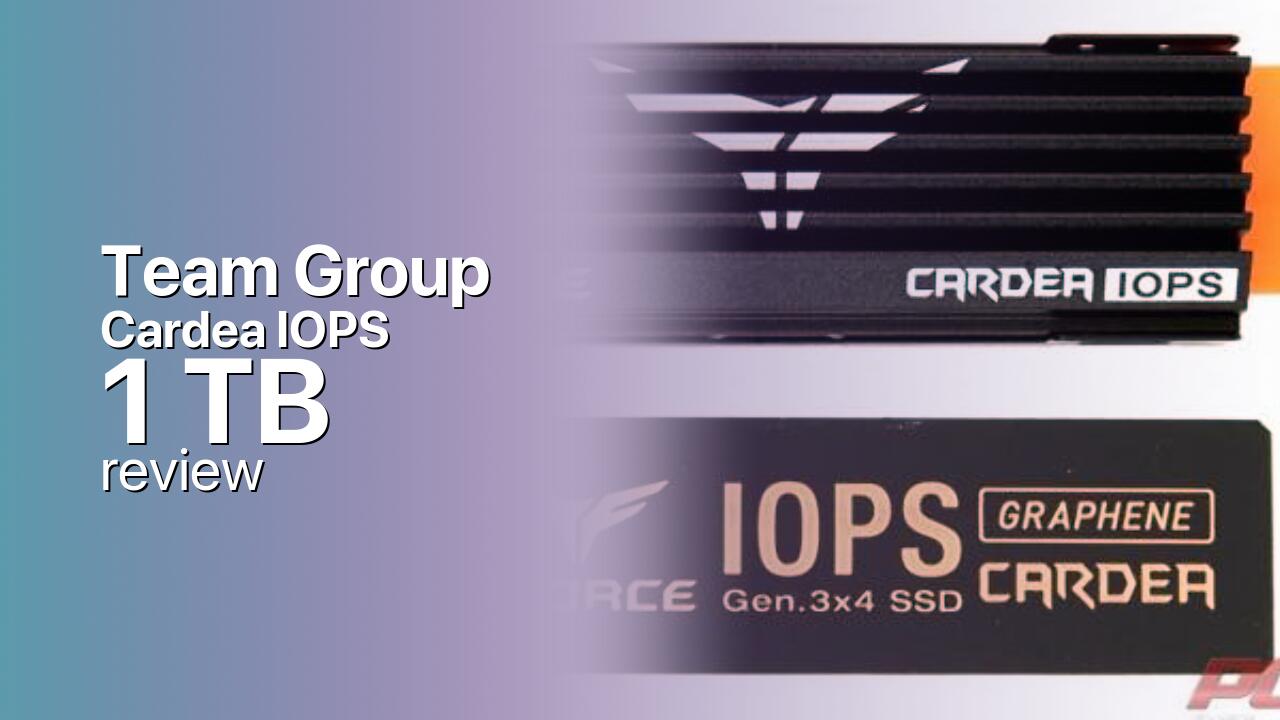
The Team Group Cardea IOPS 1TB is an older T-Force design with one clear priority: outlasting everything else on the shelf. The platform is a PCIe 3.0 x4, NVMe 1.3 M.2 2280 drive built on a DRAM-equipped Phison E12-family controller with Kioxia 96-layer TLC NAND. TeamGroup rated it at 3,400 MB/s sequential reads and 3,000 MB/s writes — the practical ceiling of the Gen3 interface — with rated random performance of 680K read and 670K write IOPS. The durability figure is the standout: 1,665 TBW on the 1 TB model, an endurance rating PCMag described as excellent and several times what contemporaries offered at the capacity.
Cooling is the second signature. TeamGroup ships two heat spreaders in one package — a thin graphene layer around 4 mm thick for slim builds and laptops, and a finned aluminum heatsink around 13 mm for open desktop slots. BabelTechReviews found the graphene-cooled drive peaked near 69 °C without throttling, but warned that running it bare invited slowdowns above 70 °C. PCMag's verdict was measured: an excellent durability rating attached to average test results against its PCIe 3.0 kin, with the Intel 670p, Crucial P5 and Samsung 980 named among the alternatives of its era.
Today the Cardea IOPS is a legacy product. It shipped in 1 TB only, its 3,400 MB/s ceiling sits well below Sony's 5,500 MB/s PS5 guidance, and it no longer appears in TeamGroup's current T-Force range — BabelTechReviews' review dates to March 2021. It remains a sensible fit for an older Gen3 desktop or laptop that needs a durable, pre-cooled NVMe upgrade, while buyers on modern platforms should look at TeamGroup's Gen4 T-Force Cardea and T-Create Classic lines instead.
Storage Comparisons:
Cardea IOPS Performance & Benchmarks
The rated numbers — 3,400 MB/s sequential reads, 3,000 MB/s writes, 680K/670K random IOPS — describe a drive at the top of the PCIe 3.0 class, and TeamGroup's own marketing leaned on that IOPS figure as the model's identity. Independent reviews confirmed the character but not the hype: PCMag ranked its results average against other Gen3 drives, while BabelTechReviews placed it behind TeamGroup's own Gen4 Cardea C440 yet comfortably ahead of SATA, awarding it an Editor's Choice for the combination of cooling, endurance and price at the time.
Team Group Cardea IOPS 1 TB vs M.2 3.0 x 4 peers
Switch between sequential throughput and random IOPS to see how this drive stacks up against other M.2 3.0 x 4 SSDs in our database. The highlighted bar is the drive on this page — click any other bar to open that drive.
- ADATA SX 8800 Pro 512 GB: 3,500 MB/s read, 2,700 MB/s write
- ADATA SX 8800 Pro 1 TB: 3,500 MB/s read, 2,700 MB/s write
- ADATA XPG Spectrix S40G RGB 256 GB: 3,500 MB/s read, 3,000 MB/s write
- ADATA XPG Spectrix S40G RGB 512 GB: 3,500 MB/s read, 3,000 MB/s write
- Team Group Cardea IOPS 1 TB (this drive): 3,400 MB/s read, 3,000 MB/s write
In use, the gap between Gen3 and Gen4 matters less than marketing suggests. Loading Windows, games and large applications off a 3,400 MB/s drive feels close to identical to a 7,000 MB/s drive, because random reads and latency dominate those workloads; where the Gen3 ceiling shows is in very large sequential copies, where a modern Gen4 drive finishes roughly twice as fast. The dual heat spreaders earn their keep here — with the graphene or aluminum layer fitted, BabelTechReviews saw no throttling at a peak near 69 °C, while a bare drive risked dropping speeds above 70 °C. The figures quoted here are manufacturer ratings and reviewer observations rather than reproduced benchmark charts, so treat the rated numbers as best-case claims.
Team Group Cardea IOPS vs Competitors
See how the Cardea IOPS stacks up against other M.2 3.0 x 4 drives in our database:
Compare with rival drives:
Endurance, TBW & Warranty
The Cardea IOPS carries a 1,665 TBW endurance rating for the 1 TB model under a 5-year limited warranty — an unusually high figure for a consumer NVMe drive of its generation, and the reason PCMag highlighted its durability rating as the drive's best quality. The math is lopsided in the buyer's favor: at 50 GB of writes per day, 1,665 TBW would take over 90 years to exhaust, so the 5-year warranty term is the practical limit. TeamGroup's spec sheet lists MTBF at 1,500,000 hours — a population statistic describing expected failure intervals across large fleets, not a promise for any individual drive. One practical caveat from BabelTechReviews' review: the warranty is voided if the factory sticker is removed, so leave it in place, and claims run through TeamGroup's support channels with proof of purchase.
Team Group Cardea IOPS 1 TB Specifications
| Category | Value |
|---|---|
| Capacity [?] | 1 TB |
| Interface [?] | M.2 3.0 x 4 |
| Controller [?] | Phison PS5012-E12S 8 Channel |
| Memory type [?] | Kioxia TLC |
| DRAM [?] | Yes |
| Read speed (MB/s) [?] | 3400 |
| Write speed (MB/s) [?] | 3000 |
| Read IOPS [?] | 680000 |
| Write IOPS [?] | 670000 |
| Endurance (TBW) [?] | 1665 |
| MTBF (million hours) [?] | 1500000 |
| Warranty (years) [?] | 5 |
Verdict: Is the Cardea IOPS Worth It in 2026?
The Team Group Cardea IOPS 1TB suits a specific buyer today: an owner of an older PCIe 3.0 desktop or laptop who wants a durable, DRAM-equipped NVMe with cooling hardware in the box and a 1,665 TBW endurance rating behind it. Skip it if the platform is current — its 3,400 MB/s ceiling, single 1 TB capacity and below-guidance PS5 speed make it a poor match for Gen4 boards and the PS5, where TeamGroup's own T-Force Cardea A440 Pro or T-Create Classic C47 serve better. As a legacy upgrade at the right price, it remains a defensible pick; as a 2026-first purchase, its time has passed. At the right clearance price, the endurance rating alone justifies the purchase.
+ Pros
- 1,665 TBW endurance rating
- 5-year limited warranty
- Two heat spreaders included (graphene and aluminum)
- 680K/670K rated random IOPS
- DRAM-equipped Phison E12-family design
- Cons
- PCIe 3.0 caps rated speed at 3,400 MB/s
- 1 TB is the only capacity
- Average benchmark results for its class, per PCMag
- Reads sit below Sony's 5,500 MB/s PS5 guidance
- Older design with thin retail availability
Buy this or similar SSD Storage:
Video Review
T-FORCE CARDEA IOPS SSD Heatsink Assembly Guide | TEAMGROUP