Team Group MP34Q 8TB: Eight Terabytes on a Single M.2 Module (2026)
Quick answer
The Team Group MP34Q 8TB is for one buyer: someone who needs eight terabytes of NVMe storage in a single module on a Gen3 system — a home server, a desktop archive, a library drive — and values the 1,800 TBW rating and 5-year warranty behind it.
Read: 3400 MB/s Write: 3000 MB/s Endurance: 1800 TBW Warranty: 5 years Interface: M.2 3.0 x 4
The Team Group MP34Q 8TB is one of the few consumer SSDs to put eight terabytes on a single M.2 module — QLC NAND with 1,800 TBW of rated endurance.
Controller & Memory
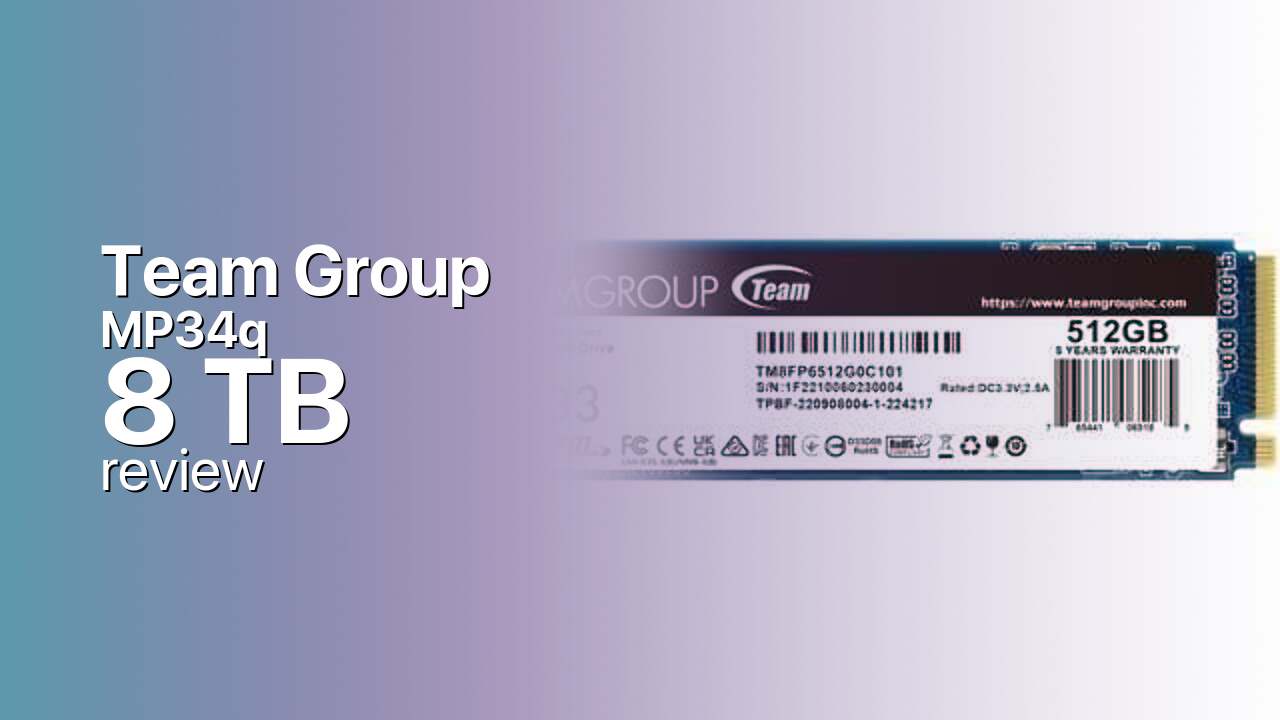
The Team Group MP34Q 8TB exists because QLC NAND makes capacities of this size possible in a single module, and TeamGroup leaned into that when it announced the line in July 2021 with the 8 TB model as the headline. The platform is the same as its smaller siblings: 96-layer QLC NAND behind Phison's E12S-class controller with a DRAM cache buffer — TechPowerUp's database notes some capacity revisions ship with a Realtek RTS5762 controller instead — on a PCIe 3.0 x4, NVMe 1.3 M.2 2280 module. Ratings are 3,400 MB/s sequential reads, 3,000 MB/s writes and 450K/400K random IOPS, which is the top of what Gen3 allows.
The endurance budget scales with the capacity: 1,800 TBW under a 5-year limited warranty, on top of 450 TBW at 2 TB and 900 TBW at 4 TB. That is a serious write allowance, and it supports the drive's real job — acting as the archive of a desktop: whole game libraries, video projects at rest, backup targets, home-server storage. TechPowerUp's review of the 2 TB sibling measured the platform's trade-off directly, with a pseudo-SLC cache that scales alongside capacity and post-cache writes settling around 250 MB/s, so the 8 TB model inherits that character at larger transfer sizes.
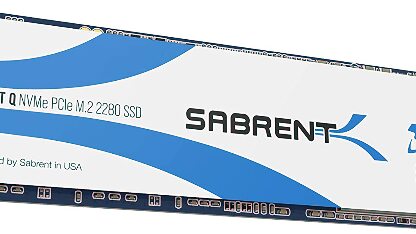
The competitive set is thin, which is the point. Sabrent's Rocket Q 8 TB uses the same Phison-plus-QLC recipe, and Samsung's 870 QVO 8 TB is the SATA-era QLC alternative; in-between, consumer NVMe options at 8 TB barely exist. Against those, the MP34Q 8 TB argues on endurance, warranty and the DRAM-backed platform rather than on peak speed — a bulk-storage argument that only matters if the capacity is genuinely needed.
Storage Comparisons:
MP34q Performance & Benchmarks
The rated numbers — 3,400 MB/s reads, 3,000 MB/s writes, 450K/400K random IOPS — top out the PCIe 3.0 interface, and TechPowerUp's review of the 2 TB MP34Q found the platform delivering on its burst claims before the QLC reality appears. The pseudo-SLC cache scales with capacity, so the 8 TB model can absorb longer continuous writes at full speed than its siblings; TechPowerUp measured roughly 467 GB of cache on the 2 TB drive, with writes collapsing to about 250 MB/s once it filled and recovering after idle. StorageReview's testing of the line recorded a 4K random peak near 331,000 IOPS and called the family a decent drive for its class.
Team Group MP34q 8 TB vs M.2 3.0 x 4 peers
Switch between sequential throughput and random IOPS to see how this drive stacks up against other M.2 3.0 x 4 SSDs in our database. The highlighted bar is the drive on this page — click any other bar to open that drive.
- ADATA SX 8800 Pro 512 GB: 3,500 MB/s read, 2,700 MB/s write
- ADATA SX 8800 Pro 1 TB: 3,500 MB/s read, 2,700 MB/s write
- ADATA XPG Spectrix S40G RGB 256 GB: 3,500 MB/s read, 3,000 MB/s write
- ADATA XPG Spectrix S40G RGB 512 GB: 3,500 MB/s read, 3,000 MB/s write
- Team Group MP34q 8 TB (this drive): 3,400 MB/s read, 3,000 MB/s write
What eight terabytes changes is the shape of the workloads. Copying a terabyte-scale library in one session runs inside the cache for much of its length; continuous writes beyond that land at QLC-class rates, so nightly multi-terabyte backup jobs will feel slow. For its intended archive duty the ceiling is irrelevant: reading a movie library, loading games or serving files on a home network never touches the sequential limit, and 450K/400K random IOPS keeps directory operations and library browsing instant. On a Gen3 system none of this bandwidth is wasted; on a Gen4 board the drive simply runs at Gen3 speed.
Team Group MP34q vs Competitors
See how the MP34q stacks up against other M.2 3.0 x 4 drives in our database:
Compare with rival drives:
Endurance, TBW & Warranty
TeamGroup rates the 8 TB MP34Q at 1,800 TBW under a 5-year limited warranty, whichever arrives first — the largest endurance budget in the line, following JEDEC write standards, and a figure that supports the drive's archive role with room to spare. At 50 GB of writes per day the budget would take nearly a century to exhaust; at 20 GB daily it outlasts any realistic ownership by centuries, so the 5-year term is the practical limit. Spec tables list MTBF of 1,800,000 hours, a population statistic across large fleets rather than a lifespan promise for an individual drive. The DRAM-backed controller and factory overprovisioning handle wear-leveling across the enormous NAND array, and claims run through TeamGroup's support channels with proof of purchase.
Team Group MP34q 8 TB Specifications
| Category | Value |
|---|---|
| Capacity [?] | 8 TB |
| Interface [?] | M.2 3.0 x 4 |
| Controller [?] | Phison PS5012-E12S 8 Channel |
| Memory type [?] | Intel 96-L QLC |
| DRAM [?] | Yes |
| Read speed (MB/s) [?] | 3400 |
| Write speed (MB/s) [?] | 3000 |
| Read IOPS [?] | 450000 |
| Write IOPS [?] | 400000 |
| Endurance (TBW) [?] | 1800 |
| MTBF (million hours) [?] | 1800000 |
| Warranty (years) [?] | 5 |
Verdict: Is the MP34q Worth It in 2026?
The Team Group MP34Q 8TB is for one buyer: someone who needs eight terabytes of NVMe storage in a single module on a Gen3 system — a home server, a desktop archive, a library drive — and values the 1,800 TBW rating and 5-year warranty behind it. Skip it for anything latency- or write-sensitive, where TLC drives and the 3,400 MB/s ceiling make a smaller, faster module the better tool, and weigh it against Sabrent's Rocket Q 8 TB, which plays the same Phison-QLC hand. Check current retail availability before planning around it — 8 TB consumer M.2 drives remain rare — and let the per-terabyte price make the final call.
+ Pros
- 8 TB on a single M.2 2280 module
- 1,800 TBW endurance rating
- 5-year limited warranty
- 3,400/3,000 MB/s rated speeds
- DRAM cache buffer backs the QLC array
- Cons
- QLC writes settle around 250 MB/s after cache
- PCIe 3.0 ceiling on newer platforms
- Hardware revisions vary (Phison E12S or Realtek RTS5762)
- Rare in consumer retail — verify availability
Buy this or similar SSD Storage:
Video Review
Teamgroup MP44 vs MP44S vs MP44L: Which PCIe 4.0 SSD Should You Buy?