Team Group MP34Q 4TB: Mid-Capacity QLC Archive for Gen3 PCs (2026)
Quick answer
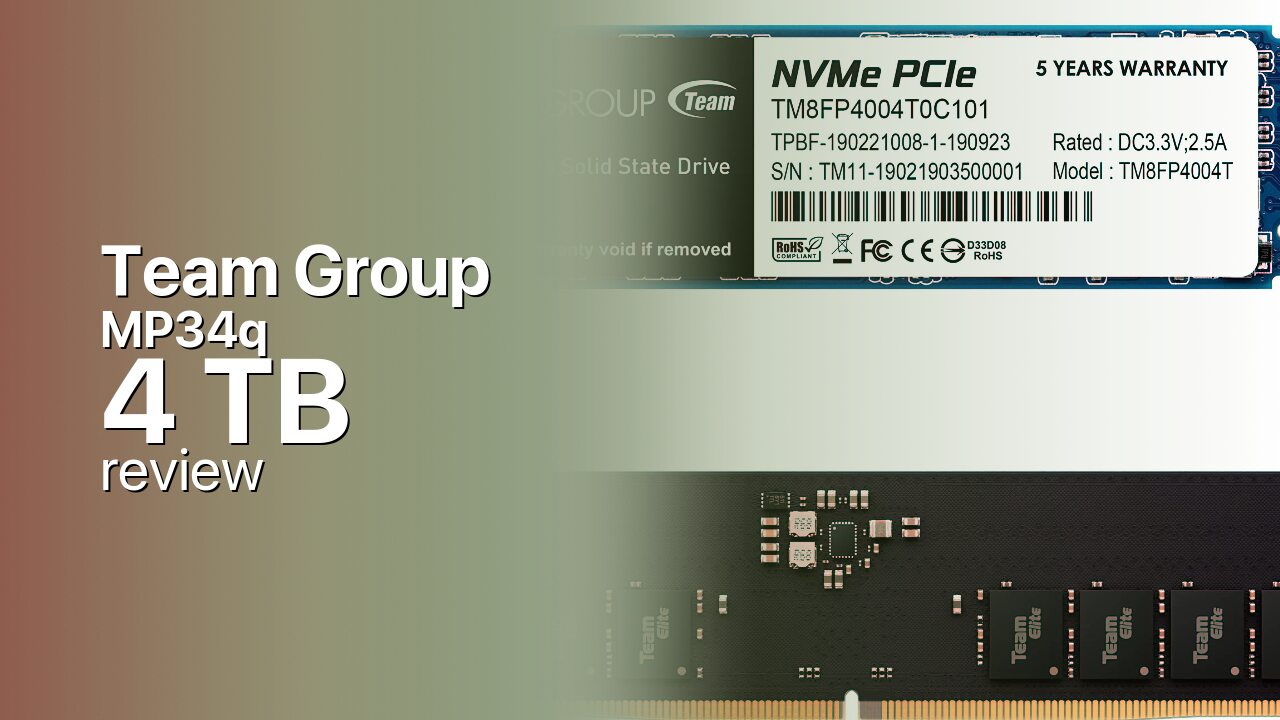
The Team Group MP34Q 4TB makes sense as bulk storage for a Gen3 desktop: four terabytes on one M.2 module, a 900 TBW rating, a 5-year warranty and a DRAM buffer that separates it from DRAM-less QLC rivals like the Crucial P3.
Read: 3400 MB/s Write: 3000 MB/s Endurance: 900 TBW Warranty: 5 years Interface: M.2 3.0 x 4
The Team Group MP34Q 4TB stores large media libraries on QLC NAND with a DRAM cache buffer, 900 TBW of endurance and Gen3 speeds rated at 3,400/3,000 MB/s.
Controller & Memory
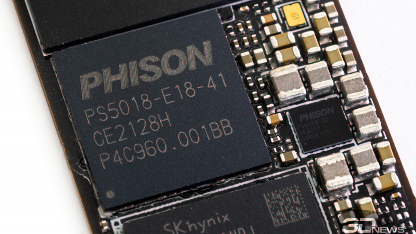
The Team Group MP34Q 4TB is the mid-step of TeamGroup's QLC bulk-storage line, announced in July 2021 alongside the headline-grabbing 8 TB variant. The platform pairs 96-layer QLC NAND with a DRAM cache buffer on Phison's E12S-class controller — though TechPowerUp's SSD database notes this capacity also exists in a Realtek RTS5762 hardware revision, so units may differ. Either way the interface is PCIe 3.0 x4 with NVMe 1.3 on a standard M.2 2280 module, rated at 3,400 MB/s sequential reads with writes up to 3,000 MB/s and random performance of 450K/400K IOPS.
Endurance doubles with the capacity: 900 TBW under a 5-year warranty, against 450 TBW at 2 TB and 1,800 TBW at 8 TB. The QLC design brings the same trade-off TechPowerUp measured on the 2 TB model — a pseudo-SLC cache that grows with capacity absorbs writes at full speed, then throughput settles around the 250 MB/s class once it fills and recovers with idle time. That behavior defines the audience: a 4 TB QLC drive suits media libraries, game collections and backup targets on a Gen3 desktop, and it makes little sense as an operating system or video-editing scratch drive.
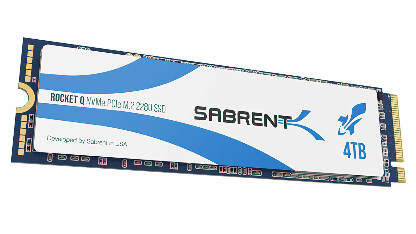
The bracket includes the Crucial P3 4 TB, a DRAM-less QLC drive with the same interface ceiling, and Sabrent's Rocket Q, which uses the same Phison-plus-QLC recipe at a higher positioning. The MP34Q's DRAM buffer and unusually large SLC cache give it a platform edge within that QLC field; against TLC drives of the same capacity it competes on capacity per module and warranty, not on sustained writes.
Storage Comparisons:
MP34q Performance & Benchmarks
Rated figures for the 4 TB MP34Q are 3,400 MB/s sequential reads and up to 3,000 MB/s writes — TechPowerUp's database entry for this capacity lists 2,900 MB/s on the Realtek-equipped revision, so expect the write rating to vary slightly by unit. Random ratings stand at 450K/400K IOPS. The performance character carries over from TechPowerUp's 2 TB review of the same platform: burst writes start near the rated ceiling inside a pseudo-SLC cache that scales with capacity, then drop to the QLC class's roughly 250 MB/s once the cache is exhausted, recovering after idle time. StorageReview's testing of the line measured a 4K random peak near 331,000 IOPS and called the family a decent drive for its class.
Team Group MP34q 4 TB vs M.2 3.0 x 4 peers
Switch between sequential throughput and random IOPS to see how this drive stacks up against other M.2 3.0 x 4 SSDs in our database. The highlighted bar is the drive on this page — click any other bar to open that drive.
- ADATA SX 8800 Pro 512 GB: 3,500 MB/s read, 2,700 MB/s write
- ADATA SX 8800 Pro 1 TB: 3,500 MB/s read, 2,700 MB/s write
- ADATA XPG Spectrix S40G RGB 256 GB: 3,500 MB/s read, 3,000 MB/s write
- ADATA XPG Spectrix S40G RGB 512 GB: 3,500 MB/s read, 3,000 MB/s write
- Team Group MP34q 4 TB (this drive): 3,400 MB/s read, 3,000 MB/s write
In practice, the 4 TB capacity changes the experience more than the silicon does. A larger cache absorbs longer copy sessions — multi-hundred-gigabyte game folders, camera-card dumps, backup jobs — before the slowdown appears, and for library duty the 3,400 MB/s read ceiling is indistinguishable from faster Gen4 drives in boot times, game loads and application launches. Sustained, continuous writes of a terabyte or more are where the drive shows its nature, folding to QLC-class rates; buyers with that workload should look at TLC storage instead. On a PCIe 3.0 board, none of the interface's limits are the MP34Q's fault — it runs at the top of what Gen3 allows.
Team Group MP34q vs Competitors
See how the MP34q stacks up against other M.2 3.0 x 4 drives in our database:
Compare with rival drives:
Endurance, TBW & Warranty
The 4 TB MP34Q carries a 900 TBW endurance rating under a 5-year limited warranty, whichever arrives first — double the 2 TB model's budget and half the 8 TB model's, with TeamGroup calculating the figures to JEDEC write standards. At 20 GB of writes per day the 900 TBW budget would take over 120 years to exhaust; even a heavy 50 GB daily workload stretches past 49 years, so the warranty term is the practical limit, not the NAND wear. Spec tables list MTBF of 1,800,000 hours — a fleet-level population statistic, not a promise for any individual drive. The DRAM-backed controller and factory overprovisioning support consistent wear-leveling across the larger NAND array, and claims run through TeamGroup's support channels with proof of purchase.
Team Group MP34q 4 TB Specifications
| Category | Value |
|---|---|
| Capacity [?] | 4 TB |
| Interface [?] | M.2 3.0 x 4 |
| Controller [?] | Phison PS5012-E12S 8 Channel |
| Memory type [?] | Intel 96-L QLC |
| DRAM [?] | Yes |
| Read speed (MB/s) [?] | 3400 |
| Write speed (MB/s) [?] | 3000 |
| Read IOPS [?] | 450000 |
| Write IOPS [?] | 400000 |
| Endurance (TBW) [?] | 900 |
| MTBF (million hours) [?] | 1800000 |
| Warranty (years) [?] | 5 |
Verdict: Is the MP34q Worth It in 2026?
The Team Group MP34Q 4TB makes sense as bulk storage for a Gen3 desktop: four terabytes on one M.2 module, a 900 TBW rating, a 5-year warranty and a DRAM buffer that separates it from DRAM-less QLC rivals like the Crucial P3. Skip it for operating system duty or sustained write workloads such as video scratch disks, where the ~250 MB/s post-cache behavior and the Sabrent Rocket Q's TLC alternatives serve better. Within the QLC class the platform is sound and the endurance generous; the buying decision comes down to current price against the 2 TB and 8 TB siblings, since the per-terabyte math decides this drive's value. For pure capacity per module on a Gen3 board, few 4 TB options match this documentation and endurance.
+ Pros
- 900 TBW endurance rating with 5-year warranty
- 3,400 MB/s rated reads on PCIe 3.0
- DRAM cache buffer backs the QLC array
- SLC cache scales with capacity
- Four terabytes on a single M.2 2280 module
- Cons
- QLC writes settle around 250 MB/s after cache
- Write rating varies by hardware revision (2,900-3,000 MB/s)
- PCIe 3.0 ceiling for newer platforms
- Poor fit for OS or sustained scratch-disk duty
Buy this or similar SSD Storage:
Video Review
Teamgroup MP44 vs MP44S vs MP44L: Which PCIe 4.0 SSD Should You Buy?