Team Group MP34Q 2TB: QLC Bulk Storage With a DRAM Cache (2026)
Quick answer
The Team Group MP34Q 2TB fits buyers filling a Gen3 desktop with bulk storage: a large game or media library, a backup target, or a secondary drive where capacity per module matters more than peak speed, backed by 450 TBW of endurance and a 5-year warranty.
Read: 3400 MB/s Write: 3000 MB/s Endurance: 450 TBW Warranty: 5 years Interface: M.2 3.0 x 4
The Team Group MP34Q 2TB is a DRAM-backed QLC bulk drive — 3,400/3,000 MB/s bursts, a 450 TBW rating and the option to scale to 8 TB.
Controller & Memory
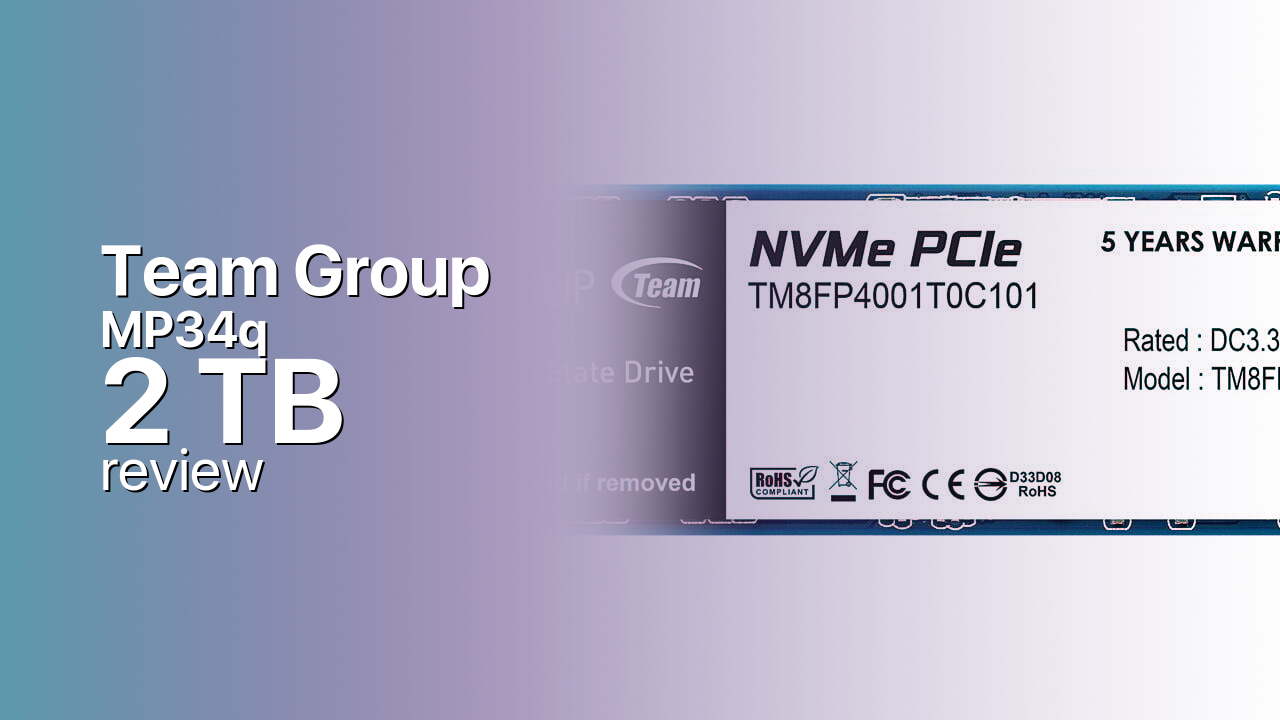
The Team Group MP34Q 2TB is TeamGroup's take on high-capacity QLC storage for PCIe 3.0 systems: a Phison PS5012-E12S-32 controller driving Intel/Micron 96-layer QLC NAND, with a 512 MB DDR3L DRAM cache buffer backing the SLC cache. TechPowerUp, which opened the drive up, called that DRAM allotment rather small for 2 TB but confirmed the platform is genuine Gen3 hardware — M.2 2280, NVMe 1.3 — rated at 3,400 MB/s reads, 3,000 MB/s writes and 450K/400K random IOPS.
The MP34Q line was announced in July 2021 with its 8 TB top capacity as the headline, and the 2 TB model is its entry point: 450 TBW of endurance under a 5-year warranty, with the 4 TB and 8 TB variants scaling to 900 and 1,800 TBW. QLC's four-bits-per-cell design is what makes these capacities possible, and it also gives the drive an unusually large pseudo-SLC cache — TechPowerUp measured roughly 467 GB on the 2 TB model before writes folded. That shapes the buyer: this is a drive for game libraries, media archives and secondary storage on a Gen3 desktop, not for operating systems or constant heavy writes.
Rivals in the QLC Gen3 bracket include the Crucial P3, which runs the same kind of NAND without a DRAM buffer, and the Intel 670p, which shares the 96-layer QLC heritage. TechPowerUp's verdict on the MP34Q 2 TB was good performance with price-versus-performance suffering at its 2021 launch price, so its standing today depends on the current tag; the TLC-based WD Blue SN570 remains the alternative for buyers who would rather avoid QLC's post-cache behavior entirely.
Storage Comparisons:
MP34q Performance & Benchmarks
TeamGroup rates the 2 TB MP34Q at 3,400 MB/s sequential reads, 3,000 MB/s writes and 450K/400K random IOPS — solid claims for a Gen3 drive, and TechPowerUp's review found the burst performance behind them, with writes starting near 3 GB/s. The SLC cache is the story: roughly 467 GB of the drive can absorb writes at full speed before the QLC NAND shows its true colors, at which point throughput collapses to around 250 MB/s. A full-drive fill averages about 260 MB/s, in line with other QLC drives and well below TLC competitors. The cache recovers with idle time, so the drive returns to full speed after a pause.
Team Group MP34q 2 TB vs M.2 3.0 x 4 peers
Switch between sequential throughput and random IOPS to see how this drive stacks up against other M.2 3.0 x 4 SSDs in our database. The highlighted bar is the drive on this page — click any other bar to open that drive.
- ADATA SX 8800 Pro 512 GB: 3,500 MB/s read, 2,700 MB/s write
- ADATA SX 8800 Pro 1 TB: 3,500 MB/s read, 2,700 MB/s write
- ADATA XPG Spectrix S40G RGB 256 GB: 3,500 MB/s read, 3,000 MB/s write
- ADATA XPG Spectrix S40G RGB 512 GB: 3,500 MB/s read, 3,000 MB/s write
- Team Group MP34q 2 TB (this drive): 3,400 MB/s read, 3,000 MB/s write
Translated to real workloads: copying a 200-400 GB game folder or batch of video files runs mostly inside the cache and finishes fast; writing hundreds of gigabytes back-to-back lands in the 250 MB/s zone, slower than a mechanical-adjacent experience for that stretch. StorageReview measured a 4K random peak near 331,000 IOPS, respectable for the class, and everyday responsiveness — boots, app launches, library browsing — sits close to any Gen3 NVMe. Gaming loads see no meaningful penalty versus faster drives; the ceiling only matters for sustained transfers, which is exactly the trade-off QLC bulk storage is priced around.
Team Group MP34q vs Competitors
See how the MP34q stacks up against other M.2 3.0 x 4 drives in our database:
Compare with rival drives:
Endurance, TBW & Warranty
The 2 TB MP34Q is rated at 450 TBW under a 5-year limited warranty, whichever limit arrives first — a workable endurance budget for QLC at this capacity, and one that scales with the line: 900 TBW at 4 TB and 1,800 TBW at 8 TB. At a typical 20 GB of writes per day, the 450 TBW budget would last over 60 years, so the warranty term is the practical limit; even a heavy 50 GB-per-day workload stretches past two decades. TeamGroup's spec tables list MTBF of 1,800,000 hours — a population statistic across large fleets, not a lifespan promise for an individual unit. The DRAM-backed platform and factory overprovisioning give the controller headroom for wear-leveling, and claims run through TeamGroup's support channels with proof of purchase.
Team Group MP34q 2 TB Specifications
| Category | Value |
|---|---|
| Capacity [?] | 2 TB |
| Interface [?] | M.2 3.0 x 4 |
| Controller [?] | Phison PS5012-E12S 8 Channel |
| Memory type [?] | Intel 96-L QLC |
| DRAM [?] | Yes |
| Read speed (MB/s) [?] | 3400 |
| Write speed (MB/s) [?] | 3000 |
| Read IOPS [?] | 450000 |
| Write IOPS [?] | 400000 |
| Endurance (TBW) [?] | 450 |
| MTBF (million hours) [?] | 1800000 |
| Warranty (years) [?] | 5 |
Verdict: Is the MP34q Worth It in 2026?
The Team Group MP34Q 2TB fits buyers filling a Gen3 desktop with bulk storage: a large game or media library, a backup target, or a secondary drive where capacity per module matters more than peak speed, backed by 450 TBW of endurance and a 5-year warranty. Skip it as an operating system drive or a video-editing scratch disk — QLC writes settling around 250 MB/s and the 3,400 MB/s Gen3 ceiling make the TLC-based WD Blue SN570 or TeamGroup's own T-Create line better there. Compared against the DRAM-less Crucial P3, this drive's DRAM buffer and huge SLC cache are real advantages, provided the current price cooperates. If the price sits near TLC competitors, the QLC trade stops making sense.
+ Pros
- 3,400/3,000 MB/s rated on PCIe 3.0
- 450 TBW endurance with 5-year warranty
- DRAM cache buffer (512 MB DDR3L)
- Huge ~467 GB pseudo-SLC cache
- Scales to 4 TB and 8 TB variants
- Cons
- QLC writes collapse to ~250 MB/s after cache
- PCIe 3.0 caps reads at 3,400 MB/s
- 512 MB DRAM is small for 2 TB
- Unfit for constant multi-hundred-GB write sessions
Buy this or similar SSD Storage:
Video Review
Teamgroup MP44 vs MP44S vs MP44L: Which PCIe 4.0 SSD Should You Buy?