Mushkin Delta 2TB Review — High-Capacity Budget PCIe 4.0 QLC SSD (2026)
Quick answer
The Mushkin Delta 2TB offers generous storage capacity at a budget price, but the combination of a first-gen PCIe 4.0 controller and QLC NAND limits its appeal.
Read: 4975 MB/s Write: 3975 MB/s Endurance: 800 TBW Warranty: 5 years Interface: M.2 4.0 x 4
The Mushkin Delta 2TB is the mid-range capacity of Mushkin's QLC-based PCIe 4.0 SSD line, offering generous storage at a budget price point but with the inherent performance trade-offs of quad-level cell NAND.
Controller & Memory
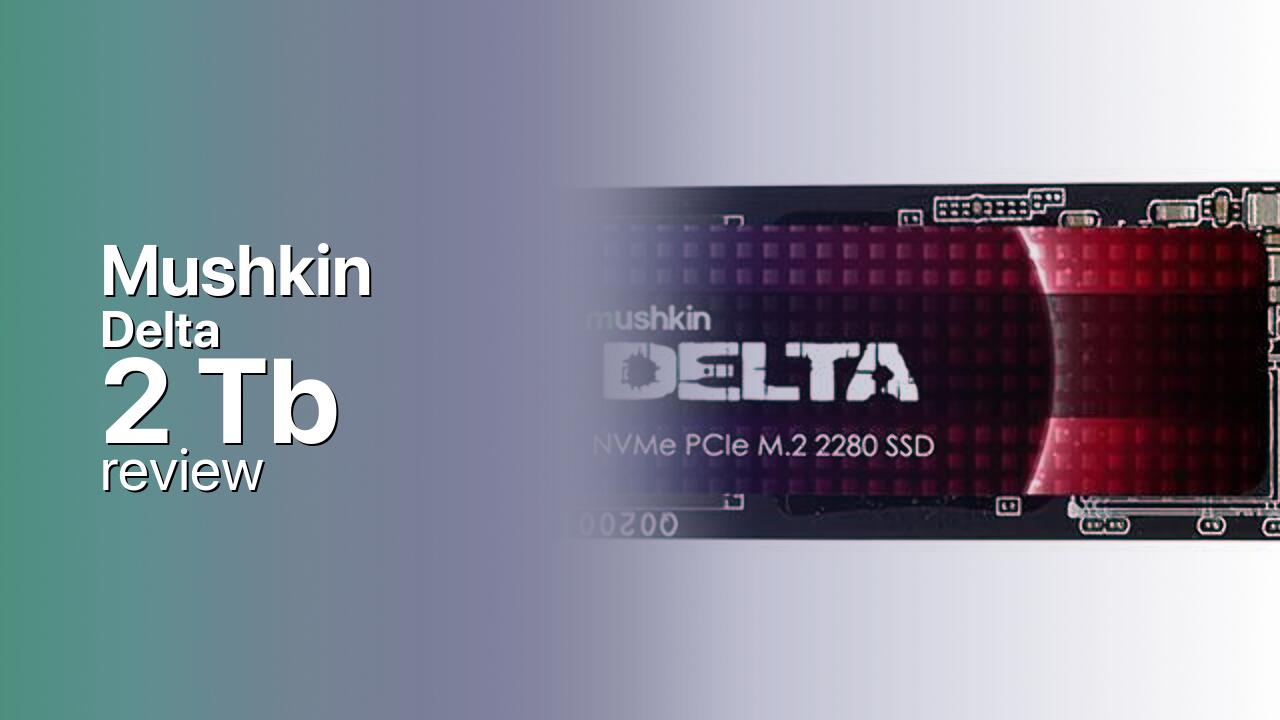
The Mushkin Delta 2TB pairs a Phison PS5016-E16 controller with 3D QLC NAND flash in the standard M.2 2280 form factor. The Phison E16 was the first consumer PCIe 4.0 controller, launched in 2019, and while it was groundbreaking at the time, it's since been superseded by the E18 and E21T designs that deliver significantly higher speeds.
QLC NAND stores four bits per cell versus three in TLC. This enables higher capacities at lower cost, which is why the Delta line extends all the way to 4 TB. The trade-offs are lower endurance, smaller SLC cache buffers, and dramatically slower sustained write speeds once the cache exhausts. For read-heavy tasks like booting, loading applications, and gaming, QLC performs just as well as TLC. Write-heavy workflows expose the architecture's limitations.
The Delta 2TB is rated at up to 4,975 MB/s sequential reads and 3,975 MB/s writes. The 2TB capacity benefits from having more NAND dies operating in parallel than the 1TB model, though the DB lists identical speed figures across all Delta capacities. The 2TB's endurance is listed at 800 TBW — the same as the 1TB model in the source data, which is unusual since larger capacities typically have proportionally higher endurance ratings.
Mushkin's Enhanced Data Protection Suite (MEDS) includes LDPC error correction, SLC caching, thermal monitoring, and AES 128/256-bit hardware encryption.
In the budget PCIe 4.0 segment, the Delta 2TB competes against the Sabrent Rocket 4.0 2TB, the Gigabyte AORUS Gen4 2TB, and the Corsair MP600 2TB — all of which use TLC NAND and deliver better sustained performance.
Storage Comparisons:
Delta Performance & Benchmarks
The Mushkin Delta 2TB is rated at up to 4,975 MB/s sequential reads and 3,975 MB/s sequential writes, with 700,000 IOPS random reads and 650,000 IOPS random writes. These numbers reflect the Phison E16 controller's capabilities on paper, but the QLC NAND tells a different story in practice.
Mushkin Delta 2 TB vs M.2 4.0 x 4 peers
Switch between sequential throughput and random IOPS to see how this drive stacks up against other M.2 4.0 x 4 SSDs in our database. The highlighted bar is the drive on this page — click any other bar to open that drive.
- Patriot Viper PV593 1 TB: 14,500 MB/s read, 14,000 MB/s write
- Patriot Viper PV593 2 TB: 14,500 MB/s read, 14,000 MB/s write
- Patriot Viper PV593 4 TB: 14,500 MB/s read, 14,000 MB/s write
- Patriot Viper PV573 2 TB: 14,000 MB/s read, 12,000 MB/s write
- Mushkin Delta 2 TB (this drive): 4,975 MB/s read, 3,975 MB/s write
The 4,975 MB/s read speed approaches the practical limit of the E16 controller and is adequate for any consumer workload. Game loading, application launches, and file access feel responsive. The 3,975 MB/s write speed is the burst figure achieved while the SLC cache is active — and on a QLC drive, the cache is notably smaller than on TLC equivalents.
Once the SLC cache exhausts during sustained writes, QLC direct-write speeds typically fall to 80–150 MB/s on Phison E16 platforms. This is roughly one-twentieth of the burst write speed and slower than a mechanical hard drive. Transferring a 100 GB file will start fast and then grind to a halt once the cache fills. For users who regularly move large files, edit video, or run database workloads, this bottleneck is a genuine concern.
The 2TB capacity does offer a larger absolute SLC cache than the 1TB model (since the cache scales with total capacity), meaning it takes longer to fill. But the fundamental QLC limitation remains: sustained writes collapse after the buffer depletes.
Tom's Hardware's review of the Delta series rated it 2.5 out of 5, calling it "Mediocrity Defined." The E16 controller's first-gen PCIe 4.0 design, combined with QLC NAND's inherent write-speed limitations, produces a drive that offers the connectivity of PCIe 4.0 without the performance that interface enables.
Mushkin Delta vs Competitors
See how the Delta stacks up against other M.2 4.0 x 4 drives in our database:
Compare with rival drives:
Endurance, TBW & Warranty
Mushkin covers the Delta 2TB with a 5-year limited warranty. The endurance rating is listed at 800 TBW in the source data — the same figure as the 1TB model, which is atypical since larger-capacity drives usually have proportionally higher TBW ratings. At 800 TBW, you could write roughly 438 GB per day across the five-year warranty period. For a typical desktop workload of 20–50 GB per day, the drive would last 44 to 110 years. QLC NAND's endurance characteristics mean that heavy write users should monitor SMART health data periodically. The 5-year warranty is generous for a QLC drive — many QLC SSDs carry only 3-year coverage. Mushkin handles warranty claims directly as a retail brand.
Mushkin Delta 2 TB Specifications
| Category | Value |
|---|---|
| Capacity [?] | 2 TB |
| Interface [?] | M.2 4.0 x 4 |
| Controller [?] | Phison E16 |
| Memory type [?] | 3D QLC |
| DRAM [?] | 2GB DDR4 |
| Read speed (MB/s) [?] | 4975 |
| Write speed (MB/s) [?] | 3975 |
| Read IOPS [?] | 700000 |
| Write IOPS [?] | 650000 |
| Endurance (TBW) [?] | 800 |
| MTBF (million hours) [?] | 1.8 |
| Warranty (years) [?] | 5 |
Verdict: Is the Delta Worth It in 2026?
The Mushkin Delta 2TB offers generous storage capacity at a budget price, but the combination of a first-gen PCIe 4.0 controller and QLC NAND limits its appeal. The 2TB capacity is useful for game libraries and media archives, and the 5-year warranty provides peace of mind. However, the QLC architecture's slow sustained writes make this a poor choice for write-heavy workflows. For users who primarily read data — gaming, media consumption, general desktop use — the Delta 2TB is adequate. But TLC-based drives like the WD Blue SN580 2TB or Mushkin's own Gamma 2TB deliver significantly better performance at a reasonable price premium.
+ Pros
- 2TB capacity for large game and media libraries
- 5-year limited warranty
- AES 256-bit hardware encryption
- Competitive pricing per gigabyte thanks to QLC NAND
- Cons
- QLC NAND — very slow sustained writes after SLC cache fills
- Phison E16 is a superseded first-gen PCIe 4.0 controller
- Outperformed by TLC-based PCIe 3.0 drives in real-world use
- 800 TBW seems low for a 2TB drive
Buy this or similar SSD Storage:



Video Review
2TB Mushkin GAMMA SSD Quick Look -- Samsung 980 Pro Performance?