Intel SSD 760P 256GB NVMe SSD Review (2026)
Quick answer
The Intel 760P 256 GB is a competent mainstream NVMe SSD that handles boot-drive duties without compromise.
Read: 3210 MB/s Write: 1315 MB/s Endurance: 144 TBW Warranty: 5 years Interface: M.2 3.0 x 4
The Intel 760P 256GB sits in the middle of Intel's mainstream NVMe range, offering a meaningful step up from the 128 GB model in both speed and endurance while keeping the price approachable.
Controller & Memory
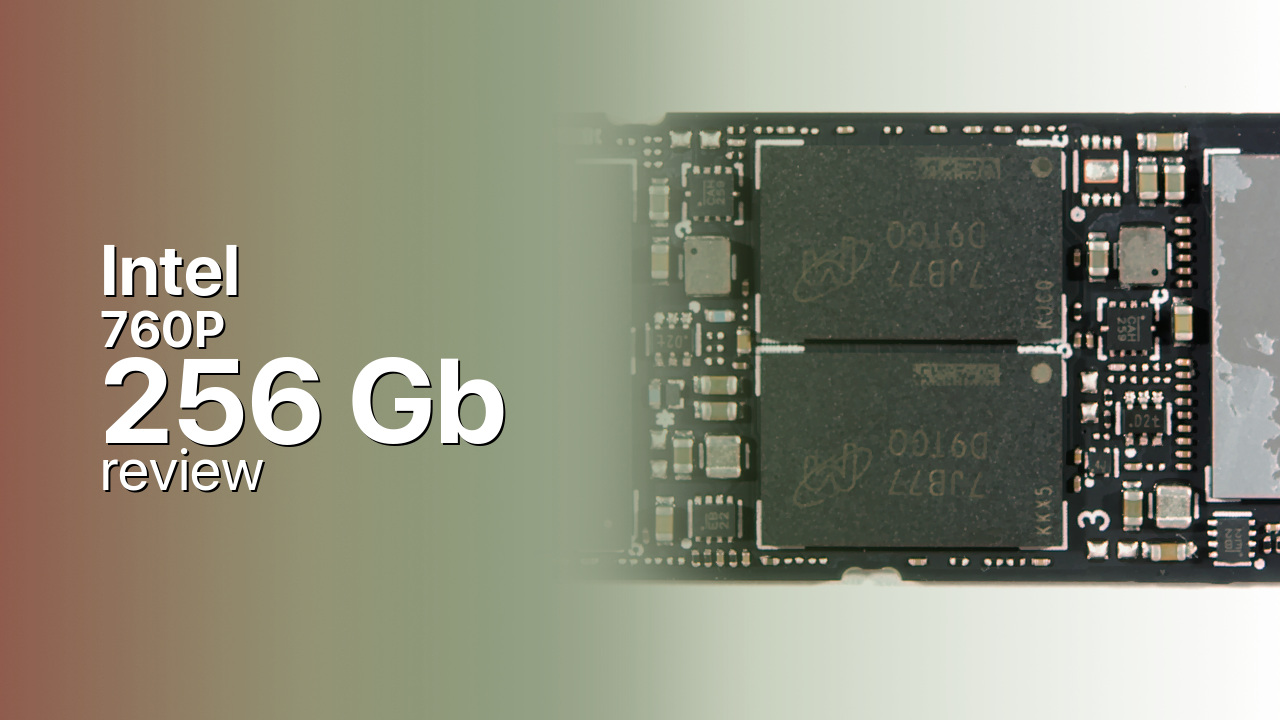
The 760P 256 GB uses the same Intel-customized Silicon Motion SM2262 eight-channel controller and Intel 64-layer 256 Gb 3D TLC NAND found across the entire series. A Micron DDR3 DRAM chip holds the flash translation layer. The drive is single-sided M.2 2280, making it compatible with thin laptops and small-form-factor desktops.
Sequential reads hit 3,210 MB/s and writes reach 1,315 MB/s -- a substantial jump over the 128 GB variant (1,640 / 650 MB/s) but still short of the 512 GB model's 1,625 MB/s write ceiling. Endurance doubles to 144 TBW, following the series' formula of 72 TBW per 128 GB of raw capacity. Random performance comes in at 205,000 read IOPS and 265,000 write IOPS.
The 760P competes with mainstream PCIe 3.0 drives like the Crucial MX500 (SATA), the WD Blue SN570, and Kingston's A2000. The 256 GB capacity is best suited as a boot-and-apps drive for a desktop that will have a separate HDD or larger SSD for bulk storage.
Storage Comparisons:
760P Performance & Benchmarks
Rated at 3,210 MB/s sequential reads and 1,315 MB/s sequential writes, the 256 GB 760P nearly saturates the PCIe 3.0 x4 read bus but trails the 512 GB and larger models on writes. The gap is due to fewer NAND dies: with less parallelism available, the controller cannot write as many channels simultaneously.
Intel 760P 256 GB vs M.2 3.0 x 4 peers
Switch between sequential throughput and random IOPS to see how this drive stacks up against other M.2 3.0 x 4 SSDs in our database. The highlighted bar is the drive on this page — click any other bar to open that drive.
- ADATA SX 8800 Pro 512 GB: 3,500 MB/s read, 2,700 MB/s write
- ADATA SX 8800 Pro 1 TB: 3,500 MB/s read, 2,700 MB/s write
- ADATA XPG Spectrix S40G RGB 256 GB: 3,500 MB/s read, 3,000 MB/s write
- ADATA XPG Spectrix S40G RGB 512 GB: 3,500 MB/s read, 3,000 MB/s write
- Intel 760P 256 GB (this drive): 3,210 MB/s read, 1,315 MB/s write
Random read performance reaches 205,000 IOPS and random writes hit 265,000 IOPS. In everyday desktop use -- booting, app launches, browser caches -- the 256 GB model feels essentially as fast as the 512 GB. The difference becomes apparent during sustained writes of files larger than the SLC cache, which is smaller here than on higher-capacity models.
Independent reviewers found the 760P 256 GB delivers consistent real-world performance that beats SATA SSDs handily, though it cannot match drives like the Samsung 970 EVO Plus in sustained write workloads or heavy random I/O scenarios.
Intel 760P vs Competitors
See how the 760P stacks up against other M.2 3.0 x 4 drives in our database:
Compare with rival drives:
Endurance, TBW & Warranty
Intel rates the 760P 256 GB at 144 TBW over its 5-year warranty, which translates to roughly 80 GB of writes per day. For a typical OS-and-applications drive seeing 15 to 30 GB of daily writes, the endurance ceiling will never be approached. The 1.5 million hour MTBF figure is a population-level reliability estimate, not an individual drive lifetime guarantee. Warranty service is through Intel's standard RMA process, limited by either the 5-year term or the TBW threshold, whichever is reached first.
Intel 760P 256 GB Specifications
| Category | Value |
|---|---|
| Capacity [?] | 256 GB |
| Interface [?] | M.2 3.0 x 4 |
| Controller [?] | Silicon Motion SM2262 |
| Memory type [?] | Intel TLC |
| DRAM [?] | Micron 256 - 1TB DDR3 |
| Read speed (MB/s) [?] | 3210 |
| Write speed (MB/s) [?] | 1315 |
| Read IOPS [?] | 205000 |
| Write IOPS [?] | 265000 |
| Endurance (TBW) [?] | 144 |
| MTBF (million hours) [?] | 1.5 |
| Warranty (years) [?] | 5 |
Verdict: Is the 760P Worth It in 2026?
The Intel 760P 256 GB is a competent mainstream NVMe SSD that handles boot-drive duties without compromise. Builders who regularly transfer large files or need more headroom should consider the 512 GB or 1 TB model instead, both of which offer higher write speeds and substantially more endurance. Against direct competitors like the Kingston A2000 250 GB or Crucial P2 250 GB, the 760P holds its own on random I/O and benefits from Intel's DRAM cache, though it is an older PCIe 3.0 design at this point.
+ Pros
- 3,210 MB/s sequential reads
- 144 TBW endurance (twice the 128 GB model)
- DRAM cache via Micron DDR3
- Single-sided M.2 2280 fits thin laptops
- Low 25 mW idle power
- 5-year Intel warranty
- Cons
- 1,315 MB/s writes, below the 512 GB model
- Older PCIe 3.0 design, surpassed by newer drives
- No included heatsink
- Only 205,000 random read IOPS
Buy this or similar SSD Storage:
Video Review
Intel 760p NVMe M.2 SSD - Performance on a Budget - Review