Orico O7000 512GB Review — the Thin Budget Gen4 Contender (2026)
Quick answer
Buy the Orico O7000 512GB as a boot drive for a budget build or a laptop in need of a thin, fast upgrade — 7,000 MB/s reads, 6,600 MB/s writes, and a 5-year warranty are a genuine statement at this price, and the 2 mm PCB fits machines other drives cannot.
Read: 7000 MB/s Write: 6600 MB/s Endurance: 300 TBW Warranty: 5 years Interface: M.2 4.0 x 4
The Orico O7000 512GB brings 7,000 MB/s reads in a 2 mm-thin, 6-gram PCB, pairing budget pricing with 300 TBW of endurance and a 5-year warranty.
Controller & Memory
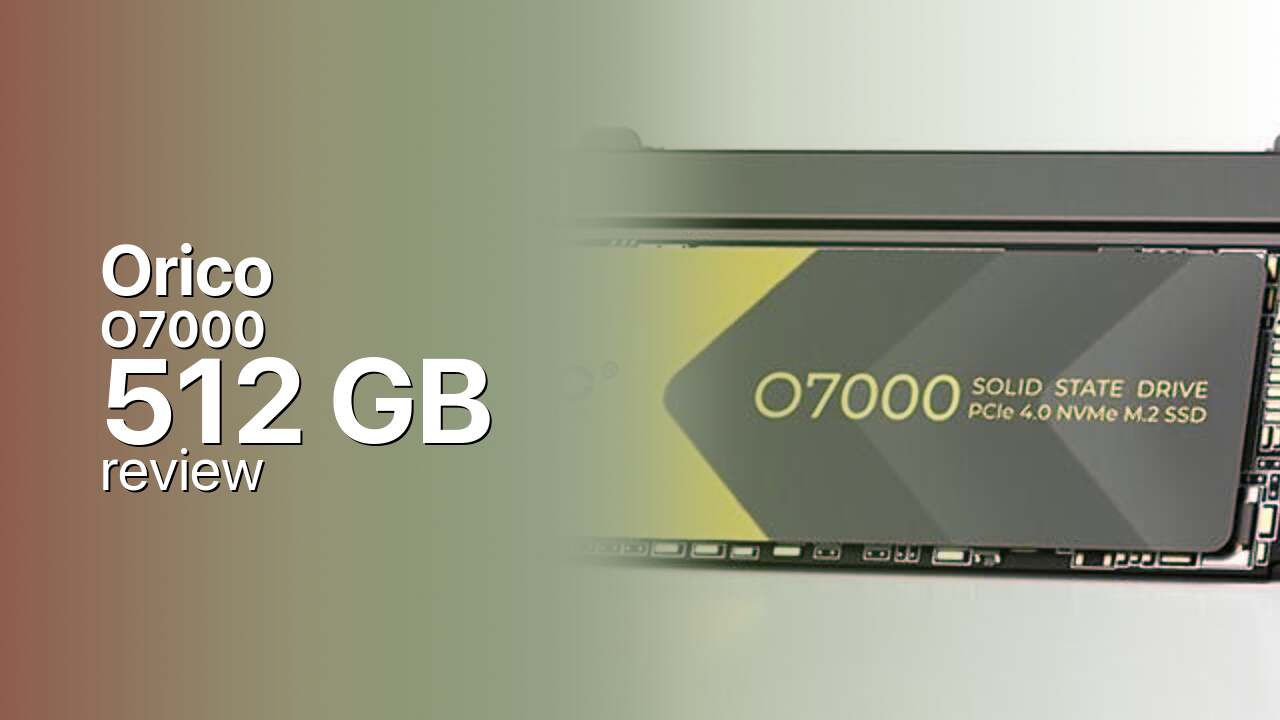
The Orico O7000 512GB is the entry point of a line that has made surprising review-wave noise for a budget brand: 7,000 MB/s reads and 6,600 MB/s writes over PCIe 4.0 x4, on a DRAM-less Maxio-class controller with YMTC TLC behind it and Host Memory Buffer handling the mapping tables. Physically it is one of the thinnest sticks in its class — 2 mm thick and 5 to 6 grams per Orico's own specifications — which makes it an easy fit for laptops where clearance is tight. TechRadar's review of the line called it a great drive for anyone operating on a budget, and the ratings genuinely compete with drives from household names.
As the range's smallest capacity, the 512 GB model carries the entry-tier endurance of 300 TBW, half the 1 TB model's 600 TBW and a quarter of the 2 TB flagship's 1,200 TBW, all under the same 5-year warranty and 1.5 million-hour MTBF rating. Orico publishes a single speed rating across the range rather than per-capacity derates, so the spec sheet reads identically from 512 GB upward — in practice, smaller capacities have less NAND to parallelize, which is the usual caveat at this size. The Kingston NV3 and Silicon Power UD90 are the natural bracket rivals; the platform-cousin Lexar NM790 sits a tier above with 7,400 MB/s ratings.
The audience is the budget boot drive buyer: an older system escaping SATA, a first gaming PC where every dollar counts, or a laptop upgrade where the thin PCB solves a clearance problem. At 512 GB it is not a library drive and not a PS5 pick on capacity grounds — it is a fast, warrantied boot stick that happens to read at 7,000 MB/s.
Storage Comparisons:
O7000 Performance & Benchmarks
Orico rates the O7000 512GB at 7,000 MB/s sequential reads and 6,600 MB/s writes over PCIe 4.0 x4, and notably publishes no random IOPS figures — the spec sheet keeps to sequential numbers. Those ratings put the drive in conversations its price has no business being in: reads within 400 MB/s of the fastest Gen4 drives ever made, and writes above what most budget sticks claim. Chinese press benchmarking of the line has measured sequential performance right around the rated figures, and TechRadar's verdict for the capacity class was that the performance-to-price balance simply works.
Orico O7000 512 GB vs M.2 4.0 x 4 peers
Switch between sequential throughput and random IOPS to see how this drive stacks up against other M.2 4.0 x 4 SSDs in our database. The highlighted bar is the drive on this page — click any other bar to open that drive.
- Patriot Viper PV593 1 TB: 14,500 MB/s read, 14,000 MB/s write
- Patriot Viper PV593 2 TB: 14,500 MB/s read, 14,000 MB/s write
- Patriot Viper PV593 4 TB: 14,500 MB/s read, 14,000 MB/s write
- Patriot Viper PV573 2 TB: 14,000 MB/s read, 12,000 MB/s write
- Orico O7000 512 GB (this drive): 7,000 MB/s read, 6,600 MB/s write
The DRAM-less design defines the fine print. A pseudo-SLC cache absorbs bursts — installs, updates, everyday file churn — and once a transfer large enough to exhaust it arrives, throughput settles to native TLC rates. At 512 GB that cache is the smallest in the line, so sustained multi-hundred-gigabyte moves will hit the drop-off sooner than on the bigger models; for a boot drive's typical workload, it rarely matters. The 2 mm PCB keeps heat manageable in laptops, though a motherboard heatsink remains worthwhile for desktop duty. Within its mission — fast, small, cheap — reviewers found the O7000 delivering exactly what it promises.
Orico O7000 vs Competitors
See how the O7000 stacks up against other M.2 4.0 x 4 drives in our database:
Compare with rival drives:
Endurance, TBW & Warranty
Orico rates the O7000 512GB at 300 TBW under a 5-year limited warranty, whichever arrives first. That is the range's smallest endurance budget — the line scales at 600 TBW per terabyte, reaching 600 TBW at 1 TB and 1,200 TBW at 2 TB — but the absolute math stays comfortable: more than four decades of use at a modest 20 GB written per day, far beyond any boot drive's real habits. The rated MTBF is 1.5 million hours, a fleet-level statistic rather than a promise about any individual stick. The 5-year coverage matches or beats the warranty terms on better-known budget drives; Orico's support network is simply younger, so the retailer's return policy remains the practical first line of defense.
Orico O7000 512 GB Specifications
| Category | Value |
|---|---|
| Capacity [?] | 512 GB |
| Interface [?] | M.2 4.0 x 4 |
| Controller [?] | Maxio MAP1602A |
| Memory type [?] | YMTC 232-L TLC |
| DRAM [?] | No |
| Read speed (MB/s) [?] | 7000 |
| Write speed (MB/s) [?] | 6600 |
| Read IOPS [?] | |
| Write IOPS [?] | |
| Endurance (TBW) [?] | 300 |
| MTBF (million hours) [?] | 1500000 |
| Warranty (years) [?] | 5 |
Verdict: Is the O7000 Worth It in 2026?
Buy the Orico O7000 512GB as a boot drive for a budget build or a laptop in need of a thin, fast upgrade — 7,000 MB/s reads, 6,600 MB/s writes, and a 5-year warranty are a genuine statement at this price, and the 2 mm PCB fits machines other drives cannot. Skip it as a game library (512 GB fills in a handful of installs) or as a PS5 upgrade (capacity, not speed, is the disqualifier here). The Kingston NV3 trades blows in the same bracket, the Silicon Power UD90 plays the same discount game, and stepping up to the 1 TB O7000 doubles everything that matters. As cheap, thin, warrantied Gen4 boot storage, it lands the essentials.
+ Pros
- 7,000 MB/s reads and 6,600 MB/s writes
- 300 TBW endurance with 5-year warranty
- Thin 2 mm, 6 g PCB suits tight laptops
- Rated speeds within reach of flagship Gen4
- MTBF rated at 1.5 million hours
- Cons
- No DRAM cache on the PCB
- Smallest pSLC cache in the O7000 range
- Random IOPS ratings unpublished by Orico
- Younger brand with a smaller support network
Buy this or similar SSD Storage:



Video Review
ORICO o7000 vs WD Black SN850x - Should you spend more on an SSD?