Sabrent Rocket Q 2TB Review — Affordable QLC NVMe SSD (2026)
Quick answer
Buy the Sabrent Rocket Q 2 TB if you need a cost-effective, high-capacity NVMe drive for a game library, media archive, or general-purpose desktop storage where read performance matters more than sustained write throughput.
Read: 3400 MB/s Write: 3000 MB/s Endurance: 530 TBW Warranty: 5 years Interface: M.2 3.0 x 4
The Sabrent Rocket Q 2 TB was one of the first QLC NVMe drives to prove that four-bit-per-cell NAND could deliver both high capacity and respectable everyday performance without the SATA tax.
Controller & Memory
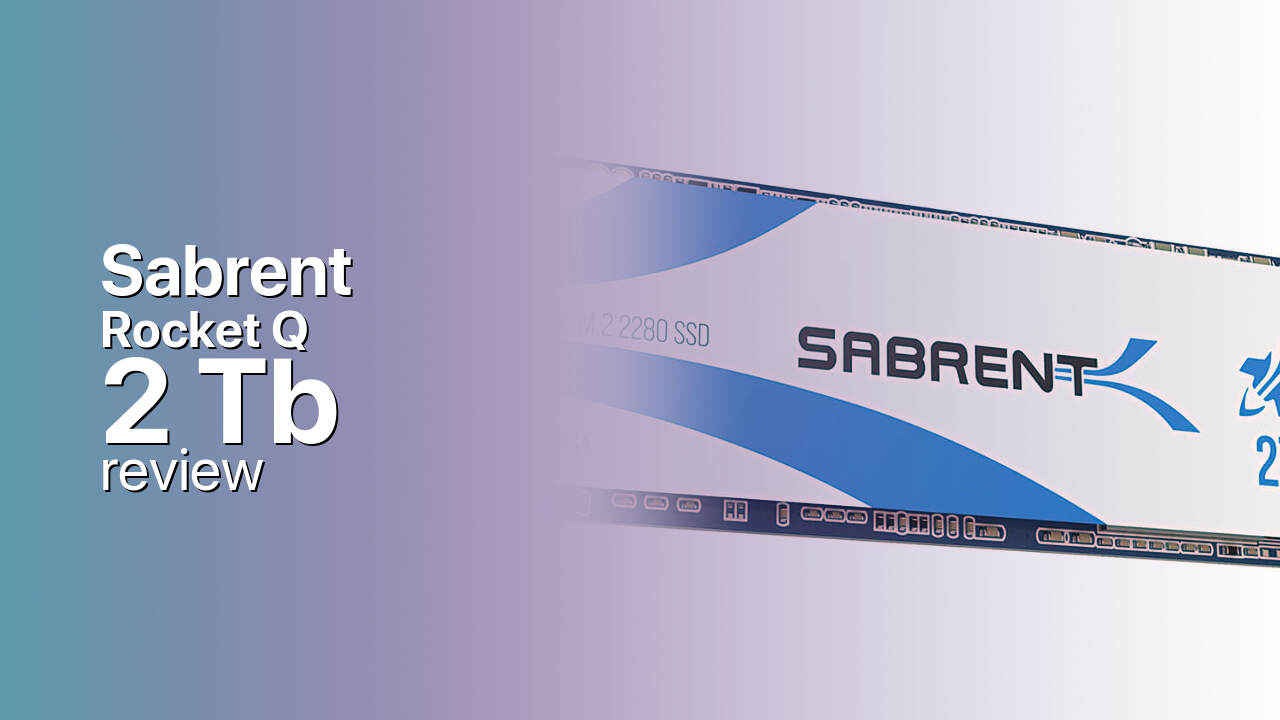
The Rocket Q is built on the Phison E12S controller, an eight-channel PCIe 3.0 x4 design paired with Micron 96-layer 3D QLC NAND and a 4 GB DDR3L DRAM cache. The presence of DRAM separates it from entry-level DRAM-less QLC drives — the controller stores the full flash translation layer in local memory rather than borrowing system RAM via HMB, which helps maintain consistent random I/O latency under mixed workloads.
Sabrent ships the Rocket Q in 500 GB, 1 TB, 2 TB, 4 TB, and 8 TB capacities, and it was among the first consumer NVMe drives to reach the 8 TB ceiling in a standard M.2 2280 form factor. Sequential throughput is rated at up to 3,400 MB/s reads and 3,000 MB/s writes, with tested CrystalDiskMark results reaching 3,451 MB/s read and 3,031 MB/s write on the 2 TB variant — essentially saturating the PCIe 3.0 x4 bus. A copper heat spreader label ships pre-applied and helps keep the controller within thermal limits during extended transfers.
The Rocket Q competes against other value-oriented NVMe drives such as the Intel 670p (also QLC but DRAM-less on 144L NAND), the Crucial P2 (QLC/TLC lottery), and the WD Blue SN550 (TLC, DRAM-less). Against SATA SSDs, the throughput advantage is obvious — sequential speeds are roughly 6x what any SATA drive can manage. Against other QLC NVMe drives, the DRAM cache and 8 TB ceiling give the Rocket Q a functional edge for users who treat their SSD as a game library or media scratch disk rather than a high-throughput workstation drive.
Storage Comparisons:
Rocket Q Performance & Benchmarks
The Rocket Q 2 TB is rated for 3,400 MB/s sequential reads and 3,000 MB/s sequential writes, with random performance reaching 255,000 IOPS read and 670,000 IOPS write at high queue depths. In CrystalDiskMark testing, the 2 TB sample reached 3,451 MB/s read and 3,031 MB/s write — essentially saturating the PCIe 3.0 x4 interface in sequential workloads. Random 4K performance at QD1 measured 74 microseconds read latency and 22 microseconds write latency, figures that place the Rocket Q firmly in the territory of responsive OS drives.
Sabrent Rocket Q 2 TB vs M.2 3.0 x 4 peers
Switch between sequential throughput and random IOPS to see how this drive stacks up against other M.2 3.0 x 4 SSDs in our database. The highlighted bar is the drive on this page — click any other bar to open that drive.
- ADATA SX 8800 Pro 512 GB: 3,500 MB/s read, 2,700 MB/s write
- ADATA SX 8800 Pro 1 TB: 3,500 MB/s read, 2,700 MB/s write
- ADATA XPG Spectrix S40G RGB 256 GB: 3,500 MB/s read, 3,000 MB/s write
- ADATA XPG Spectrix S40G RGB 512 GB: 3,500 MB/s read, 3,000 MB/s write
- Sabrent Rocket Q 2 TB (this drive): 3,400 MB/s read, 3,000 MB/s write
The Rocket Q uses a pseudo-SLC write cache that scales with capacity. On the 2 TB variant this cache is large enough to absorb typical consumer write bursts — game installs, file copies under roughly 100 GB, and general application writes all complete at full NVMe speed. Once the SLC cache fills, native QLC write speeds settle in the 150 to 250 MB/s range, which is typical for first-generation 96-layer QLC. For a drive positioned as bulk game storage this is a non-issue; for users who regularly move multi-hundred-gigabyte video projects, a TLC drive with larger sustained write throughput is a better fit. Independent reviewers consistently note that the Rocket Q punches above its QLC weight class in mixed read/write workloads thanks to the DRAM-backed controller, and the pre-applied copper heat spreader keeps the Phison E12S from throttling in typical desktop airflow.
Sabrent Rocket Q vs Competitors
See how the Rocket Q stacks up against other M.2 3.0 x 4 drives in our database:
Compare with rival drives:
Endurance, TBW & Warranty
Sabrent rates the Rocket Q 2 TB for 530 TBW of endurance and backs it with a 5-year limited warranty, provided the drive is registered within 90 days of purchase. At a typical consumer workload of 20 to 50 GB written per day, that endurance budget translates to roughly 29 to 72 years of service — well beyond the expected useful life of the host system. The 530 TBW figure is characteristic of QLC NAND and is lower per-gigabyte than equivalent TLC drives; for example, the TLC-based Sabrent Rocket (non-Q) 2 TB carries a 3,600 TBW rating. That gap matters for write-intensive workloads like video editing scratch disks, database logging, or continuous surveillance recording, but is irrelevant for a game library or media archive where writes are infrequent and reads dominate. MTBF is rated at 1.8 million hours, a standard population-level statistic for consumer NVMe SSDs. Warranty claims are handled directly through the Sabrent support portal rather than through the retailer.
Sabrent Rocket Q 2 TB Specifications
| Category | Value |
|---|---|
| Capacity [?] | 2 TB |
| Interface [?] | M.2 3.0 x 4 |
| Controller [?] | Phison E12S |
| Memory type [?] | Micron 96L QLC |
| DRAM [?] | DDR3L |
| Read speed (MB/s) [?] | 3400 |
| Write speed (MB/s) [?] | 3000 |
| Read IOPS [?] | 255000 |
| Write IOPS [?] | 670000 |
| Endurance (TBW) [?] | 530 |
| MTBF (million hours) [?] | 1.8 |
| Warranty (years) [?] | 5 |
Verdict: Is the Rocket Q Worth It in 2026?
Buy the Sabrent Rocket Q 2 TB if you need a cost-effective, high-capacity NVMe drive for a game library, media archive, or general-purpose desktop storage where read performance matters more than sustained write throughput. The DRAM cache and PCIe 3.0-saturating read speeds make it a better everyday performer than DRAM-less QLC alternatives, and the 8 TB ceiling means the platform scales if you need more space later. Skip it if your workload involves heavy sustained writes — video editing directly to the drive, database operations, or write-heavy VM storage — where the 530 TBW endurance and post-cache QLC write speed will become bottlenecks. For those use cases, a TLC-based drive like the standard Sabrent Rocket or WD Black SN750 delivers more write headroom. If you need QLC capacity at PCIe 4.0 speeds, the Sabrent Rocket Q4 doubles sequential throughput at a higher price. For everyone else, the Rocket Q remains a smart answer to the question: why buy SATA when NVMe costs the same?
+ Pros
- Up to 8 TB capacity — among the largest consumer M.2 NVMe drives
- DRAM cache (4 GB DDR3L) maintains latency under mixed workloads
- 3,400 MB/s reads saturate the PCIe 3.0 x4 bus
- Copper heat spreader pre-applied from the factory
- 5-year warranty with product registration
- Strong mixed-workload performance for a QLC drive
- Cons
- 530 TBW endurance is low per-GB compared to TLC alternatives
- Post-cache QLC write speeds drop to 150–250 MB/s
- PCIe 3.0 only — no Gen 4 support
- 5-year warranty requires registration within 90 days
- Not suitable for sustained write-heavy workloads
Buy this or similar SSD Storage:



Video Review
Sabrent Rocket Q 2TB NVMe M.2