Silicon Power US75 512GB Review — A Slim Gen4 Boot Drive (2026)
Quick answer
Buy the Silicon Power US75 512GB as a cheap, slim, cool-running boot disk: full-band 7,000 MB/s reads, TLC rather than QLC flash, a 5-year warranty and an 8-gram single-sided board that fits anything with an M.2 slot.
Read: 7000 MB/s Write: 4400 MB/s Endurance: 300 TBW Warranty: 5 years Interface: M.2 4.0 x 4
The Silicon Power US75 512GB squeezes 7,000 MB/s Gen4 reads into an 8-gram single-sided board — a boot-drive specialist whose write rating tells a humbler story.
Controller & Memory
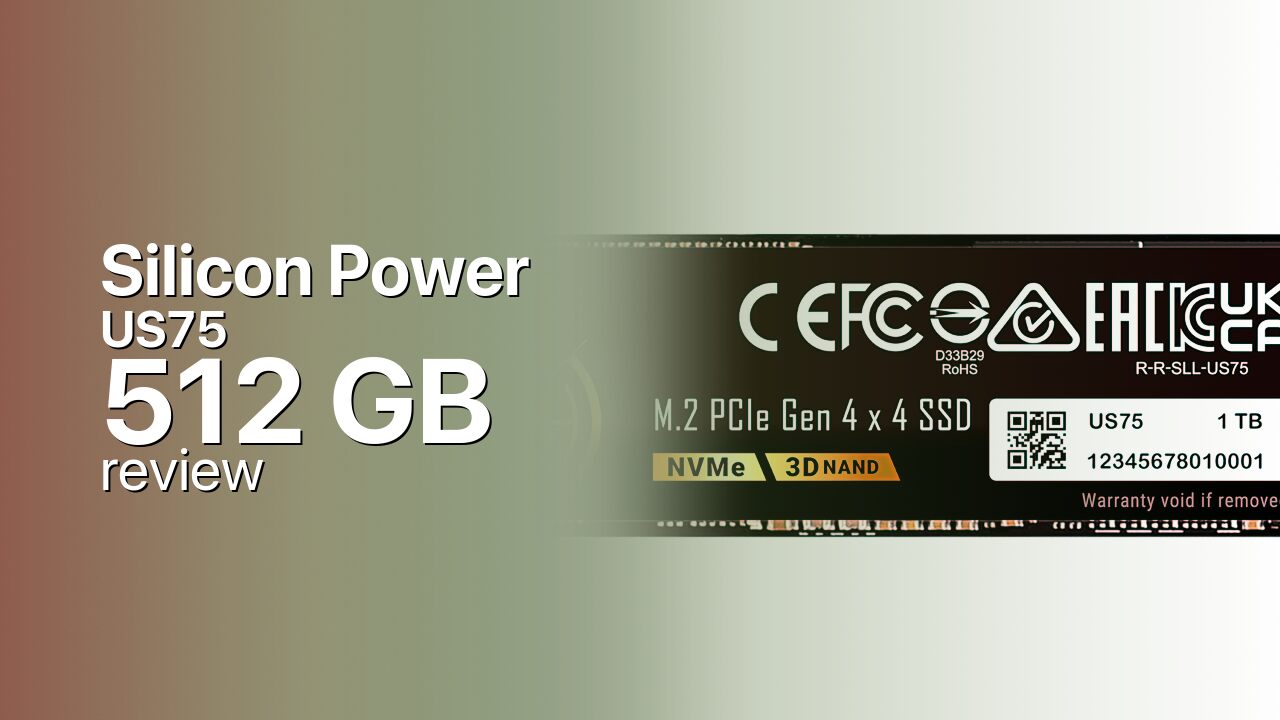
The Silicon Power US75 512GB is built on Maxio's MAP1602 four-channel controller running DRAM-less with Host Memory Buffer, behind which sit YMTC's 232-layer 3D TLC packages. It is a bare, slim M.2 2280 card — 22.0 x 80.0 x 3.6 mm and 8 grams, single-sided — which makes it a natural fit for thin laptops, handheld-adjacent builds and any slot where a heatsink would foul a shroud. Silicon Power rates it at 7,000 MB/s sequential reads, the full top-band Gen4 figure, over an NVMe 1.4 interface.
The capacity-specific caveat is writes: Silicon Power's own spec table rates this model at just 4,400 MB/s, while the 1 TB version steps up to 6,000 MB/s and the 2 TB and 4 TB models reach 6,500 MB/s. Endurance scales the same way — 300 TBW here against 600 TBW at 1 TB and 2,400 TBW at 4 TB, all under a 5-year warranty. That places the 512 GB US75 squarely in boot-disk territory: an operating system, applications and their updates, with bulk storage living elsewhere. A heatsink-equipped US75 SKU exists in Silicon Power's catalog for buyers who want one pre-fitted.
Against its tier, the Crucial P3 Plus 500 GB plays the QLC game the US75 avoids with its TLC NAND, while the Kingston NV3 and WD Blue SN580 run similar DRAM-less recipes with comparable ratings. Reviewers of the larger US75 models — Tom's Hardware called the 2 TB a practical choice for everyday gamers — consistently describe a cool-running, efficient drive, and the 512 GB card shares that thermally relaxed platform.
Storage Comparisons:
US75 Performance & Benchmarks
Silicon Power rates the 512 GB US75 at 7,000 MB/s sequential reads and 4,400 MB/s sequential writes, with no official IOPS figure published. The read rating is the headline: 7,000 MB/s puts the drive in the top Gen4 band for boot times, application launches and DirectStorage game streaming, and day to day a system disk never reveals whether it reads at 4,400 or 7,400 MB/s. The 4,400 MB/s write rating shows up in what this drive should not do — sustained bulk transfers, video ingest and repeated 100 GB game installs will take visibly longer than on the 1 TB and larger variants.
Silicon Power US75 512 GB vs M.2 4.0 x 4 peers
Switch between sequential throughput and random IOPS to see how this drive stacks up against other M.2 4.0 x 4 SSDs in our database. The highlighted bar is the drive on this page — click any other bar to open that drive.
- Patriot Viper PV593 1 TB: 14,500 MB/s read, 14,000 MB/s write
- Patriot Viper PV593 2 TB: 14,500 MB/s read, 14,000 MB/s write
- Patriot Viper PV593 4 TB: 14,500 MB/s read, 14,000 MB/s write
- Patriot Viper PV573 2 TB: 14,000 MB/s read, 12,000 MB/s write
- Silicon Power US75 512 GB (this drive): 7,000 MB/s read, 4,400 MB/s write
As a DRAM-less design, the US75 leans on Host Memory Buffer for its translation tables and on a pseudo-SLC cache for burst writes. At 512 GB that cache is modest, so large sustained transfers settle to native TLC rates sooner than they would on the bigger models — the classic small-capacity trade-off. Thermals are the family's strength: Tom's Hardware's testing of the 2 TB US75 found it runs efficiently and cool, with the bare card needing no special cooling for gaming duty, and FunkyKit measured similarly unremarkable, low temperatures. For boot and office workloads the 512 GB card inherits exactly that character, and its light NAND population has less heat to shed than any larger sibling.
Silicon Power US75 vs Competitors
See how the US75 stacks up against other M.2 4.0 x 4 drives in our database:
Compare with rival drives:
Endurance, TBW & Warranty
Silicon Power backs the US75 512GB with a 5-year limited warranty rated to 300 TBW, whichever arrives first — figures confirmed independently by TechPowerUp and Tom's Hardware for this capacity. Writing 20 GB per day, more than a typical boot drive endures, would take about 41 years to exhaust the budget, so the warranty term is the realistic limit. The MTBF is rated at 1.5 million hours per Silicon Power's spec sheet; that number describes expected failures across a large fleet of drives, not a lifespan promise for any individual card. Larger US75 capacities scale their TBW budgets to 600, 1,200 and 2,400. Claims run through Silicon Power's regional support channels with proof of purchase, with retailers handling most first-line returns in practice.
Silicon Power US75 512 GB Specifications
| Category | Value |
|---|---|
| Capacity [?] | 512 GB |
| Interface [?] | M.2 4.0 x 4 |
| Controller [?] | Maxio MAP1602 |
| Memory type [?] | YMTC 232-L TLC |
| DRAM [?] | No |
| Read speed (MB/s) [?] | 7000 |
| Write speed (MB/s) [?] | 4400 |
| Read IOPS [?] | n/a |
| Write IOPS [?] | n/a |
| Endurance (TBW) [?] | 300 |
| MTBF (million hours) [?] | 1500000 |
| Warranty (years) [?] | 5 |
Verdict: Is the US75 Worth It in 2026?
Buy the Silicon Power US75 512GB as a cheap, slim, cool-running boot disk: full-band 7,000 MB/s reads, TLC rather than QLC flash, a 5-year warranty and an 8-gram single-sided board that fits anything with an M.2 slot. Skip it as a game or content drive — the 4,400 MB/s write rating, 300 TBW budget and 512 GB of raw space all argue for stepping up to the 1 TB model. If a rival undercuts it on price, the Crucial P3 Plus trades the US75's TLC for slower-degrading QLC, and the WD Blue SN580 is the familiar-name alternative. As an OS disk, this drive is exactly enough. Just plan bulk storage elsewhere before the 512 GB fills.
+ Pros
- 7,000 MB/s rated reads on PCIe 4.0
- 300 TBW endurance with 5-year warranty
- Slim 8 g single-sided board fits thin laptops
- MTBF rated at 1.5 million hours
- YMTC 232-layer TLC, not QLC
- Cons
- Writes rated just 4,400 MB/s at this capacity
- No heatsink included
- 512 GB fills quickly with modern games
- DRAM-less design with a small SLC cache
Buy this or similar SSD Storage:



Video Review
Silicon Power US70 NVME SDD Review