Silicon Power XPower XD80 2TB Review — The Family Flagship, Tested (2026)
Quick answer
The Silicon Power XPower XD80 2TB earns its flagship title on endurance and cooling rather than outright speed: full 3,400/3,000 MB/s Gen3 ratings, 1,600 TBW of warranty-backed endurance and two Golden Award reviews for a drive that arrives with its heatsink attached.
Read: 3400 MB/s Write: 3000 MB/s Endurance: 1600 TBW Warranty: 5 years Interface: M.2 3.0 x 4
The Silicon Power XPower XD80 2TB is the line's flagship — full 3,400/3,000 MB/s ratings, 1,600 TBW endurance and Golden Award reviews under its factory heatsink.
Controller & Memory
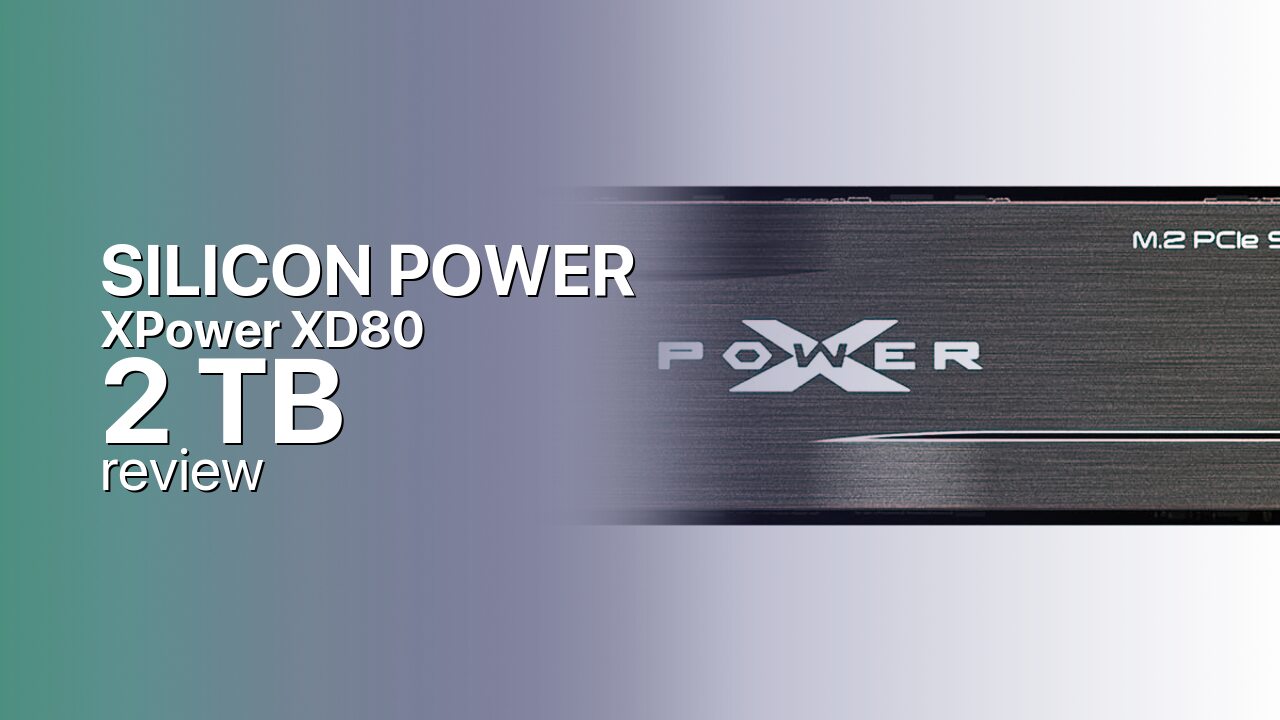
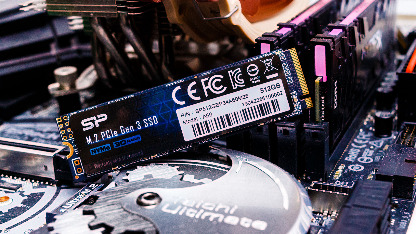
The Silicon Power XPower XD80 2TB is both the largest and the most heavily reviewed member of the XPower line: a PCIe 3.0 x4 NVMe 1.3 drive on Phison's PS5012-E12S controller with four Kioxia 96-layer TLC packages, a 512MB DDR3L DRAM cache and a pseudo-SLC write buffer that independent testing measured at roughly 50 GB. Ratings are the family's full set — 3,400 MB/s sequential reads and 3,000 MB/s writes — and the aluminum heatsink fitted at the factory is credited by Silicon Power with up to 20 percent lower temperatures. Nikktech's teardown confirmed the platform outright: PS5012-E12S, 512MB of DDR3L DRAM and a single-sided PCB. The endurance rating is the headline: 1,600 TBW, the highest in the range, under a five-year limited warranty.
This is the capacity where the platform's original positioning makes the most sense: a two-terabyte game library or content disk for a PCIe 3.0 desktop, with cooling already handled and an endurance budget that borders on theoretical. At launch it fought the Samsung 970 EVO Plus 2TB, WD Black SN750 2TB and Kingston KC2500 2TB, and reviews from Guru3D and Nikktech handed it Golden Awards — praising performance, the heatspreader and the endurance terms, while noting throttling under hours-long sustained writes. Buyers on modern platforms should weigh the WD Black SN770 for Gen4 speed, and PlayStation 5 upgraders must: Sony's program requires PCIe 4.0 drives. The line also stops here — there is no 4TB XD80 — and the single-sided 2280 PCB means the 2TB needs no added height beyond its fitted cooler.
Storage Comparisons:
XPower XD80 Performance & Benchmarks
Silicon Power rates the 2TB XD80 at 3,400 MB/s sequential reads and 3,000 MB/s writes; its own spec tables omit random-IOPS ratings, with TechPowerUp's database listing 500K random reads and 600K random writes for this capacity. Guru3D's testing, which earned the drive a Golden Award, found a pseudo-SLC write buffer of roughly 50 GB — enough to absorb game installs and multi-hundred-gigabyte batch copies at rated speed — with sustained writes settling around 1 GB/s once the cache depletes. Nikktech's 12-hour heavy-write testing showed throttling in the later hours, with the fitted heatspreader making a relatively significant difference in most tests; the takeaway is that the cooling is not decorative.
SILICON POWER XPower XD80 2 TB vs M.2 3.0 x 4 peers
Switch between sequential throughput and random IOPS to see how this drive stacks up against other M.2 3.0 x 4 SSDs in our database. The highlighted bar is the drive on this page — click any other bar to open that drive.
- ADATA SX 8800 Pro 512 GB: 3,500 MB/s read, 2,700 MB/s write
- ADATA SX 8800 Pro 1 TB: 3,500 MB/s read, 2,700 MB/s write
- ADATA XPG Spectrix S40G RGB 256 GB: 3,500 MB/s read, 3,000 MB/s write
- ADATA XPG Spectrix S40G RGB 512 GB: 3,500 MB/s read, 3,000 MB/s write
- SILICON POWER XPower XD80 2 TB (this drive): 3,400 MB/s read, 3,000 MB/s write
In everyday terms, the 2TB model behaves like any strong Gen3 drive: reads at the practical PCIe 3.0 ceiling mean boot times and game loading are indistinguishable from faster-rated rivals, and 3,000 MB/s of burst write covers everything short of sustained video-ingest workloads, where the post-cache 1 GB/s floor becomes the real number. Against modern Gen4 drives the raw throughput halves, but on a Gen3-only board that headroom is unusable anyway — and the endurance rating and cooling remain the family's calling cards.
SILICON POWER XPower XD80 vs Competitors
See how the XPower XD80 stacks up against other M.2 3.0 x 4 drives in our database:
Compare with rival drives:
Endurance, TBW & Warranty
The endurance rating at this capacity is 1,600 TBW under a five-year limited warranty, whichever arrives first — the figure in Silicon Power's official TBW document and TechPowerUp's spec database, and one of the most generous ever attached to a consumer 2 TB drive of this generation. Launch-era reviews quoted an earlier datasheet table with higher figures, so published numbers vary by datasheet revision. At 50 GB of writes per day, even the current rating stretches to roughly ninety years of service, so the warranty term is the practical limit by an enormous margin under either reading. The series carries a 2,000,000-hour MTBF rating — a population statistic, not a per-drive lifespan promise — and SP ToolBox provides firmware updates and health monitoring. Warranty claims run through Silicon Power's standard support channels with proof of purchase.
SILICON POWER XPower XD80 2 TB Specifications
| Category | Value |
|---|---|
| Capacity [?] | 2 TB |
| Interface [?] | M.2 3.0 x 4 |
| Controller [?] | Phison PS5012-E12S 8 Channel |
| Memory type [?] | Kioxia 96-L TLC |
| DRAM [?] | Yes |
| Read speed (MB/s) [?] | 3400 |
| Write speed (MB/s) [?] | 3000 |
| Read IOPS [?] | 500000 |
| Write IOPS [?] | 600000 |
| Endurance (TBW) [?] | 1600 |
| MTBF (million hours) [?] | 2000000 |
| Warranty (years) [?] | 5 |
Verdict: Is the XPower XD80 Worth It in 2026?
The Silicon Power XPower XD80 2TB earns its flagship title on endurance and cooling rather than outright speed: full 3,400/3,000 MB/s Gen3 ratings, 1,600 TBW of warranty-backed endurance and two Golden Award reviews for a drive that arrives with its heatsink attached. Skip it on a modern platform — the WD Black SN770 2TB delivers Gen4 throughput the XD80 cannot match — and PS5 buyers must look at Gen4 drives outright. As a large, cool-running library disk for a PCIe 3.0 desktop that will not be upgraded soon, it remains one of the most durable and best-documented choices of its generation — the capacity the reviewers actually tested.
+ Pros
- 3,400/3,000 MB/s full rating set
- 1,600 TBW endurance rating
- Roughly 50 GB pseudo-SLC write buffer (Guru3D testing)
- Golden Awards from Guru3D and Nikktech
- Five-year limited warranty
- Factory aluminum heatsink
- Cons
- Sustained writes settle near 1 GB/s
- Throttling under hours-long heavy writes (Nikktech testing)
- PCIe 3.0 ceiling — not a PS5 candidate
- Line stops at 2 TB — no larger capacity
- IOPS rating absent from SP's own spec tables
Buy this or similar SSD Storage:
Video Review
NVMe M.2 XD80