Silicon Power XPower XD80 1TB Review — Full-Speed Gen3, Heatsink Fitted (2026)
Quick answer
The Silicon Power XPower XD80 1TB is the capacity to choose within this line: full 3,400/3,000 MB/s ratings, 800 TBW of endurance and the fitted heatsink that defines the family, all under a five-year warranty.
Read: 3400 MB/s Write: 3000 MB/s Endurance: 800 TBW Warranty: 5 years Interface: M.2 3.0 x 4
The Silicon Power XPower XD80 1TB unlocks the line's full 3,400/3,000 MB/s ratings with 800 TBW endurance, a factory heatsink and five years of coverage.
Controller & Memory
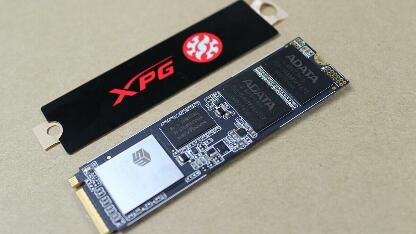
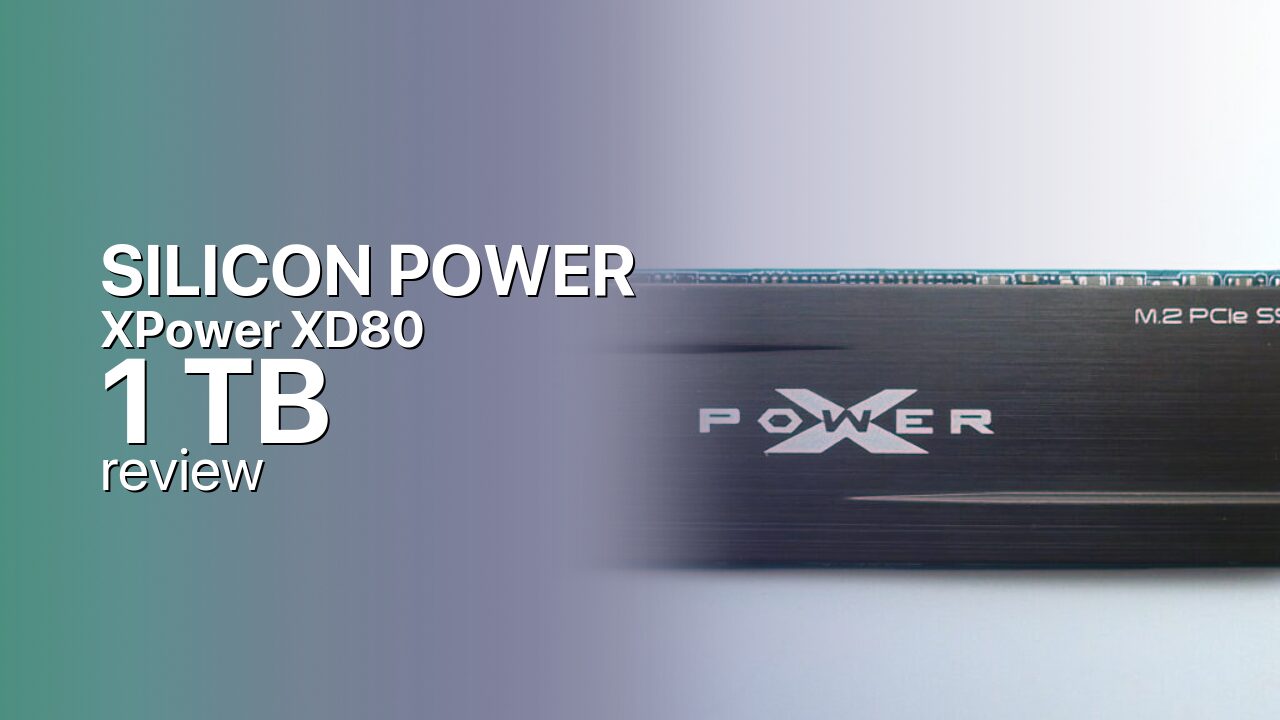
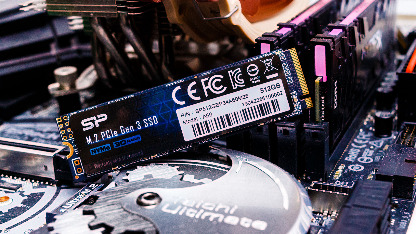
The Silicon Power XPower XD80 1TB is the first capacity in the XPower line to carry the family's full rating set: 3,400 MB/s sequential reads and 3,000 MB/s writes over a PCIe 3.0 x4 NVMe 1.3 interface, identical to the 2TB flagship. Underneath sit Phison's PS5012-E12S controller, Kioxia 96-layer TLC NAND, a DDR3L DRAM cache and a pseudo-SLC write buffer, while the aluminum heatsink Silicon Power fits on every XD80 is credited with up to 20 percent lower temperatures. Endurance doubles to 800 TBW at this capacity — twice the 512GB model's 400 TBW — under the same five-year limited warranty that covers the range.
A terabyte is the capacity where a Gen3 drive becomes a whole-PC disk: operating system, applications and a genuine game library on one M.2 slot. Era rivals at 1 TB included the Samsung 970 EVO Plus, WD Black SN750 and Kingston KC2500 — all competent Gen3 performers sold without cooling, which made the XD80's fitted heatsink its clearest differentiator. The audience today is unchanged: owners of PCIe 3.0 platforms such as AMD's B450 and X470 boards or Intel's 400-series chipsets who want one drive and no cooling complications, and the single-sided 2280 PCB with its attached cooler suits open desktop slots best. PlayStation 5 builders still need a Gen4 drive by Sony's criteria, and buyers chasing modern Gen4 throughput should compare the WD Black SN770 before committing to the older interface. The range runs from 256GB to 2TB; this 1TB model is the cheapest tier with the full rating set, which is why it became the family's default recommendation.
Storage Comparisons:
XPower XD80 Performance & Benchmarks
Silicon Power rates the 1TB XD80 at 3,400 MB/s sequential reads and 3,000 MB/s writes — full parity with the 2TB flagship — and its own spec tables omit random-IOPS ratings, with TechPowerUp's database listing 390K random reads and 450K random writes for this capacity. In practice this is the Gen3 tier's ceiling: boot times and game loading are indistinguishable from faster-rated Gen3 drives, and the 3,000 MB/s write rating absorbs Windows updates, game installs and batch copies without hesitation. The pseudo-SLC cache scales with capacity and absorbs everyday bursts easily; under very long sustained transfers it depletes and throughput settles to native TLC rates — Guru3D measured roughly 1 GB/s in that state on the 2TB model, and the character here is comparable.
SILICON POWER XPower XD80 1 TB vs M.2 3.0 x 4 peers
Switch between sequential throughput and random IOPS to see how this drive stacks up against other M.2 3.0 x 4 SSDs in our database. The highlighted bar is the drive on this page — click any other bar to open that drive.
- ADATA SX 8800 Pro 512 GB: 3,500 MB/s read, 2,700 MB/s write
- ADATA SX 8800 Pro 1 TB: 3,500 MB/s read, 2,700 MB/s write
- ADATA XPG Spectrix S40G RGB 256 GB: 3,500 MB/s read, 3,000 MB/s write
- ADATA XPG Spectrix S40G RGB 512 GB: 3,500 MB/s read, 3,000 MB/s write
- SILICON POWER XPower XD80 1 TB (this drive): 3,400 MB/s read, 3,000 MB/s write
The family's independent record is strong for its class: Guru3D awarded the 2TB XD80 a Golden Award and Nikktech matched it, both crediting the heatsink with measurable thermal gains under sustained load. At 1 TB the same cooling works over a larger NAND budget, which is why this capacity is widely seen as the most balanced member of the line — full speed, maximum practical endurance, no thermal asterisks.
SILICON POWER XPower XD80 vs Competitors
See how the XPower XD80 stacks up against other M.2 3.0 x 4 drives in our database:
Compare with rival drives:
Endurance, TBW & Warranty
Endurance at this capacity is rated at 800 TBW under a five-year limited warranty, whichever arrives first — the figure in Silicon Power's official TBW document and TechPowerUp's spec database, and one that comfortably exceeds typical 1 TB ratings of the era (Samsung's 970 EVO Plus carried 600 TBW). Launch-era reviews quoted an earlier datasheet table with higher figures, so published numbers vary by datasheet revision. At a steady 50 GB of writes per day, the budget represents roughly forty years of service, so the warranty term is the realistic limit for any desktop or gaming workload. The series carries a 2,000,000-hour MTBF rating — a population statistic, not a per-drive lifespan promise — and SP ToolBox handles firmware updates and health reporting.
SILICON POWER XPower XD80 1 TB Specifications
| Category | Value |
|---|---|
| Capacity [?] | 1 TB |
| Interface [?] | M.2 3.0 x 4 |
| Controller [?] | Phison PS5012-E12S 8 Channel |
| Memory type [?] | Kioxia 96-L TLC |
| DRAM [?] | Yes |
| Read speed (MB/s) [?] | 3400 |
| Write speed (MB/s) [?] | 3000 |
| Read IOPS [?] | 390000 |
| Write IOPS [?] | 450000 |
| Endurance (TBW) [?] | 800 |
| MTBF (million hours) [?] | 2000000 |
| Warranty (years) [?] | 5 |
Verdict: Is the XPower XD80 Worth It in 2026?
The Silicon Power XPower XD80 1TB is the capacity to choose within this line: full 3,400/3,000 MB/s ratings, 800 TBW of endurance and the fitted heatsink that defines the family, all under a five-year warranty. Skip it for a PlayStation 5 — Sony requires PCIe 4.0 — and look at the WD Black SN770 if a modern Gen4 upgrade matters more than included cooling; The Samsung 970 EVO Plus 1TB remains the era's benchmark for bare-drive consistency. For a PCIe 3.0 desktop that needs one drive for everything, this is the XD80 to buy — provided the platform is genuinely Gen3 and likely to stay that way.
+ Pros
- 3,400/3,000 MB/s full rating set
- 800 TBW endurance rating
- Five-year limited warranty
- Factory aluminum heatsink
- Full speed parity with the 2TB model
- DDR3L DRAM cache with SLC buffering
- Cons
- PCIe 3.0 ceiling — not a PS5 candidate
- IOPS rating absent from SP's own spec tables
- Sustained writes settle near 1 GB/s after the SLC cache
- Attached heatsink complicates secondary cooling
- Trails modern Gen4 drives on raw throughput
Buy this or similar SSD Storage:
Video Review
Silicon Power: Xpower PCIe Gen 4x4 SSD XS70 1TB