Team Group Cardea Z44Q 2TB — QLC PCIe 4.0 NVMe SSD Review
The Team Group Cardea Z44Q 2 TB is a Phison E16-powered PCIe 4.0 drive that pairs QLC NAND with a DRAM cache, trading sustained write endurance for cost-effective high capacity.
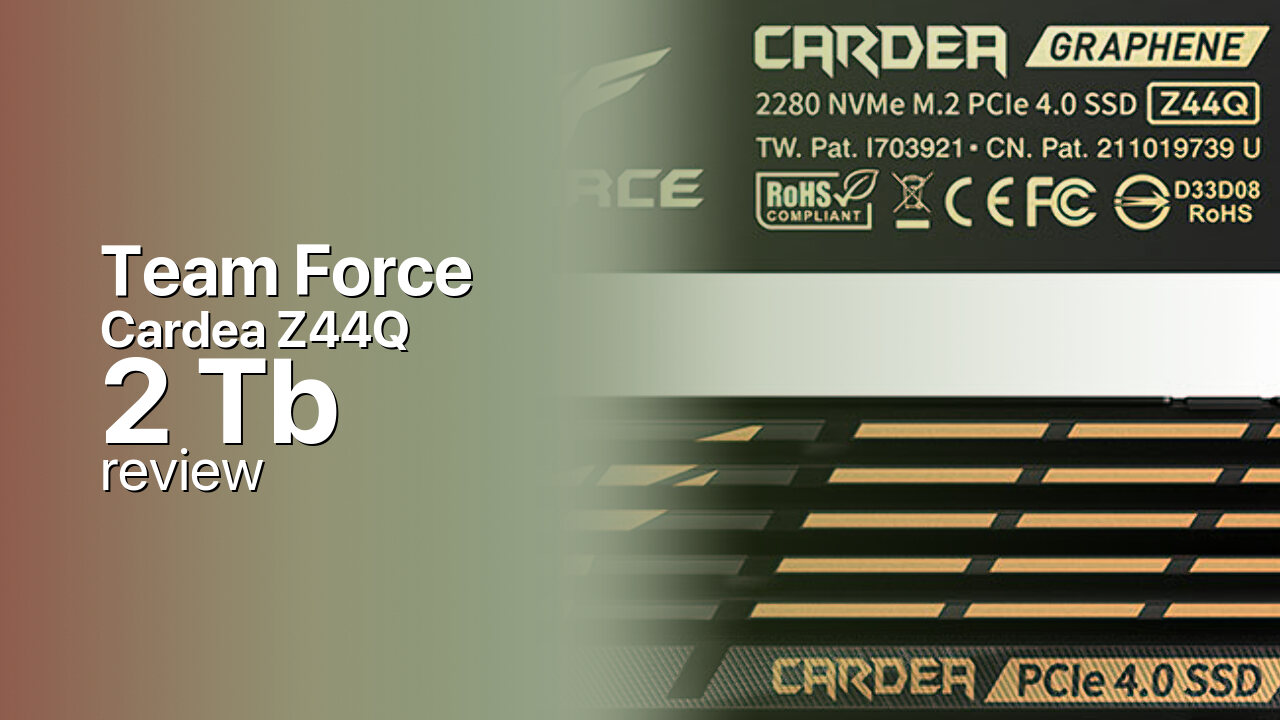
The Z44Q is built on the Phison PS5016-E16, the first commercially available PCIe 4.0 consumer controller and a platform that predates the faster E18 by roughly a generation. It is an eight-channel design manufactured on a 28 nm process, paired here with Micron 96-layer QLC NAND and an SK Hynix DDR4 DRAM cache. The inclusion of DRAM sets the Z44Q apart from many modern QLC drives — including the Crucial P3 Plus and Intel 670p — which are DRAM-less and rely on HMB. DRAM-equipped QLC drives are increasingly rare, as manufacturers have moved the cost-saving QLC segment toward DRAM-less designs to hit lower price points.
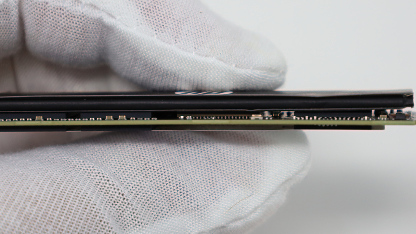
The 2 TB capacity is the sweet spot for a QLC drive: it provides enough NAND dies in parallel to reach the E16 controller's 5,000 MB/s read and 4,000 MB/s write ceilings, and the large physical flash pool means the pseudo-SLC cache is generously sized. Endurance at 2 TB is 800 TBW — a 400-TBW-per-terabyte ratio that reflects QLC NAND's inherent write-amplification penalty, roughly half the endurance-per-terabyte of a comparable TLC drive. Team Group offers the Z44Q in 1 TB and 2 TB capacities only, skipping the 500 GB tier where QLC endurance and sustained-write penalties would be most visible. The drive uses a single-sided M.2 2280 PCB with a graphene-coated copper heat spreader, similar to the one found on the Cardea Zero Z340.
In the PCIe 4.0 QLC segment, the Z44Q competes against the Sabrent Rocket Q4 and Corsair MP600 Core — both also Phison E16 QLC reference designs — as well as newer DRAM-less QLC drives like the Crucial P3 Plus and Solidigm P41 Plus. The Z44Q's DRAM cache gives it an edge in sustained mixed I/O consistency against the DRAM-less alternatives, while the older E16 controller means peak throughput trails current-generation E18 and E21T-based designs. For a large-capacity game library or media storage drive where writes are infrequent and reads dominate, the Z44Q's QLC compromises are well-hidden. For an OS drive or a write-heavy scratch disk, a TLC alternative is strongly preferable.
✅ Storage Comparisons:
🚀 Performance and benchmarks
Team Group rates the 2 TB Z44Q at 5,000 MB/s sequential reads and 4,000 MB/s sequential writes, with random IOPS of 350,000 read and 600,000 write — figures that reflect the E16 controller's PCIe 4.0 capability without reaching the ~7,000 MB/s ceiling of second-generation Gen4 controllers like the Phison E18. The read throughput is sufficient for any consumer application, and the write figure benefits from the 2 TB variant's generous SLC cache, which can absorb roughly 200–300 GB of burst writes at full speed before transitioning to native QLC speeds.
Team Group Cardea Z44Q 2 TB vs M.2 4.0 x 4 peers
Switch between sequential throughput and random IOPS to see how this drive stacks up against other M.2 4.0 x 4 SSDs in our database. The highlighted bar is the drive on this page — click any other bar to open that drive.
- PNY XLR8 CS3140 1 TB: 7,500 MB/s read, 5,650 MB/s write
- PNY XLR8 CS3140 2 TB: 7,500 MB/s read, 6,850 MB/s write
- Asgard AN4 512 GB: 7,500 MB/s read, 5,500 MB/s write
- Asgard AN4 1 TB: 7,500 MB/s read, 5,500 MB/s write
- Team Group Cardea Z44Q 2 TB (this drive): 5,000 MB/s read, 3,700 MB/s write
Once the SLC cache is exhausted, native QLC sequential writes drop to approximately 150–200 MB/s — roughly hard-drive territory, and the defining weakness of the QLC platform. On a 2 TB drive used as a game library, this scenario is rare: game installs are bottlenecked by internet download speeds or optical-disc read rates long before the drive's write speed becomes limiting. For content creators ingesting large video files or running database workloads, the post-cache write cliff is a genuine constraint and a TLC drive like the WD Black SN770 or Samsung 980 Pro is a better tool for the job. The graphene-copper heat spreader provides adequate passive cooling for the E16 controller, though sustained sequential writes that fill the SLC cache will also generate enough heat to push the controller toward its throttle point in poorly ventilated chassis.
🖥️ Endurance and warranty
Team Group backs the Z44Q 2 TB with a five-year warranty, limited by an 800 TBW endurance rating. At 30 GB/day, this endurance budget spans roughly 73 years — ample for the read-heavy workloads a QLC drive is designed for. The 1 TB Z44Q carries 400 TBW, maintaining the same 400-TBW-per-terabyte ratio. For comparison, a TLC drive at 2 TB typically carries 1,200–1,400 TBW, roughly 50–75% more endurance per terabyte. The lower figure is not a reliability concern for the Z44Q's intended use as a game library or media drive, where writes are dominated by one-time game installs and periodic updates. Users planning to use the Z44Q as a video-editing scratch disk or for any workload involving sustained writes should factor the lower TBW ceiling into their drive selection.
📊 Specs
| Category | Value |
|---|---|
| Capacity [?] | 2 TB |
| Interface [?] | M.2 4.0 x 4 |
| Controller [?] | Phison PS5016-E16 |
| Memory type [?] | Micron 3D QLC |
| DRAM [?] | SK Hynix DDR4 |
| Read speed (MB/s) [?] | 5000 |
| Write speed (MB/s) [?] | 3700 |
| Read IOPS [?] | 350000 |
| Write IOPS [?] | 600000 |
| Endurance (TBW) [?] | 400 |
| MTBF (million hours) [?] | 3000000 |
| Warranty (years) [?] | 5 |
Conclusion
The Cardea Z44Q 2 TB is a well-executed QLC drive that benefits from an increasingly rare combination: QLC NAND paired with a DRAM cache. It delivers PCIe 4.0 read speeds at a capacity and price point that TLC drives struggle to match, and its 5,000 MB/s reads make it a strong choice for a dedicated game library, media archive, or secondary fast storage where writes are occasional and reads dominate. The trade-offs are real — native QLC writes after the SLC cache exhausts are hard-drive-slow, and 800 TBW endurance is below the TLC norm — but they land in places that the Z44Q's target buyer rarely visits. For an OS boot drive or a mixed read-write workload, skip the Z44Q and buy a TLC drive. For a cost-effective 2 TB of fast read storage with DRAM, the Z44Q fills a specific and shrinking niche.
+ Pros
- 5,000 MB/s PCIe 4.0 reads — fast enough for any game or media library
- DRAM cache included — increasingly rare on QLC NVMe drives
- 2 TB at a QLC price point — cost-effective large capacity
- Graphene-copper heat spreader — thin and functional
- 5-year warranty — competitive for a QLC platform
- Cons
- Post-SLC-cache writes drop to ~150 MB/s — hard-drive territory
- 800 TBW endurance — roughly half the TLC norm per terabyte
- Phison E16 is a first-generation PCIe 4.0 controller, outpaced by E18/E21T
- Only 1 TB and 2 TB capacities — no 4 TB option for QLC's capacity strength
🛒 Buy this or similar SSD Storage:
✨ Video Review
High Speed Cardea Z44Q by Team Group - Review