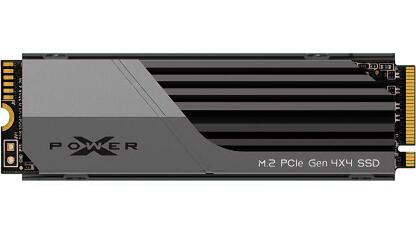
Team Group Cardea Z44Q 4TB — DRAM-less QLC PCIe 4.0 NVMe
The Team Group Cardea Z44Q 4TB earns its place as one of the better QLC PCIe 4.0 drives by pairing 800 TBW of endurance with a factory-included dual heatsink at a capacity where most alternatives cost substantially more.
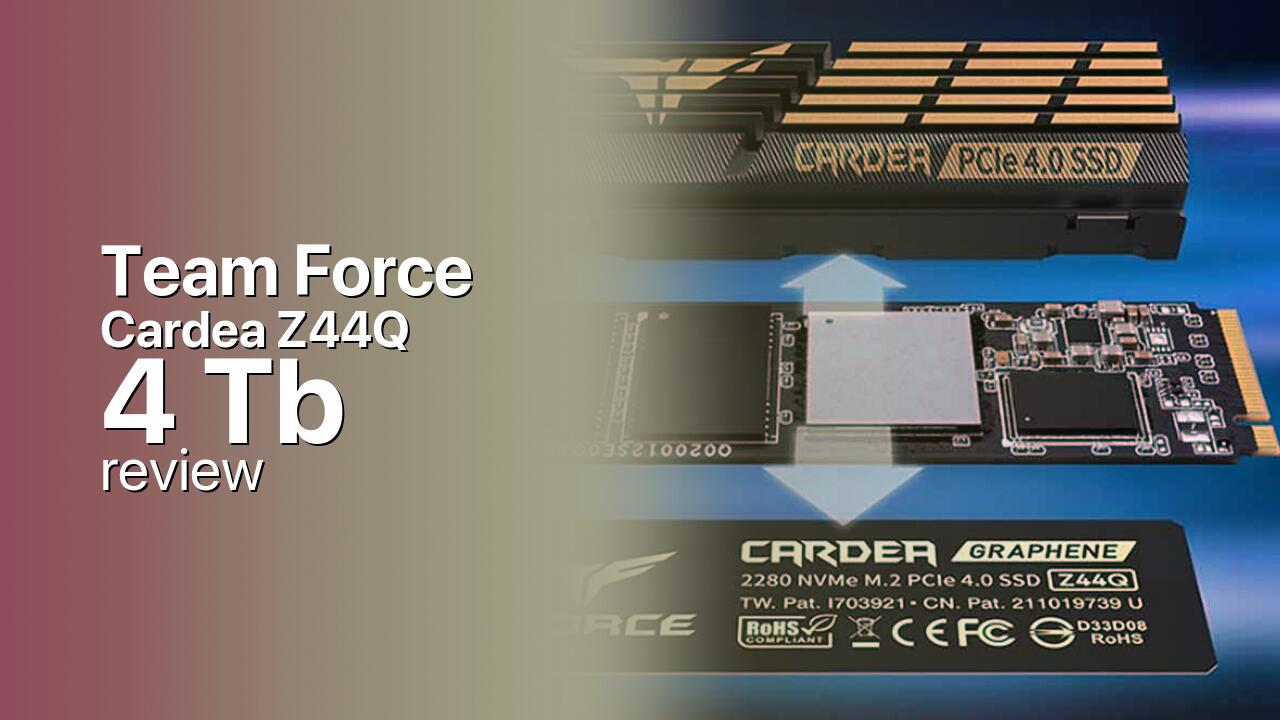
Inside the Cardea Z44Q, Team Group pairs 3D QLC NAND with a DRAM-less controller that relies on the host system's memory via HMB (Host Memory Buffer). This keeps the bill of materials down while still hitting the 5,000 MB/s sequential read ceiling of PCIe 4.0 x4. The 4 TB variant ships as a double-sided M.2 2280 PCB, which limits its fit in thin laptops and some mini-PC enclosures — but is standard for high-capacity NVMe drives. Team Group includes both an aluminum heat spreader and a graphene thermal pad in the box, so the drive is ready for desktop motherboards and the PlayStation 5 expansion slot out of the gate.
The Z44Q sits in Team Group's T-Force gaming line as the high-capacity QLC option, below the faster TLC-based Cardea A440 and Z440 models. Across the three capacities — 1 TB, 2 TB, and 4 TB — sequential read speeds stay at 5,000 MB/s, but write performance drops on the smaller drives: 3,700 MB/s for the 2 TB and 3,500 MB/s for the 1 TB. Endurance scales linearly at roughly 200 TBW per terabyte, giving the 4 TB model its 800 TBW rating. That is low for a 4 TB SSD by TLC standards, but acceptable for a drive aimed at game libraries and media storage rather than sustained workstation throughput.
The Z44Q competes against other budget-oriented QLC PCIe 4.0 drives like the Corsair MP600 Core XT and the Sabrent Rocket Q4. Against the Corsair it holds an edge with the included heatsink and slightly higher endurance on the 4 TB model; against the Sabrent it trades blows on peak throughput but typically carries a lower cost per gigabyte. Buyers who need sustained write performance for video editing or database workloads should look at TLC alternatives like the WD Black SN770 or Crucial P3 Plus instead, as the Z44Q's QLC NAND slows sharply once its SLC cache is exhausted on large transfers.
✅ Storage Comparisons:
🚀 Performance and benchmarks
Team Group rates the 4 TB Cardea Z44Q at up to 5,000 MB/s sequential reads and 4,000 MB/s sequential writes — numbers that max out the PCIe 4.0 x4 interface's practical ceiling for a DRAM-less QLC design. Random performance is rated at up to 350,000 IOPS read and 600,000 IOPS write in most third-party databases, though the manufacturer's own product page lists higher figures of 580,000 and 850,000 IOPS respectively. The discrepancy likely reflects different measurement methodologies; the more conservative numbers should be treated as the reliable floor. In practice, these figures translate to game load times within a second or two of premium TLC drives — a gap invisible in blind testing for gaming and operating system responsiveness.
Team Group Cardea Z44Q 4 TB vs M.2 4.0 x 4 peers
Switch between sequential throughput and random IOPS to see how this drive stacks up against other M.2 4.0 x 4 SSDs in our database. The highlighted bar is the drive on this page — click any other bar to open that drive.
- PNY XLR8 CS3140 1 TB: 7,500 MB/s read, 5,650 MB/s write
- PNY XLR8 CS3140 2 TB: 7,500 MB/s read, 6,850 MB/s write
- Asgard AN4 512 GB: 7,500 MB/s read, 5,500 MB/s write
- Asgard AN4 1 TB: 7,500 MB/s read, 5,500 MB/s write
- Team Group Cardea Z44Q 4 TB (this drive): 5,000 MB/s read, 4,000 MB/s write
Where the QLC architecture reveals itself is under sustained write loads. The Z44Q uses a large dynamic SLC cache to absorb incoming writes at full speed, but once that cache fills — roughly after 200 to 400 GB of sequential writes in a single session, depending on how full the drive is — write throughput drops to QLC native speeds, which can fall below 200 MB/s. For a boot drive or game library this is irrelevant; games and operating systems write in short bursts that stay within the cache. For users who regularly ingest large video files or run database workloads, however, this write cliff makes the Z44Q a poor fit. Independent reviewers consistently describe the performance profile as fast for consumer bursts and unsuited for sustained workstation throughput.
🖥️ Endurance and warranty
Team Group backs the Cardea Z44Q 4 TB with a 5-year limited warranty, standard for the T-Force lineup, capped by the 800 TBW endurance rating. At a typical consumer write load of 30 to 50 GB per day, 800 TBW works out to roughly 44 to 73 years of use — well past the drive's practical service life. The endurance ratio of 200 TBW per terabyte is on the lower end for PCIe 4.0 drives but is consistent with QLC NAND, which trades write longevity for bit density and cost. The MTBF is rated at 3 million hours, a population-level statistic common across consumer SSDs that indicates reliability under normal operating conditions rather than a guarantee for any individual unit. Warranty claims are handled through Team Group's standard RMA process; buyers should register the drive and retain proof of purchase, as the 5-year window is tied to the original sale date and is not transferable.
📊 Specs
| Category | Value |
|---|---|
| Capacity [?] | 4 TB |
| Interface [?] | M.2 4.0 x 4 |
| Controller [?] | Phison PS5016-E16 |
| Memory type [?] | QLC |
| DRAM [?] | 2GB DDR4 |
| Read speed (MB/s) [?] | 5000 |
| Write speed (MB/s) [?] | 4000 |
| Read IOPS [?] | 350000 |
| Write IOPS [?] | 600000 |
| Endurance (TBW) [?] | 800 |
| MTBF (million hours) [?] | 3 |
| Warranty (years) [?] | 5 |
Conclusion
The Team Group Cardea Z44Q 4 TB is the right drive for a specific buyer: someone who needs four terabytes of fast NVMe storage for a game library, media collection, or general desktop use and wants to spend as little as possible without dropping to SATA speeds. The included heatsink removes the usual hidden cost of adding a third-party cooler, and the 5,000 MB/s reads are more than enough for DirectStorage titles and quick level loads. Skip it if your workflow involves regular large-file writes — video editors, 3D artists, and anyone dumping hundreds of gigabytes to disk in a single session will hit the QLC write cliff and find TLC alternatives like the WD Black SN770 or Crucial P3 Plus more productive at similar capacities. For its intended use case, the Z44Q 4 TB gets the fundamentals right, pairing PCIe 4.0 throughput with a sensible endurance envelope at the lowest end of the 4 TB NVMe price spectrum.
+ Pros
- 5,000 MB/s sequential reads on PCIe 4.0 x4
- 800 TBW endurance rating for the 4 TB model
- Includes both aluminum heatsink and graphene thermal pad
- Large dynamic SLC write cache keeps consumer writes at full speed
- 5-year limited warranty with industry-standard TBW cap
- 4 TB of QLC NAND in a single M.2 2280 slot
- Cons
- QLC write speeds drop sharply after SLC cache exhaustion
- No dedicated DRAM cache, uses HMB from system memory
- Low endurance-per-terabyte compared to TLC alternatives
- Double-sided PCB limits fit in thin laptop M.2 slots
- Rated read speed falls below Sony's 5,500 MB/s PS5 recommendation
🛒 Buy this or similar SSD Storage:



✨ Video Review
Team Force T-Force Delta RGB Ram Kit What's in the box ? Lets find out in this Unboxing