Team Group T-Force Cardea Zero Z440 1TB NVMe Review (2026)
Quick answer
The Cardea Zero Z440 1TB is one of the most practical first-generation PCIe 4.0 SSDs available.
Read: 5000 MB/s Write: 4400 MB/s Endurance: 3000 TBW Warranty: 5 years Interface: M.2 4.0 x 4
The Team Group T-Force Cardea Zero Z440 1TB is a PCIe 4.0 NVMe SSD that combines Phison E16 performance with a slim graphene copper foil cooler and 3,000 TBW endurance — a drive built to fit where bulkier Gen4 SSDs cannot.
Controller & Memory
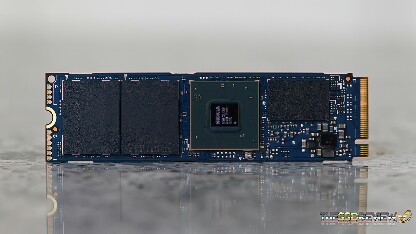
The Z440 1TB uses the Phison PS5016-E16 controller — a dual-core Arm Cortex-R5 at 733 MHz with two CoXProcessor cores for NAND management — paired with Kioxia (Toshiba) BiCS4 96-layer 3D TLC and 1 GB of DDR4 DRAM for the FTL mapping table. This is the same E16 platform found in the Corsair MP600, Sabrent Rocket 4.0, and Gigabyte Aorus Gen4.
The 1TB model is the primary capacity that reviewers tested, and it is rated for 5,000 MB/s sequential read and 4,400 MB/s sequential write with 750,000 random read/write IOPS. PCMag noted that the write speed at 1TB is actually rated 400 MB/s higher than the 2TB variant (4,400 vs 4,000 MB/s), which is unusual — typically larger capacities write faster. The drive is double-sided with NAND on both PCB faces.
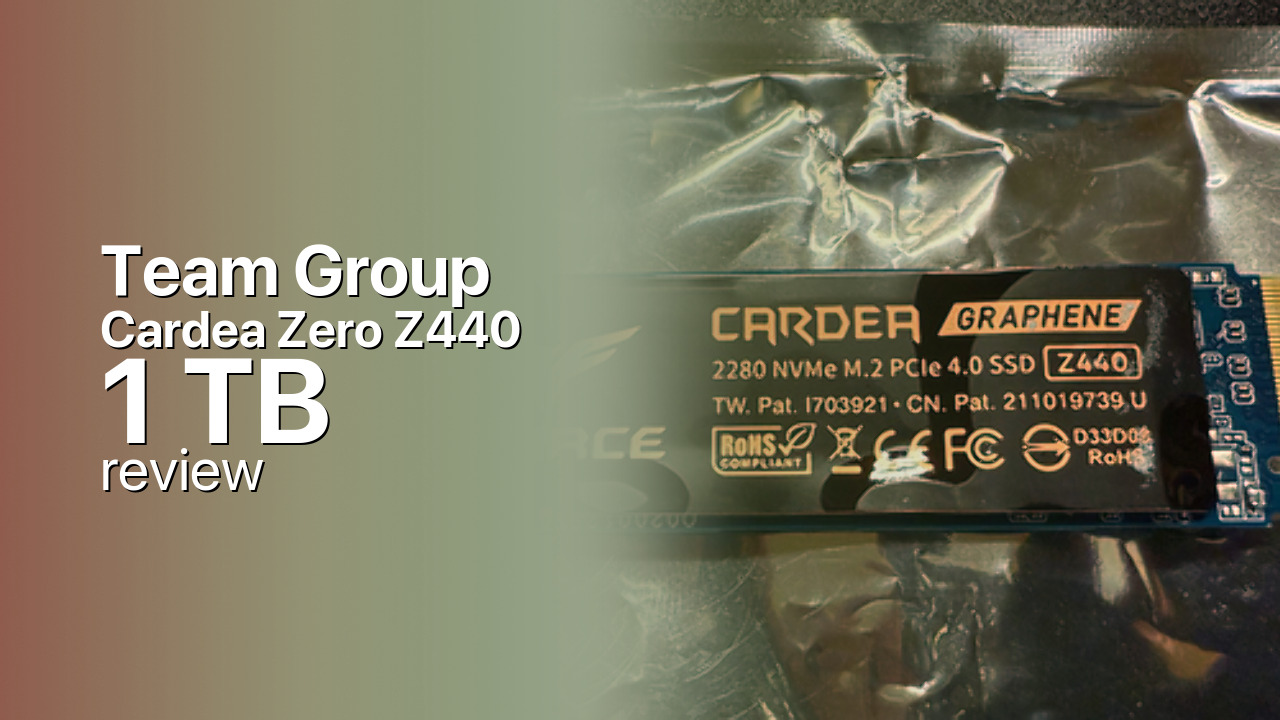
The graphene copper foil heat spreader is the Z440's key design decision. Unlike the Ceramic C440's ceramic plate or the Corsair MP600's bulky finned heatsink, the graphene foil adds negligible height, allowing the Z440 to fit under motherboard-integrated M.2 heatsinks. PCMag and Guru3D both praised this practical approach.
Storage Comparisons:
Cardea Zero Z440 Performance & Benchmarks
The Z440 1TB delivers 5,000 MB/s sequential read and 4,400 MB/s sequential write — the E16 controller's ceiling. PCMag's independent testing confirmed these figures in CrystalDiskMark, finding the Z440 competitive with or slightly ahead of the Corsair MP600 and Seagate FireCuda 520 in several benchmarks. The drive set the pace for 4K random read speeds among the PCIe 4.0 drives PCMag had tested at the time.
Team Group Cardea Zero Z440 1 TB vs M.2 4.0 x 4 peers
Switch between sequential throughput and random IOPS to see how this drive stacks up against other M.2 4.0 x 4 SSDs in our database. The highlighted bar is the drive on this page — click any other bar to open that drive.
- Patriot Viper PV593 1 TB: 14,500 MB/s read, 14,000 MB/s write
- Patriot Viper PV593 2 TB: 14,500 MB/s read, 14,000 MB/s write
- Patriot Viper PV593 4 TB: 14,500 MB/s read, 14,000 MB/s write
- Patriot Viper PV573 2 TB: 14,000 MB/s read, 12,000 MB/s write
- Team Group Cardea Zero Z440 1 TB (this drive): 5,000 MB/s read, 4,400 MB/s write
In PCMark 10 real-world storage tests, the Z440 posted strong scores for Windows boot, game loading, and file copies. It tied or topped its PCIe 4.0 competitors in ISO and JPEG copy tests. The SLC cache at 1TB is roughly 333 GB (one-third of usable capacity), providing generous burst write headroom. Post-cache sustained writes settle to approximately 1,500 MB/s. The graphene foil keeps the controller below 80 degrees Celsius under load, which is adequate but not as effective as the C440's ceramic spreader or a dedicated aluminum heatsink.
Team Group Cardea Zero Z440 vs Competitors
See how the Cardea Zero Z440 stacks up against other M.2 4.0 x 4 drives in our database:
Compare with rival drives:
Endurance, TBW & Warranty
The 1TB model carries a 3,000 TBW endurance rating with a 5-year warranty. At 50 GB of writes per day, this translates to roughly 164 years. The MTBF is rated at 1.7 million hours. The 3,000 TBW figure is generous for a consumer drive and reflects the endurance characteristics of the Kioxia 96L TLC flash. Team Group offers a SMART Tool utility for S.M.A.R.T. data monitoring and benchmarking, though it lacks cloning and migration features found in Samsung Magician or Sabrent's toolkit.
Team Group Cardea Zero Z440 1 TB Specifications
| Category | Value |
|---|---|
| Capacity [?] | 1 TB |
| Interface [?] | M.2 4.0 x 4 |
| Controller [?] | Phison PS5016-E16 |
| Memory type [?] | Toshiba 3D TLC |
| DRAM [?] | DDR4, SLC Cache |
| Read speed (MB/s) [?] | 5000 |
| Write speed (MB/s) [?] | 4400 |
| Read IOPS [?] | 750000 |
| Write IOPS [?] | 750000 |
| Endurance (TBW) [?] | 3000 |
| MTBF (million hours) [?] | 1.7 |
| Warranty (years) [?] | 5 |
Verdict: Is the Cardea Zero Z440 Worth It in 2026?
The Cardea Zero Z440 1TB is one of the most practical first-generation PCIe 4.0 SSDs available. The graphene foil cooling and slim profile solve a real problem — fitting under existing motherboard heatsinks — without sacrificing E16 performance. The 3,000 TBW endurance and 5-year warranty provide long-term confidence. The E16 platform is now a generation behind the E18 and newer controllers, so builders prioritizing raw speed should consider the Samsung 980 Pro or Sabrent Rocket 4 Plus. For users who value practical compatibility, strong endurance, and solid Gen4 performance at 1TB, the Z440 is a well-designed choice.
+ Pros
- 5,000 MB/s read, 4,400 MB/s write on PCIe 4.0
- Graphene foil fits under motherboard heatsinks
- 3,000 TBW endurance with 5-year warranty
- Strong PCMark 10 real-world scores
- 1 TB capacity fits OS plus game library
- Cons
- E16 surpassed by E18 generation in speed
- Double-sided PCB limits laptop compatibility
- No management software available
- Graphene foil less effective than dedicated heatsinks
Buy this or similar SSD Storage:



Video Review
Best Bang for Buck PCIe 3.0 NVMe SSD? ⏩ T-Force Cardea z340 SSD Review