WD Black SN750 250GB Review — PCIe 3.0 NVMe SSD (2026)
Quick answer
The WD Black SN750 250GB is a capable boot drive for budget builds and users migrating from SATA SSDs who want the NVMe experience without spending more than necessary.
Read: 3100 MB/s Write: 1600 MB/s Endurance: 200 TBW Warranty: 5 years Interface: M.2 3.0 x 4
The WD Black SN750 250GB brings PCIe 3.0 NVMe performance to the budget end of the lineup, but the small capacity takes a significant toll on write speeds and endurance.
Controller & Memory
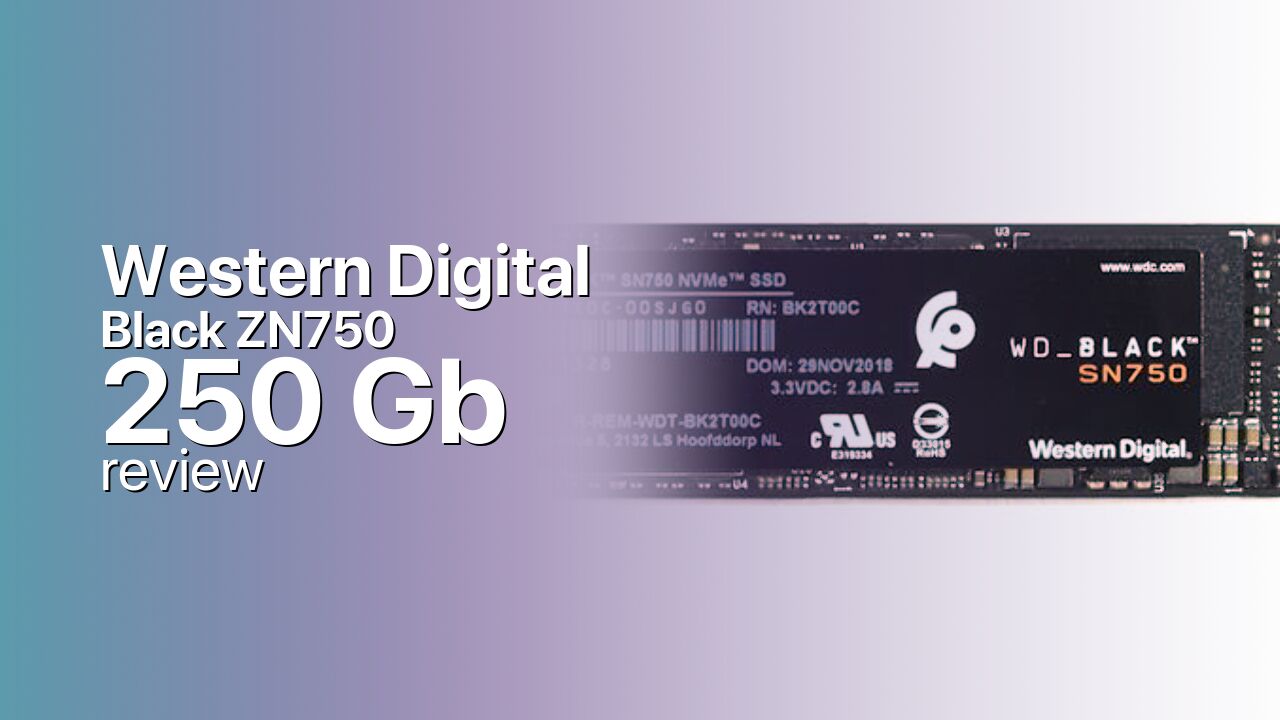
Western Digital's Black SN750 series spans from 250GB to 2TB, but the 250GB model is the outlier in terms of performance. While it uses the same SanDisk 64-layer TLC NAND and WD-designed controller as the larger capacities, the 250GB variant is rated at only 3,100 MB/s sequential reads and 1,600 MB/s writes—a sharp drop from the 500GB model's 3,470/2,600 MB/s and the 1TB's full 3,470/3,000 MB/s ratings. The random IOPS also suffer at 220K/180K versus 420K/380K on the 500GB. This is typical for smaller NVMe drives, which have fewer NAND packages to parallelize operations.
Internally, the 250GB SN750 includes 512MB of SK Hynix DDR4 DRAM cache—half the amount of larger capacities, but still a full DRAM implementation rather than the host memory buffer (HMB) scheme used by DRAM-less budget drives. This helps the drive maintain consistent performance as it fills, though the reduced capacity means the SLC cache is smaller and will exhaust faster under sustained writes. The drive ships in the standard M.2 2280 single-sided form factor, fitting thin laptops and the PS5 expansion slot.
The SN750 250GB competes with entry-level NVMe drives like the Sabrent Rocket and addlink S70, as well as Samsung's 970 EVO (non-Plus). Samsung's drive has a slight edge in sustained write performance, while the SN750 trades on WD's firmware optimizations and Gaming Mode utility. For most users, the 250GB capacity is best suited as a boot/OS drive paired with a larger HDD or SATA SSD for bulk storage. The 200 TBW endurance rating is adequate for this use case—writing 30 GB per day would take roughly 18 years to exhaust the warranty.
Storage Comparisons:
Black ZN750 Performance & Benchmarks
The WD Black SN750 250GB is rated at 3,100 MB/s sequential reads and 1,600 MB/s sequential writes. These are significantly lower than the larger capacities in the same series—the 500GB jumps to 3,470/2,600 MB/s, and the 1TB hits 3,470/3,000 MB/s. Random 4K performance is rated at 220,000 IOPS reads and 180,000 IOPS writes, roughly half the IOPS of the 500GB and 1TB models.
Western Digital Black ZN750 250 GB vs M.2 3.0 x 4 peers
Switch between sequential throughput and random IOPS to see how this drive stacks up against other M.2 3.0 x 4 SSDs in our database. The highlighted bar is the drive on this page — click any other bar to open that drive.
- ADATA SX 8800 Pro 512 GB: 3,500 MB/s read, 2,700 MB/s write
- ADATA SX 8800 Pro 1 TB: 3,500 MB/s read, 2,700 MB/s write
- ADATA XPG Spectrix S40G RGB 256 GB: 3,500 MB/s read, 3,000 MB/s write
- ADATA XPG Spectrix S40G RGB 512 GB: 3,500 MB/s read, 3,000 MB/s write
- Western Digital Black ZN750 250 GB (this drive): 3,100 MB/s read, 1,600 MB/s write
The performance drop on the 250GB model is due to fewer NAND die for parallel operations. NVMe speed scales with the number of NAND packages the controller can address simultaneously, and a 250GB drive simply has less silicon to work with. In real-world testing, the 250GB SN750 still delivers a massive jump over SATA SSDs in sequential throughput—roughly 4–5x faster reads and 3–4x faster writes. However, the gap to larger NVMe drives is noticeable in large file transfers. Copying a 50GB game from another NVMe drive will take longer on this 250GB model than on a 1TB SN750.
The SLC cache on the 250GB variant is smaller than on larger capacities, typically around 3–5 GB of pseudo-SLC before the drive drops to native TLC write speeds. For gaming and desktop use, this is adequate—game installs are read-heavy operations, and most write bursts (downloads, patches, document saves) fit within the cache. Sustained writes like 50+ GB file transfers will eventually drop to TLC speeds of roughly 800–1,000 MB/s, which is still faster than SATA but well below the cached burst rate.
Western Digital Black ZN750 vs Competitors
See how the Black ZN750 stacks up against other M.2 3.0 x 4 drives in our database:
Compare with rival drives:
Endurance, TBW & Warranty
Western Digital rates the SN750 250GB at 200 TBW endurance over a 5-year warranty period. This is half the endurance of the 500GB model and a third of the 1TB's 600 TBW rating. In practical terms, writing 30 GB per day would take roughly 18 years to reach 200 TBW. For a boot/OS drive workload, which typically sees far fewer writes, this is more than sufficient for the drive's useful life.
The MTBF rating is 1.75 million hours, consistent across the SN750 series. WD handles warranty claims directly through their support portal, and the drive is covered for 5 years or until the TBW limit is exceeded, whichever comes first. Unlike some competitors, WD does not include data migration software or cloning tools with the SN750—you will need to provide your own solution if you are upgrading an existing boot drive. Consider Macrium Reflect or the free version of Clonezilla for this purpose.
Western Digital Black ZN750 250 GB Specifications
| Category | Value |
|---|---|
| Capacity [?] | 250 GB |
| Interface [?] | M.2 3.0 x 4 |
| Controller [?] | SanDisk 20-82-007011 |
| Memory type [?] | SanDisk 64L TLC |
| DRAM [?] | SK Hynix 1GB DDR4 SDRAM |
| Read speed (MB/s) [?] | 3100 |
| Write speed (MB/s) [?] | 1600 |
| Read IOPS [?] | 220000 |
| Write IOPS [?] | 180000 |
| Endurance (TBW) [?] | 200 |
| MTBF (million hours) [?] | 1.75 |
| Warranty (years) [?] | 5 |
Verdict: Is the Black ZN750 Worth It in 2026?
The WD Black SN750 250GB is a capable boot drive for budget builds and users migrating from SATA SSDs who want the NVMe experience without spending more than necessary. The 3,100 MB/s read speed delivers the snappy responsiveness expected from NVMe, and the full DRAM cache (albeit 512MB rather than 1GB) prevents the performance inconsistency seen in DRAM-less HMB drives. Buy it if you need a fast OS boot drive on a tight budget and plan to store games and media on a separate larger drive.
Skip it if you can afford the 500GB model—the extra $30–40 buys dramatically faster write speeds (1,600 to 2,600 MB/s), double the endurance, and a usable amount of storage for a few games alongside Windows. The 250GB capacity is uncomfortably small in 2026; a Windows 11 installation alone can consume 80–100 GB, leaving little room for anything else. Consider the WD Blue SN580 or Sabrent Rocket Q if budget is the primary concern and you need more storage, but be aware those are DRAM-less drives with weaker random performance.
+ Pros
- 3,100 MB/s sequential reads—4–5x faster than SATA SSDs
- Full DRAM cache with 512MB SK Hynix DDR4 for consistent random I/O
- Single-sided M.2 2280 form factor fits laptops and PS5
- Gaming Mode in WD SSD Dashboard disables aggressive power saving
- 200 TBW endurance with 5-year warranty adequate for boot drive use
- Cons
- Write speeds drop sharply versus larger capacities (1,600 MB/s vs 2,600–3,000 MB/s)
- Random IOPS roughly half of 500GB and 1TB models (220K/180K vs 420K/380K)
- Only 200 TBW endurance—half of 500GB model
- 250GB capacity is tight for Windows 11 plus more than a handful of games
- No hardware encryption support
Buy this or similar SSD Storage:
Video Review
SSD Battle Royale - Samsung 970 EVO Plus vs WD Black SN750 | Hardware