BIWIN Black Opal NV7400 1TB: DRAM-less PCIe 4.0 Speed (2026)
Quick answer
The Black Opal NV7400 1TB suits budget and mainstream builders who want near-flagship sequential speed without paying for a DRAM chip they may not need, including PS5 owners and thin-laptop upgraders.
Read: 7400 MB/s Write: 6500 MB/s Endurance: 1000 TBW Warranty: 5 years Interface: M.2 4.0 x 4
The BIWIN Black Opal NV7400 1TB pairs a DRAM-less Maxio controller with Host Memory Buffer to hit 7,400 MB/s reads, matching DRAM-equipped rivals at a lower cost.
Controller & Memory
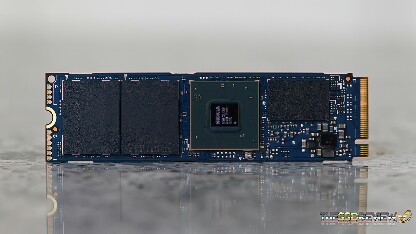
The NV7400 1TB runs a Maxio MAP1602A-F3C controller, a 4-channel NVMe 2.0 chip that skips onboard DRAM and instead borrows a slice of system RAM through Host Memory Buffer to hold its mapping tables. It's paired with 3D TLC NAND; independent reviews of other capacities in this line report Micron's 232-layer B58R flash, though BIWIN's own spec sheet doesn't name a NAND vendor for every capacity. The DRAM-less design trades a small amount of steady-state random performance for lower power draw and heat, which matters more in thin laptops and small-form-factor desktops than in a full tower with plenty of airflow.
BIWIN sells this line in 512GB, 1TB, 2TB, and 4TB capacities, and the 1TB sits close to the ceiling: 512GB drops to 4,200 MB/s writes and 800K IOPS, while 1TB and 2TB both reach the full 7,400 MB/s read and 6,500 MB/s write rating advertised for the series. Endurance scales roughly linearly with capacity across the line, from 500 TBW at 512GB up to 4,000 TBW at 4TB, so the 1TB's 1,000 TBW rating sits squarely in the middle.
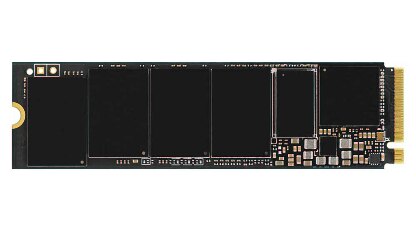
As a single-sided M.2 2280 drive with no DRAM chip to cool, the NV7400 fits thin laptops and small-form-factor builds without extra thermal headroom, and it competes against other DRAM-less PCIe 4.0 drives like the WD Blue SN580, Crucial P3 Plus, and Teamgroup MP44 rather than DRAM-equipped flagships like the Samsung 990 Pro. Its main pitch against those DRAM-less rivals is a higher rated sequential speed at a similar street price.
Storage Comparisons:
Black Opal NV7400 Performance & Benchmarks
The 1TB Black Opal NV7400 is rated for 7,400 MB/s sequential reads and 6,500 MB/s sequential writes, with random performance rated up to 1,000,000 IOPS reading and 900,000 IOPS writing. Hitting DRAM-equipped-flagship sequential numbers on a DRAM-less controller is the NV7400's main selling point; the Maxio MAP1602A-F3C leans on Host Memory Buffer and an SLC write cache to get there rather than dedicated onboard DRAM.
BIWIN Black Opal NV7400 1 TB vs M.2 4.0 x 4 peers
Switch between sequential throughput and random IOPS to see how this drive stacks up against other M.2 4.0 x 4 SSDs in our database. The highlighted bar is the drive on this page — click any other bar to open that drive.
- Patriot Viper PV593 1 TB: 14,500 MB/s read, 14,000 MB/s write
- Patriot Viper PV593 2 TB: 14,500 MB/s read, 14,000 MB/s write
- Patriot Viper PV593 4 TB: 14,500 MB/s read, 14,000 MB/s write
- Patriot Viper PV573 2 TB: 14,000 MB/s read, 12,000 MB/s write
- BIWIN Black Opal NV7400 1 TB (this drive): 7,400 MB/s read, 6,500 MB/s write
That SLC cache is where the trade-off shows up: once a sustained write outruns it, throughput drops toward the native TLC write speed, and DRAM-less drives generally see a steeper drop than DRAM-equipped ones once the cache is exhausted. BIWIN doesn't publish the exact cache size, so buyers moving very large files (bulk footage transfers, full game library moves) should expect the write speed to taper on a long, continuous copy rather than holding 6,500 MB/s throughout. For everyday use, boot times, game loads, and level streaming, the 1TB capacity's read speed comfortably clears PS5's 5,500 MB/s minimum, and it's fast enough for DirectStorage-enabled PC games without being the bottleneck. Random IOPS matter less than sequential speed for most desktop use, but the rated 1,000,000/900,000 figures are competitive with DRAM-equipped drives a tier above this one on price.
BIWIN Black Opal NV7400 vs Competitors
See how the Black Opal NV7400 stacks up against other M.2 4.0 x 4 drives in our database:
Compare with rival drives:
Endurance, TBW & Warranty
The 1TB Black Opal NV7400 carries a 1,000 TBW endurance rating and a 5-year warranty. At a typical consumer workload of 30 to 50GB written per day, 1,000 TBW takes roughly 55 to 90 years to exhaust, well past both the warranty term and the drive's realistic service life. BIWIN also rates the NV7400 at 1,500,000 hours MTBF, a population-level statistic describing expected failure rates across a large batch of drives rather than a promise for any single unit. The 5-year warranty matches what DRAM-equipped rivals in this price tier typically offer, so buyers aren't giving up warranty coverage for the DRAM-less design, only some steady-state performance headroom. As with most consumer NVMe warranties, whichever limit arrives first ends coverage, so heavy write workloads that approach 1,000 TBW well before the 5-year mark would age out of endurance coverage rather than time.
BIWIN Black Opal NV7400 1 TB Specifications
| Category | Value |
|---|---|
| Capacity [?] | 1 TB |
| Interface [?] | M.2 4.0 x 4 |
| Controller [?] | Maxio MAP1602A |
| Memory type [?] | Biwin 3D TLC |
| DRAM [?] | No |
| Read speed (MB/s) [?] | 7400 |
| Write speed (MB/s) [?] | 6500 |
| Read IOPS [?] | 1000000 |
| Write IOPS [?] | 900000 |
| Endurance (TBW) [?] | 1000 |
| MTBF (million hours) [?] | 1500000 |
| Warranty (years) [?] | 5 |
Verdict: Is the Black Opal NV7400 Worth It in 2026?
The Black Opal NV7400 1TB suits budget and mainstream builders who want near-flagship sequential speed without paying for a DRAM chip they may not need, including PS5 owners and thin-laptop upgraders. Buyers doing frequent large sustained writes, like video editors dumping 4K footage daily, should lean toward a DRAM-equipped drive that holds its write speed longer once the SLC cache fills. The WD Blue SN580 and Crucial P3 Plus are the closest DRAM-less alternatives if brand reputation and a longer independent track record matter more than BIWIN's slightly higher rated write speed. For a primary game or OS drive on a budget, the NV7400's 7,400 MB/s reads, 1,000 TBW endurance, and full 5-year warranty make it a reasonable pick.
+ Pros
- 7,400 MB/s reads rival DRAM-equipped drives
- 1,000 TBW endurance at 1TB
- Full 5-year warranty
- NVMe 2.0 controller support
- Lower power draw from DRAM-less design
- Ships across 512GB to 4TB capacities
- Cons
- Write speed tapers once SLC cache fills
- No onboard DRAM for mapping tables
- 512GB sibling drops to 4,200 MB/s writes
- Fewer independent long-term reviews than WD or Crucial
- No official Sony PS5 compatibility listing
Buy this or similar SSD Storage:



Video Review
Testing My FIRST Biwin SSD! — Biwin Black Opal NV7400 2TB