ADATA Legend 850 512 GB: A DRAM-less PCIe 4.0 NVMe SSD (2026)
Quick answer
Pick the ADATA Legend 850 512 GB for a budget PCIe 4.0 boot drive in a laptop or small-form-factor desktop where the single-sided PCB and cool-running SM2269XTF controller earn their keep without demanding a heatsink.
Read: 5000 MB/s Write: 2700 MB/s Endurance: 500 TBW Warranty: 5 years Interface: M.2 4.0 x 4
The ADATA Legend 850 512 GB pairs a Silicon Motion SM2269XTF controller with HMB on a single-sided M.2 2280 PCB, making it a practical DRAM-less PCIe 4.0 boot drive for laptops and budget desktops.
Controller & Memory
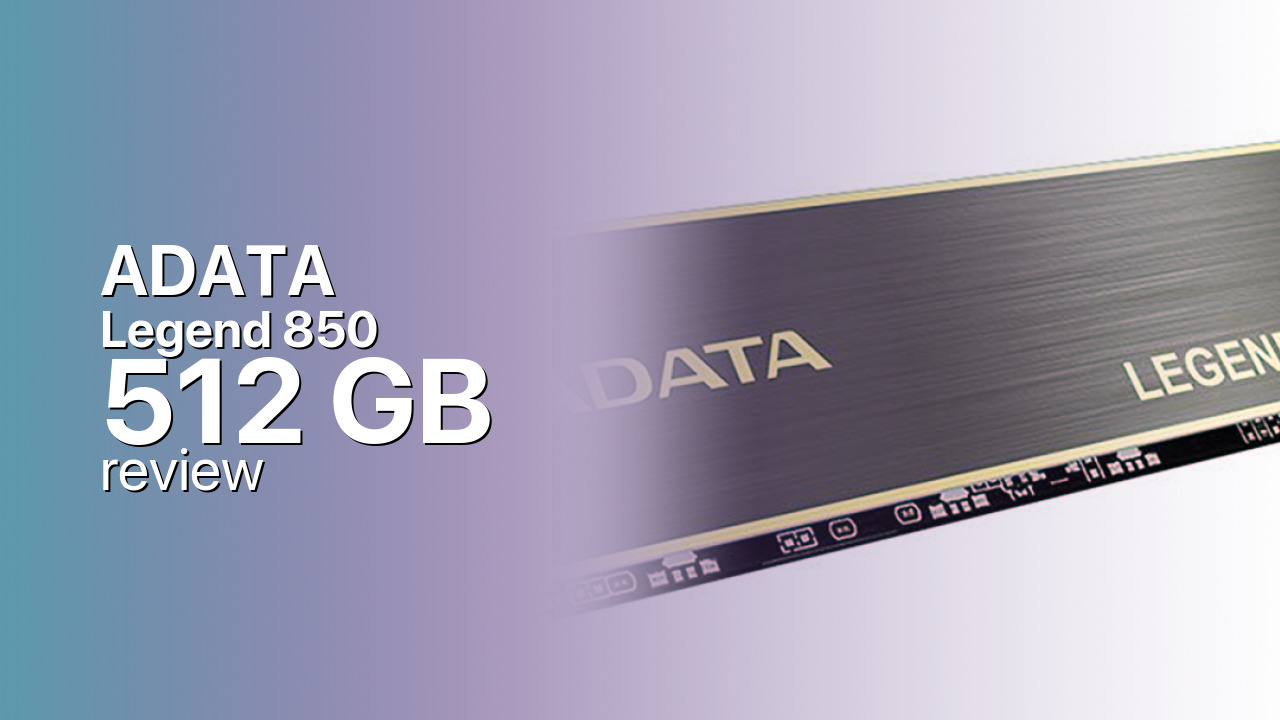
The ADATA Legend 850 512 GB runs a Silicon Motion SM2269XTF four-channel controller paired with 3D TLC NAND on a single-sided M.2 2280 PCB. The SM2269XTF is a DRAM-less design that leans on Host Memory Buffer technology, borrowing a slice of the host system's RAM for its mapping tables instead of carrying an onboard DRAM chip. That trade-off shaves cost and power draw at the expense of a few percentage points of random-I/O responsiveness, a reasonable swap for a budget PCIe 4.0 drive. The single-sided layout fits easily into thin laptops, ultrabooks, and Mini-ITX boards where double-sided modules can foul against the chassis, and the controller itself runs cool enough that thermal throttling is rarely an issue even without a heatsink.
ADATA sells the Legend 850 in 512 GB, 1 TB, and 2 TB capacities, and the 512 GB variant is the odd one out on writes: it is rated at 5,000 MB/s sequential reads but only 2,700 MB/s writes, where the 1 TB and 2 TB siblings hit 4,500 MB/s writes. The read ceiling is the same across the line, so for a boot drive or game library that mostly reads, the 512 GB loses little; only sustained write-heavy workflows feel the gap. ADATA also produced a Limited Edition of the 512 GB with a patterned heatsink designed by German artist Mister Fred, though a standard bare-drive version is more commonly stocked at retail.
On the compatibility front, the drive fits any M.2 NVMe slot, backward-compatible with PCIe 3.0 at reduced bandwidth, and it clears Sony's physical spec for the PS5 expansion bay, though its 5,000 MB/s read falls slightly short of Sony's 5,500 MB/s recommendation. In practice it works in the PS5, but a drive rated at 5,500 MB/s or above sidesteps the caveat entirely. The natural rivals in the budget DRAM-less PCIe 4.0 segment are the WD Blue SN580, which trades the SM2269XTF for a Western Digital in-house controller with similar HMB behaviour, and the Kingston NV2, which is cheaper but uses a variable-controller lottery that makes its performance harder to pin down. The Crucial P3 500 GB sits in the same price band but cuts endurance with QLC NAND, so the Legend 850's TLC gives it a durability edge for boot-drive duty.
Storage Comparisons:
Legend 850 Performance & Benchmarks
Rated sequential performance on the ADATA Legend 850 512 GB is 5,000 MB/s reads and 2,700 MB/s writes over a PCIe 4.0 x4 link, backed by up to 380,000 random read IOPS and 530,000 random write IOPS. Those numbers sit in the middle of the DRAM-less PCIe 4.0 pack: reads match what the SM2269XTF platform can extract from four PCIe 4.0 lanes, while the 2,700 MB/s write ceiling reflects both the 512 GB capacity's lower NAND parallelism and the controller's cost-optimised four-channel layout. ADATA's own testing on a PS5 reports roughly 4,000 MB/s sequential reads, a step down from the 5,000 MB/s PC figure but still well above the PS5's internal storage baseline.
ADATA Legend 850 512 GB vs M.2 4.0 x 4 peers
Switch between sequential throughput and random IOPS to see how this drive stacks up against other M.2 4.0 x 4 SSDs in our database. The highlighted bar is the drive on this page — click any other bar to open that drive.
- Patriot Viper PV593 1 TB: 14,500 MB/s read, 14,000 MB/s write
- Patriot Viper PV593 2 TB: 14,500 MB/s read, 14,000 MB/s write
- Patriot Viper PV593 4 TB: 14,500 MB/s read, 14,000 MB/s write
- Patriot Viper PV573 2 TB: 14,000 MB/s read, 12,000 MB/s write
- ADATA Legend 850 512 GB (this drive): 5,000 MB/s read, 2,700 MB/s write
In real-world use the Legend 850 behaves like a competent HMB drive. The SLC write cache absorbs bursty desktop workloads and game installs at full speed, and while the cache is smaller on the 512 GB than on the 1 TB or 2 TB variants, a boot drive rarely sees the kind of sustained multi-hundred-gigabyte write that would deplete it. Game load times are indistinguishable from a DRAM-cached PCIe 4.0 drive in blind testing because the bottleneck shifts to the CPU and asset decompression long before the SSD's random-read latency becomes the limit. For a dedicated scratch disk or a workflow that regularly ingests large video files, the 512 GB Legend 850 is the wrong tool because of the lower write ceiling and smaller cache; for a boot drive or secondary game library, it is sensibly matched.
ADATA Legend 850 vs Competitors
See how the Legend 850 stacks up against other M.2 4.0 x 4 drives in our database:
Compare with rival drives:
Endurance, TBW & Warranty
ADATA covers the Legend 850 512 GB with a five-year limited warranty, capped at 500 TBW, whichever comes first. That 500 TBW endurance rating is the entry point of a lineup that scales to 600 TBW on the 1 TB and 1,200 TBW on the 2 TB, so the 512 GB actually carries a higher TBW-per-terabyte ratio than its larger siblings, an unusual outcome that favours the small drive in longevity. At a moderate consumer workload of 20 GB of writes per day, the NAND would take nearly 70 years to exhaust; even a heavier 50 GB-per-day routine clears 27 years, so the five-year warranty term will expire long before the flash does. ADATA rates the drive at up to 1.5 million hours MTBF, a population-level reliability statistic that describes expected failure rates across a large fleet rather than the lifespan of any single unit. The Legend 850 also supports AES 256-bit hardware encryption, a feature often omitted on entry-level PCIe 4.0 drives.
ADATA Legend 850 512 GB Specifications
| Category | Value |
|---|---|
| Capacity [?] | 512 GB |
| Interface [?] | M.2 4.0 x 4 |
| Controller [?] | Silicon Motion SM2269XTF 4 Channel |
| Memory type [?] | 3D TLC |
| DRAM [?] | HMB |
| Read speed (MB/s) [?] | 5000 |
| Write speed (MB/s) [?] | 2700 |
| Read IOPS [?] | 380000 |
| Write IOPS [?] | 530000 |
| Endurance (TBW) [?] | 500 |
| MTBF (million hours) [?] | 1500000 |
| Warranty (years) [?] | 5 |
Verdict: Is the Legend 850 Worth It in 2026?
Pick the ADATA Legend 850 512 GB for a budget PCIe 4.0 boot drive in a laptop or small-form-factor desktop where the single-sided PCB and cool-running SM2269XTF controller earn their keep without demanding a heatsink. Skip it for a write-heavy workstation, where the 512 GB variant's 2,700 MB/s write ceiling and smaller SLC cache create a bottleneck the 1 TB model avoids, and pass on it for a PlayStation 5 if staying above Sony's 5,500 MB/s recommended read floor matters without the caveat. The closest alternative in the same HMB PCIe 4.0 tier is the WD Blue SN580 500 GB, which trades the SM2269XTF for a WD controller but delivers comparable real-world responsiveness. The Legend 850 512 GB does nothing flashy, but 500 TBW of TLC endurance, a five-year warranty, and a laptop-friendly form factor make it a quietly defensible choice in a segment increasingly crowded with corner-cut QLC drives.
+ Pros
- 5,000 MB/s sequential reads on PCIe 4.0
- 500 TBW endurance, higher TBW-per-TB than the 1 TB sibling
- Single-sided M.2 2280 PCB fits thin laptops
- AES 256-bit hardware encryption
- Five-year warranty, TBW-limited
- Cool-running SM2269XTF controller, rarely needs a heatsink
- Cons
- 2,700 MB/s writes well below the 1 TB and 2 TB siblings
- No onboard DRAM cache, HMB only
- Read speed slightly below Sony's PS5 recommendation
- Smaller SLC cache versus higher capacities in the line
- No included heatsink on the standard variant
Buy this or similar SSD Storage:



Video Review
REVIEW (2026): ADATA Legend 850 512GB SSD. ESSENTIAL details.