Lexar NM790 8TB Review — Maximum Capacity, Gen4 Maturity (2026)
Quick answer
Buy the Lexar NM790 8TB if the goal is one stick that ends capacity conversations — a maxed-out PS5, a home-media library, or an archive drive that never needs a follow-up purchase.
Read: 7000 MB/s Write: 6200 MB/s Endurance: 6000 TBW Warranty: 5 years Interface: M.2 4.0 x 4
The Lexar NM790 8TB maxes out what a single M.2 slot can hold, pairing 7,000 MB/s reads with 6,000 TBW of endurance on the DRAM-less NM790 platform.
Controller & Memory
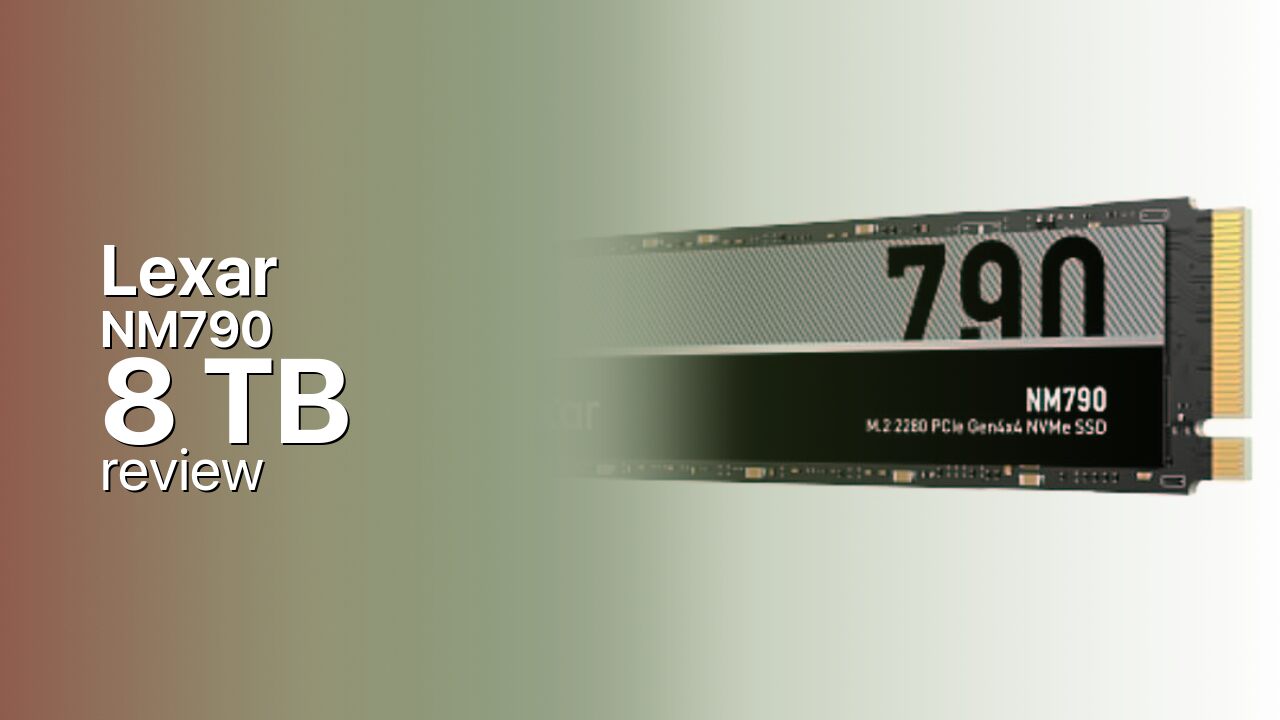
With eight terabytes on a single M.2 2280 stick, the Lexar NM790 8TB is the ceiling of its range: the same Maxio MAP1602 12nm controller, the same YMTC 232-layer TLC platform, and the same DRAM-less architecture that leans on Host Memory Buffer 3.0 and dynamic SLC caching. The capacity bump does come with a spec trade — rated speeds settle at 7,000 MB/s reads and 6,200 MB/s writes instead of the 7,400/6,500 MB/s smaller capacities claim, and random reads top out at 850K IOPS. AES-256 hardware encryption and TCG Opal 2.0 carry over unchanged.
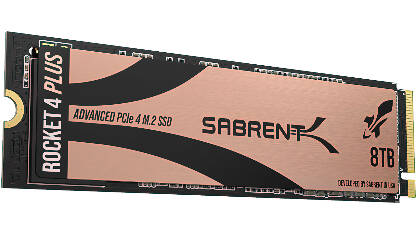
The 8TB model arrived after the rest of the lineup as a data-hoarder play, and its endurance rating scales accordingly: 6,000 TBW, double the 4 TB model's 3,000 TBW, under the same 5-year warranty. Tom's Hardware's coverage of the launch framed it exactly that way — a capacity doubling with a small speed give-back, on a formatted 8,192 GB. Few PCIe 4.0 drives reach 8 TB at all, and the ones that do — the Sabrent Rocket 4 Plus and Corsair MP600 Pro XT in 8 TB trims — are DRAM-equipped flagships positioned a tier higher. For bulk single-slot storage on a Gen4 board, the NM790 8TB is one of the few mainstream options.
The audience is anyone whose library outgrew 4 TB: massive game collections, multi-terabyte photo and video archives, or a home lab that wants one stick instead of two. The PS5 accepts M.2 drives up to 8 TB, so this fills a console to its maximum supported capacity in one slot — though a heatsink still has to fit inside Sony's 11.25 mm height limit, and since Lexar does not publish the 8 TB PCB layout, buyers planning an ultra-thin install should check thickness on arrival. Against the 4 TB model, you trade a little peak write speed for a doubling of space and endurance.
Storage Comparisons:
NM790 Performance & Benchmarks
Lexar rates the 8TB NM790 at 7,000 MB/s sequential reads and 6,200 MB/s writes, with random performance of up to 850K read and 900K write IOPS. Those numbers sit below the smaller capacities' ratings, but the context is generous: Sony's PS5 guidance recommends 5,500 MB/s, so the derated 8TB still clears the console's target with room to spare, and PCIe 4.0's real-world ceiling means the 200 MB/s give-back against the 4 TB model is rarely perceptible. DirectStorage titles, PS5 game loads, and multi-gigabyte archive transfers all run at the front of the PCIe 4.0 field.
Lexar NM790 8 TB vs M.2 4.0 x 4 peers
Switch between sequential throughput and random IOPS to see how this drive stacks up against other M.2 4.0 x 4 SSDs in our database. The highlighted bar is the drive on this page — click any other bar to open that drive.
- Patriot Viper PV593 1 TB: 14,500 MB/s read, 14,000 MB/s write
- Patriot Viper PV593 2 TB: 14,500 MB/s read, 14,000 MB/s write
- Patriot Viper PV593 4 TB: 14,500 MB/s read, 14,000 MB/s write
- Patriot Viper PV573 2 TB: 14,000 MB/s read, 12,000 MB/s write
- Lexar NM790 8 TB (this drive): 7,000 MB/s read, 6,200 MB/s write
The DRAM-less caveats carry over too. A dynamic SLC cache absorbs writes at rated speed, then throughput drops to native TLC rates once the cache fills — and at 8 TB, transfers are more likely to be large enough to reach that point, so sustained-copy behavior matters more here than on smaller capacities. Thermals follow the same logic: denser flash in one 2280 footprint wants airflow, and testing across the NM790 line has shown thermal throttling during extended SNIA stress writes without a heatsink. Tom's Hardware's review work on the series highlighted sustained performance and efficiency as strengths, and nothing in the 8TB's design suggests a departure from that character.
Lexar NM790 vs Competitors
See how the NM790 stacks up against other M.2 4.0 x 4 drives in our database:
Compare with rival drives:
Endurance, TBW & Warranty
Lexar backs the NM790 8TB with a 5-year limited warranty rated to 6,000 TBW — double the 4 TB model and six times the 1 TB, preserving the series' roughly 600 TBW-per-terabyte scaling. At a demanding 40 GB written per day, exhaustion would take more than four centuries, so the rating is effectively theoretical for personal workloads. The MTBF is 1.5 million hours, a fleet-level figure rather than an individual promise. Firmware-level sudden power-loss protection, wear leveling, and bad-block management are built in, along with hardware AES-256 encryption. As with the rest of the range, warranty claims run through Lexar directly in most regions rather than through the retailer, so keeping proof of purchase matters.
Lexar NM790 8 TB Specifications
| Category | Value |
|---|---|
| Capacity [?] | 8 TB |
| Interface [?] | M.2 4.0 x 4 |
| Controller [?] | Maxiotech MAP1602A |
| Memory type [?] | YMTC 232-L TLC |
| DRAM [?] | No |
| Read speed (MB/s) [?] | 7000 |
| Write speed (MB/s) [?] | 6200 |
| Read IOPS [?] | 850000 |
| Write IOPS [?] | 900000 |
| Endurance (TBW) [?] | 6000 |
| MTBF (million hours) [?] | 1500000 |
| Warranty (years) [?] | 5 |
Verdict: Is the NM790 Worth It in 2026?
Buy the Lexar NM790 8TB if the goal is one stick that ends capacity conversations — a maxed-out PS5, a home-media library, or an archive drive that never needs a follow-up purchase. Skip it if peak write speed leads the wishlist; the 4 TB model's 6,500 MB/s rating and lighter thermals make it the better pure-performance buy, and DRAM-equipped rivals like the Sabrent Rocket 4 Plus 8TB hold steadier under brutal sustained loads. Within the NM790 range this is the capacity play, not the speed play — but with 6,000 TBW behind it, the endurance math favors it over every smaller sibling. For bulk PCIe 4.0 storage in 2026, it is the practical default.
+ Pros
- 6,000 TBW endurance with a 5-year warranty
- 8 TB on a single M.2 2280 stick
- 7,000 MB/s reads clear the PS5 recommendation
- Rated up to 900K random-write IOPS
- AES-256 encryption with TCG Opal 2.0
- HMB 3.0 design draws less power than DRAM drives
- Cons
- Rated speeds dip to 7,000/6,200 MB/s
- No DRAM cache on the PCB
- No heatsink included on the base model
- SLC cache exhaustion slows very large transfers
Buy this or similar SSD Storage:



Video Review
NEW BEST BUDGET SSD? | Lexar NM790 SSD review