BIWIN Black Opal NV7400 512GB — DRAM-less PCIe 4.0 on a Budget (2026)
Quick answer
The BIWIN Black Opal NV7400 512 GB is a competent entry-level PCIe 4.0 NVMe for a budget build, a boot drive, or a light gaming library, built on a proven MAP1602A-plus-Micron-B58R platform that independent reviewers have validated at higher capacities.
Read: 7050 MB/s Write: 4200 MB/s Endurance: 500 TBW Warranty: 5 years Interface: M.2 4.0 x 4
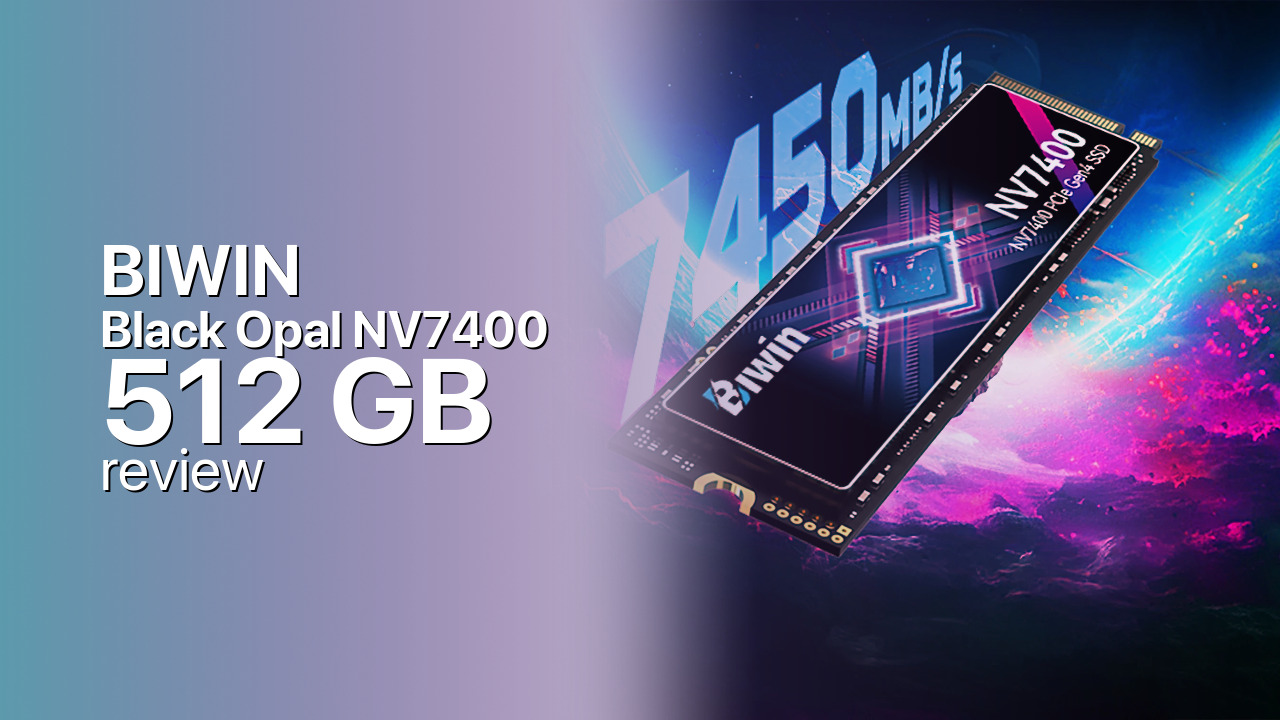
The BIWIN Black Opal NV7400 512 GB is a DRAM-less PCIe 4.0 NVMe built on the Maxio MAP1602A controller and Micron B58R NAND, delivering 7,050 MB/s reads and a 5-year warranty on a single-sided PCB.
Controller & Memory
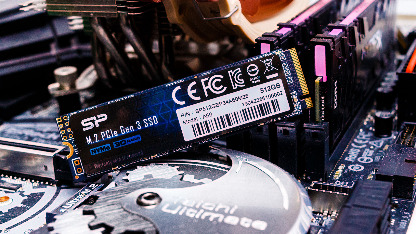
The NV7400 is BIWIN's DRAM-less PCIe 4.0 line, built on the Maxio MAP1602A controller paired with Micron 232-layer B58R 3D TLC NAND, the same controller-and-NAND combination that powers a wave of current-generation budget-performance Gen4 drives. The MAP1602A is a 12 nm quad-channel design with no on-drive DRAM — it uses Host Memory Buffer (HMB) to borrow a small slice of system RAM for its flash translation layer mapping table. That architecture keeps the bill of materials low while delivering Gen4-class sequential speeds, though sustained random I/O under heavy mixed workloads will not match a discrete-DRAM flagship. The drive ships on a single-sided M.2 2280 PCB with a 1 mm graphene thermal pad bonded to the label, enough to keep temperatures in check for typical consumer workloads without adding bulk.
The 512 GB capacity reviewed here is the entry-level SKU of the NV7400 line, and it is the most sharply capacity-tiered. BIWIN also offers 1 TB, 2 TB, and 4 TB variants, all of which reach 7,400 MB/s reads and 6,500 MB/s writes with 1,000,000 random read IOPS. The 512 GB drops to 7,050 MB/s reads and 4,200 MB/s writes, and its random IOPS settle at 800,000 for both read and write, because the fewer NAND dies on the smaller PCB limit the controller's ability to stripe writes in parallel. This is a capacity-tiering pattern seen across every DRAM-less Gen4 platform — the 512 GB is genuinely slower, not just smaller. Buyers who need full sequential write speed should step up to the 1 TB model.
The NV7400 competes directly with other DRAM-less PCIe 4.0 drives in the 500 GB class: the WD Blue SN580, Kingston NV3, and Team Group MP44L. Against those, the NV7400's calling cards are its 5-year warranty (the SN580 and NV3 carry 5 years, but many budget DRAM-less drives ship with 3), its single-sided form factor (fits thin laptops and the PlayStation 5 expansion bay), and the proven MAP1602A-plus-Micron-B58R platform, which independent reviewers have benchmarked extensively in other drives built on the same silicon. The main caveat is availability — BIWIN's retail presence is concentrated in Asia-Pacific, and North American and European buyers may find the drive harder to source than a WD or Kingston equivalent.
Storage Comparisons:
Black Opal NV7400 Performance & Benchmarks
Biwin rates the NV7400 512 GB at 7,050 MB/s sequential reads and 4,200 MB/s sequential writes over PCIe 4.0 x4, with up to 800,000 random read and 800,000 random write IOPS. The read figure sits close to the PCIe 4.0 ceiling; the write figure reflects the capacity-tiered reality of a 512 GB DRAM-less drive with fewer NAND dies — the 1 TB and larger capacities reach 6,500 MB/s writes and 1,000,000 random read IOPS because they populate enough dies to stripe writes across the MAP1602A four channels at full speed. For a boot drive or a light game library, 4,200 MB/s is still roughly eight times a SATA ceiling, and the 800,000 random IOPS keep OS responsiveness and game load times firmly in NVMe territory.
BIWIN Black Opal NV7400 512 GB vs M.2 4.0 x 4 peers
Switch between sequential throughput and random IOPS to see how this drive stacks up against other M.2 4.0 x 4 SSDs in our database. The highlighted bar is the drive on this page — click any other bar to open that drive.
- Patriot Viper PV593 1 TB: 14,500 MB/s read, 14,000 MB/s write
- Patriot Viper PV593 2 TB: 14,500 MB/s read, 14,000 MB/s write
- Patriot Viper PV593 4 TB: 14,500 MB/s read, 14,000 MB/s write
- Patriot Viper PV573 2 TB: 14,000 MB/s read, 12,000 MB/s write
- BIWIN Black Opal NV7400 512 GB (this drive): 7,050 MB/s read, 4,200 MB/s write
The MAP1602A uses an SLC write cache to deliver rated burst speeds, after which sustained writes drop to native TLC speed — behaviour shared with every consumer NVMe in this class. Independent reviews of the NV7400 2 TB and 4 TB models show the controller running cool and the SLC cache recovering quickly, with cache size scaling to capacity, though no dedicated 512 GB benchmarks have been published. The 512 GB cache is proportionally smaller than the 2 TB. For the OS-and-games workload a 512 GB DRAM-less drive typically serves, the cache is large enough that a user rarely exhausts it. The drive supports NVMe 2.0 and HMB, benefiting DirectStorage-compatible titles where the API is enabled, though the DRAM-less architecture means sustained mixed-workload latency runs higher than a discrete-DRAM alternative.
BIWIN Black Opal NV7400 vs Competitors
See how the Black Opal NV7400 stacks up against other M.2 4.0 x 4 drives in our database:
Compare with rival drives:
Endurance, TBW & Warranty
BIWIN covers the Black Opal NV7400 512 GB with a 5-year limited warranty, terminated at whichever arrives first between the term and the endurance rating of 500 TBW. At a typical consumer write workload of 20 GB per day, 500 TBW translates to roughly 68 years of writes — far beyond the practical life of a 512 GB consumer SSD, so the 5-year term is the binding coverage for almost every buyer. The 500 TBW figure is competitive for a DRAM-less PCIe 4.0 drive: the WD Blue SN580 500 GB carries 300 TBW, the Kingston NV3 500 GB carries 320 TBW, and the Team Group MP44L 500 GB carries 600 TBW, landing the NV7400 in the middle. BIWIN rates the drive at 1,500,000 hours MTBF, a standard population-level statistic that should not be read as a promise about any individual unit. The 5-year warranty is the practical takeaway — it matches the coverage on premium drives like the Samsung 990 Pro and WD Black SN850X, and it is the NV7400 strongest differentiator against budget DRAM-less competitors.
BIWIN Black Opal NV7400 512 GB Specifications
| Category | Value |
|---|---|
| Capacity [?] | 512 GB |
| Interface [?] | M.2 4.0 x 4 |
| Controller [?] | Maxio MAP1602A |
| Memory type [?] | Micron 232-layer 3D TLC |
| DRAM [?] | No |
| Read speed (MB/s) [?] | 7050 |
| Write speed (MB/s) [?] | 4200 |
| Read IOPS [?] | 800000 |
| Write IOPS [?] | 800000 |
| Endurance (TBW) [?] | 500 |
| MTBF (million hours) [?] | 1500000 |
| Warranty (years) [?] | 5 |
Verdict: Is the Black Opal NV7400 Worth It in 2026?
The BIWIN Black Opal NV7400 512 GB is a competent entry-level PCIe 4.0 NVMe for a budget build, a boot drive, or a light gaming library, built on a proven MAP1602A-plus-Micron-B58R platform that independent reviewers have validated at higher capacities. Its calling cards are the 5-year warranty, single-sided form factor, and 7,050 MB/s reads — all at a price undercutting most brand-name competitors. The cost of the 512 GB capacity is a sharply reduced sequential write speed (4,200 MB/s versus the 1 TB 6,500 MB/s) and proportionally lower random IOPS, making the 1 TB the better value for sustained-write or content-creation workloads. Buyers who cannot source the NV7400 easily outside Asia-Pacific should consider the WD Blue SN580 500 GB or Team Group MP44L 500 GB as widely available alternatives on similar silicon. For the budget builder in a market where BIWIN retails directly, the NV7400 512 GB pairs a genuine 5-year warranty with PCIe 4.0 speeds at Gen3-class pricing — a combination that earns its place in the value conversation.
+ Pros
- 7,050 MB/s reads — near the PCIe 4.0 ceiling at this price
- 5-year warranty — matches premium flagships, uncommon at this tier
- Single-sided M.2 2280 — fits thin laptops and PS5 expansion bay
- MAP1602A + Micron B58R is a proven, well-reviewed platform
- 500 TBW endurance — competitive against WD SN580 (300) and NV3 (320)
- Graphene thermal pad integrated into label, no added bulk
- Cons
- Write speed drops sharply at 512 GB — 4,200 vs 6,500 MB/s on the 1 TB
- DRAM-less HMB architecture limits sustained mixed-workload latency
- No hardware encryption enabled despite controller support for AES256
- Limited retail availability outside Asia-Pacific — hard to source in NA/EU
- No independent benchmarks published for the 512 GB capacity specifically
Buy this or similar SSD Storage:
Video Review
Testing My FIRST Biwin SSD! — Biwin Black Opal NV7400 2TB