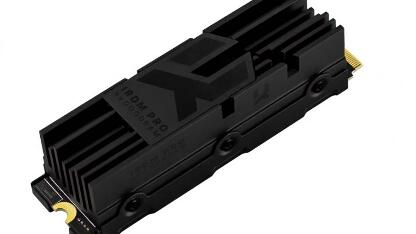
Gigabyte Aorus Gen4 2TB: high endurance, real heatsink (2026)
Quick answer
The Gigabyte Aorus Gen4 2TB suits desktop builders who want a DRAM-equipped drive with genuinely exceptional endurance and don't need the absolute fastest Gen4 numbers available today.
Read: 5000 MB/s Write: 4400 MB/s Endurance: 3600 TBW Warranty: 5 years Interface: M.2 4.0 x 4
The Gigabyte Aorus Gen4 2TB pairs a DRAM cache and full copper heatsink with an exceptionally high 3,600 TBW rating, even though its Phison E16 controller now trails newer Gen4 flagships on peak speed.
Controller & Memory
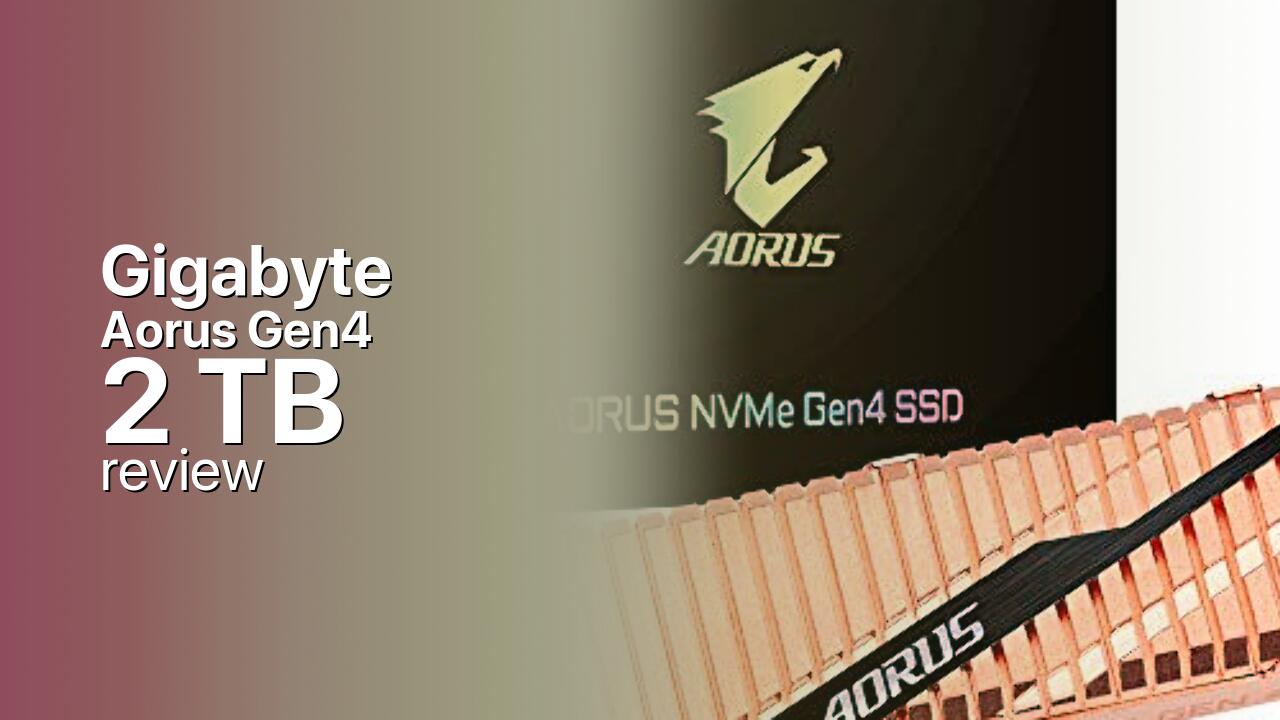
Gigabyte builds the Aorus Gen4 around a Phison PS5016-E16-32 eight-channel controller with 2 GB of DDR4 DRAM cache and Kioxia's (formerly Toshiba's) BiCS4 96-layer TLC NAND. It connects over PCIe 4.0 x4, NVMe 1.3, in an M.2 2280 form factor, and unlike most budget drives in its class it ships with a full copper heatsink and thermal pads on both sides of the PCB.
The Aorus Gen4 also ships in 500 GB and 1 TB capacities, and buyers should be careful not to confuse it with Gigabyte's newer 'Aorus Gen4 7000s' - a different, faster Phison E18-based drive that reaches 7,000 MB/s but carries a lower 1,400 TBW rating on its 2TB model. This original Aorus Gen4 trades outright peak speed for exceptional endurance headroom instead.
The included copper heatsink adds noticeable height, which is great for sustained desktop workloads but means this drive is not a fit for thin laptops or the PS5 without heatsink removal - check compatibility before buying for either use case. At this generation and tier it competes with other DRAM-equipped Phison E16-class drives like the Samsung 980 Pro and WD Black SN850, both of which are similarly positioned but with lower rated endurance than this drive's notably high 3,600 TBW.
Storage Comparisons:
Aorus Gen4 Performance & Benchmarks
Gigabyte rates the Aorus Gen4 2TB at up to 5,000 MB/s sequential reads and 4,400 MB/s sequential writes over PCIe 4.0 x4, with 750,000 random read IOPS and 700,000 random write IOPS. The Phison E16 is Phison's first-generation PCIe 4.0 controller, now several years old, so these numbers trail current Gen4 flagships that reach 7,000 MB/s or more.
Gigabyte Aorus Gen4 2 TB vs M.2 4.0 x 4 peers
Switch between sequential throughput and random IOPS to see how this drive stacks up against other M.2 4.0 x 4 SSDs in our database. The highlighted bar is the drive on this page — click any other bar to open that drive.
- Patriot Viper PV593 1 TB: 14,500 MB/s read, 14,000 MB/s write
- Patriot Viper PV593 2 TB: 14,500 MB/s read, 14,000 MB/s write
- Patriot Viper PV593 4 TB: 14,500 MB/s read, 14,000 MB/s write
- Patriot Viper PV573 2 TB: 14,000 MB/s read, 12,000 MB/s write
- Gigabyte Aorus Gen4 2 TB (this drive): 5,000 MB/s read, 4,400 MB/s write
What the Aorus Gen4 still delivers is consistency: the onboard 2 GB DRAM cache keeps mapping-table lookups fast and helps sustained performance hold up better under heavy multitasking than DRAM-less rivals, while the included copper heatsink manages thermals well under extended load without throttling. For gaming, general desktop use, and moderate content work, the real-world difference against faster newer drives is smaller than the spec sheet gap suggests, since most everyday tasks don't saturate a Gen4 x4 link's full bandwidth anyway, and the drive rarely runs into thermal throttling thanks to its included heatsink, even under sustained desktop workloads.
Gigabyte Aorus Gen4 vs Competitors
See how the Aorus Gen4 stacks up against other M.2 4.0 x 4 drives in our database:
Compare with rival drives:
Endurance, TBW & Warranty
Gigabyte rates the Aorus Gen4 2TB at 3,600 TBW of total write endurance, backed by a 5-year warranty, whichever limit is reached first. At a typical 20-50 GB of writes per day, that endurance budget lasts roughly 197 to 493 years before hitting the rated limit - an exceptionally generous figure even by SSD standards, and notably higher than many same-era competitors. The MTBF rating is 1.8 million hours, a statistical reliability figure describing failure rates across a large population of drives rather than a promise for any individual unit.
For buyers who prioritize long-term endurance headroom over outright peak speed, the Aorus Gen4's TBW rating is one of the strongest in its price and generation.
Gigabyte Aorus Gen4 2 TB Specifications
| Category | Value |
|---|---|
| Capacity [?] | 2 TB |
| Interface [?] | M.2 4.0 x 4 |
| Controller [?] | Phison PS5016-E16 8 Channel |
| Memory type [?] | Kioxia 96-L TLC |
| DRAM [?] | Yes |
| Read speed (MB/s) [?] | 5000 |
| Write speed (MB/s) [?] | 4400 |
| Read IOPS [?] | 750000 |
| Write IOPS [?] | 700000 |
| Endurance (TBW) [?] | 3600 |
| MTBF (million hours) [?] | 1800000 |
| Warranty (years) [?] | 5 |
Verdict: Is the Aorus Gen4 Worth It in 2026?
The Gigabyte Aorus Gen4 2TB suits desktop builders who want a DRAM-equipped drive with genuinely exceptional endurance and don't need the absolute fastest Gen4 numbers available today. It's a weaker choice for laptop or PS5 buyers, where the included copper heatsink adds height that may not fit, and for anyone chasing peak sequential speed, where newer Gen4 or Gen5 drives pull well ahead. Buyers who want more speed from a similar-generation DRAM-equipped drive should look at the Samsung 980 Pro or WD Black SN850. Overall, the Aorus Gen4 2TB is a strong pick specifically for its endurance and thermal design, at the cost of trailing current flagships on raw speed.
+ Pros
- 3,600 TBW endurance, exceptionally high for 2TB
- 2GB DDR4 DRAM cache for consistent performance
- Included full copper heatsink with dual-sided thermal pads
- 5-year warranty
- 750,000 read IOPS
- Cons
- 5,000/4,400 MB/s trails newer Gen4 flagships
- Heatsink adds height, may not fit thin laptops or PS5
- Similarly-named 'Aorus Gen4 7000s' is a different, faster drive
- Phison E16 is an older-generation Gen4 controller
Buy this or similar SSD Storage:



Video Review
AORUS NVME GEN4 2TB SSD Unboxing #gamingpc #aorus #custompc #pcgamers #pcbuilder #pcbuilds #ssd