Crucial T700 1 TB: the original PCIe 5.0 NVMe from Crucial (2026)
Quick answer
The Crucial T700 1 TB is the older-generation PCIe 5.0 entry in Crucial's lineup, launched in 2023 and now positioned below the faster T705.
Read: 12400 MB/s Write: 11800 MB/s Endurance: 600 TBW Warranty: 5 years Interface: M.2 5.0
The Crucial T700 1 TB is a PCIe 5.0 x4 NVMe SSD built on the Phison PS5026-E26 controller and Micron 232-layer TLC NAND, rated 12,400 MB/s reads with 600 TBW endurance and a 5-year warranty.
Controller & Memory
The T700 was Crucial's first PCIe 5.0 NVMe drive, released in mid-2023 alongside the first consumer platforms to expose PCIe 5.0 M.2 slots: Intel's 13th Gen on Z790 and AMD Ryzen 7000 on X670E. It runs the Phison PS5026-E26 controller — an eight-channel design on TSMC's 12nm process, with two ARM Cortex-R5 cores and Phison's CoXProcessor 2.0 engine — paired with Micron's 232-layer TLC NAND (the B58R die) and an LPDDR4 DRAM cache. The DRAM holds the logical-to-physical address table in dedicated on-board memory, avoiding the latency penalty of Host Memory Buffer designs that borrow system RAM across the PCIe link.
As of 2024, Crucial followed up with the T705, which reaches 14,500 MB/s reads and 12,700 MB/s writes using the same Phison E26 controller and the same Micron B58R NAND — a roughly 17% uplift in sequential read throughput achieved through firmware and binning improvements rather than a new NAND generation. The T700 remains in production and has settled into a lower price bracket, making it the entry point for buyers who want confirmed PCIe 5.0 throughput without paying the T705 premium. Both drives use identical NAND; the T705's speed advantage is real, but the T700 delivers the same fundamental platform and endurance characteristics at lower cost.
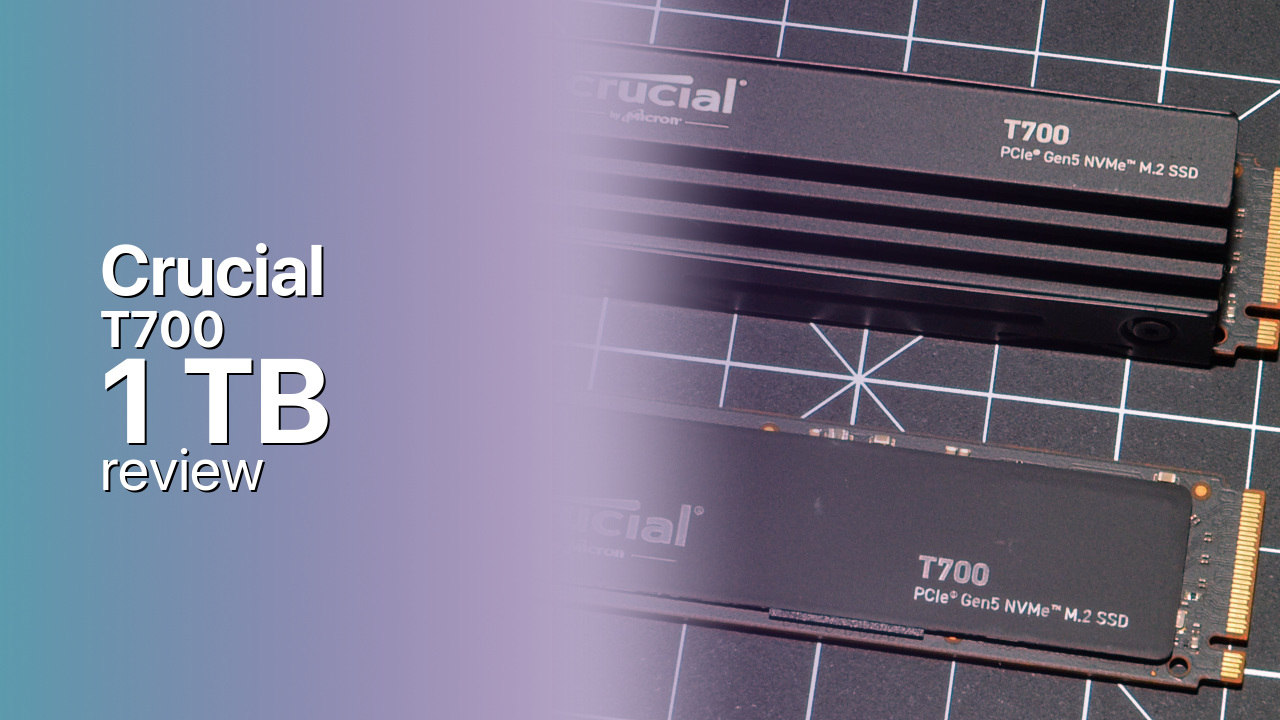
The T700 is available in 1 TB, 2 TB, and 4 TB capacities, with and without a factory heatsink. The heatsink variant uses an aluminium and nickel-plated copper design. The E26 controller runs warmer than PCIe 4.0 predecessors — a direct consequence of the higher PCIe 5.0 signalling rate — so using the heatsink variant or ensuring good M.2 slot airflow is advisable. On platforms without adequate cooling the controller will throttle under sustained sequential writes, reducing throughput until temperatures fall.
Storage Comparisons:
T700 Performance & Benchmarks
The Crucial T700 1 TB is rated at 12,400 MB/s sequential reads and 11,800 MB/s sequential writes over PCIe 5.0 x4 — figures independently verified in CrystalDiskMark testing across multiple published reviews. Random performance on the 1 TB model is rated at 1,350,000 read IOPS and 1,400,000 write IOPS. These figures are lower than the 2 TB and 4 TB T700 models, which reach 1,500,000 IOPS in both directions, because the 1 TB configuration has fewer NAND dies to parallelise across the eight controller channels.
Crucial T700 1 TB vs M.2 5.0 peers
Switch between sequential throughput and random IOPS to see how this drive stacks up against other M.2 5.0 SSDs in our database. The highlighted bar is the drive on this page — click any other bar to open that drive.
- Corsair MP700 Pro XT 1 TB: 14,900 MB/s read, 14,200 MB/s write
- Corsair MP700 Pro XT 2 TB: 14,900 MB/s read, 14,500 MB/s write
- Corsair MP700 Pro XT 4 TB: 14,900 MB/s read, 14,400 MB/s write
- Crucial T710 1 TB: 14,900 MB/s read, 13,800 MB/s write
- Crucial T700 1 TB (this drive): 12,400 MB/s read, 11,800 MB/s write
In sequential write workloads the drive operates in two phases. Writes within the dynamic SLC cache — which covers the majority of everyday PC use — sustain the full rated 11,800 MB/s. Once the SLC buffer is saturated by a large continuous write, throughput transitions to direct TLC write rates, which remain competitive with mid-range PCIe 4.0 drives but are substantially below the burst figure. This behaviour is common across all E26-based drives at 1 TB; the smaller NAND die count limits SLC cache size compared to the 2 TB and 4 TB models.
For gaming and OS workloads the 1 TB T700 performs at the same level as other E26 drives in its tier. Sequential reads of 12,400 MB/s provide bandwidth for DirectStorage-capable titles, and the 1,350,000 read IOPS rating handles the random small-block access patterns that dominate conventional game loading.
Crucial T700 vs Competitors
See how the T700 stacks up against other M.2 5.0 drives in our database:
Compare with rival drives:
Endurance, TBW & Warranty
Crucial covers the T700 with a 5-year warranty — a correction from the erroneous 2-year figure in some database entries. The 1 TB model carries a rated endurance of 600 TBW (terabytes written), representing the cumulative write budget across the warranty term. The warranty expires at whichever threshold is reached first: five years from purchase, or 600 TBW of cumulative writes.
At a typical consumer write rate of 30 GB per day, exhausting 600 TBW would take approximately 55 years, so the 5-year period will expire first for virtually all buyers. At a heavier 100 GB per day rate the drive reaches 600 TBW in around 16 years — still well beyond any practical warranty claim. Only users sustaining 400 GB or more per day will encounter the endurance boundary within the warranty period; those use cases belong to the 2 TB model (1,200 TBW) or the 4 TB model (2,400 TBW). Warranty service is handled through Crucial's regional support channels.
Crucial T700 1 TB Specifications
| Category | Value |
|---|---|
| Capacity [?] | 1 TB |
| Interface [?] | M.2 5.0 |
| Controller [?] | Phison PS5026-E26 8 Channel |
| Memory type [?] | Micron 232-L TLC |
| DRAM [?] | Yes |
| Read speed (MB/s) [?] | 12400 |
| Write speed (MB/s) [?] | 11800 |
| Read IOPS [?] | 1350000 |
| Write IOPS [?] | 1400000 |
| Endurance (TBW) [?] | 600 |
| MTBF (million hours) [?] | 2000000 |
| Warranty (years) [?] | 5 |
Verdict: Is the T700 Worth It in 2026?
The Crucial T700 1 TB is the older-generation PCIe 5.0 entry in Crucial's lineup, launched in 2023 and now positioned below the faster T705. It delivers confirmed 12,400 MB/s reads, 11,800 MB/s writes, 600 TBW, and a 5-year warranty on a Phison E26 and Micron 232-layer NAND platform — the same hardware foundation as the T705, at a lower price point.
Choose the T700 1 TB if you want a PCIe 5.0 Phison E26 drive and the T705's speed premium is not worth the price difference for your workloads. The 600 TBW endurance comfortably covers mainstream desktop use.
Skip it in favour of the T705 if sequential peak throughput matters and pricing is close. Skip it entirely if your platform only supports PCIe 4.0 — a WD Black SN850X or Samsung 990 Pro delivers equivalent real-world performance at a lower cost and without the thermal demands of a Gen5 controller.
+ Pros
- 12,400 MB/s sequential reads on PCIe 5.0 x4
- 11,800 MB/s sequential writes verified across published reviews
- Phison PS5026-E26 with LPDDR4 DRAM cache
- Micron 232-layer B58R TLC NAND — same generation as T705
- 600 TBW covers virtually all mainstream workloads within the 5-year warranty
- 5-year warranty from Crucial
- Available with or without factory heatsink
- Cons
- Superseded by T705 (14,500 MB/s reads) released in 2024
- 1 TB IOPS lower than 2 TB and 4 TB models: 1,350,000/1,400,000 vs 1,500,000/1,500,000
- SLC cache saturation causes write speed drop on large sequential workloads
- Requires good M.2 thermal management — E26 throttles without adequate cooling
- No meaningful performance benefit on PCIe 4.0 platforms
Buy this or similar SSD Storage:



Video Review
PCIe Gen5 Drives are Here! Are they Worth It?? - Crucial T700 PCIe Gen 5 NVMe SSD