Team Group T-Force Z540 1 TB in real-world testing (2026)
Quick answer
The Team Group T-Force Z540 1 TB suits buyers whose motherboard has a PCIe 5.0 M.2 slot and who want headroom for large-file transfers where the extra bandwidth pays off.
Read: 12400 MB/s Write: 11800 MB/s Endurance: 600 TBW Warranty: 5 years Interface: M.2 5.0
The Team Group T-Force Z540 1 TB delivers headline PCIe 5.0 throughput on the proven Phison E26 platform, though its real-world payoff depends on a heatsink and a workload that actually saturates Gen5.
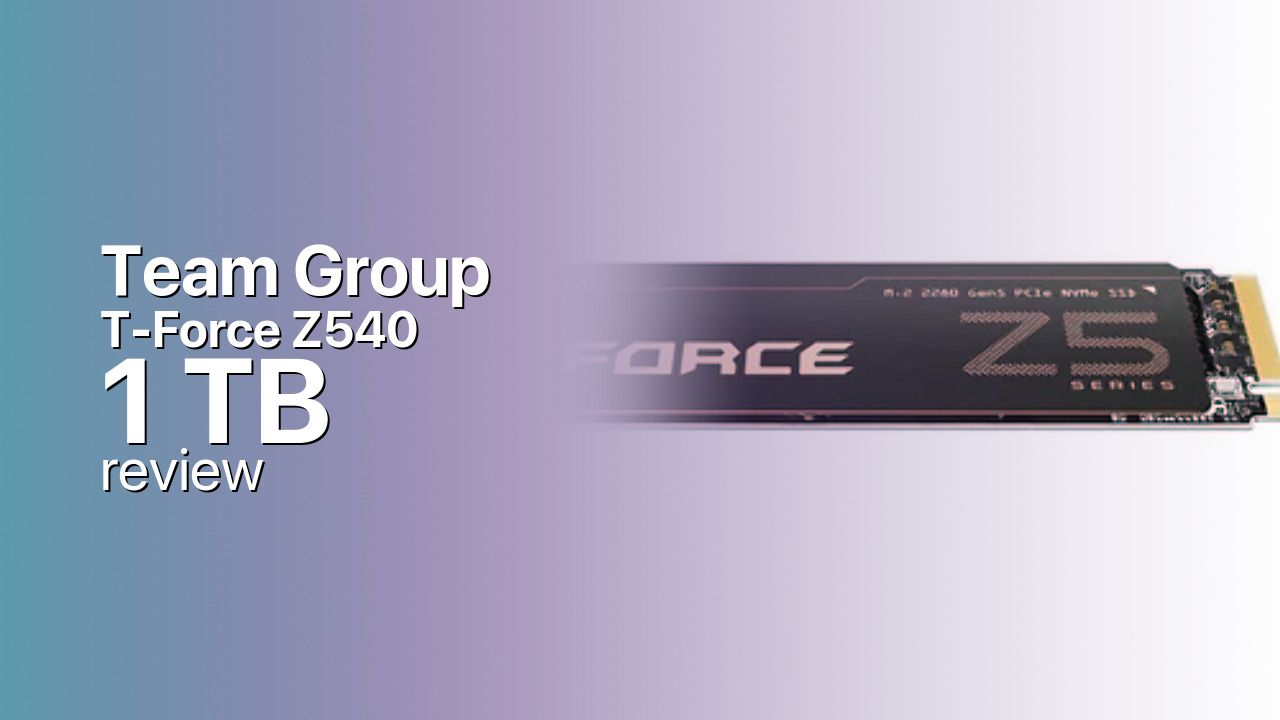
Controller & Memory
The Team Group T-Force Z540 1 TB is a straightforward execution of the now-mature PCIe 5.0 recipe: Phison's PS5026-E26 eight-channel controller paired with Micron 232-layer TLC NAND and a DRAM buffer, all on a standard M.2 2280 module. There is nothing exotic here, and that is the point: Team Group has skipped the gimmicks and shipped a drive that hits the platform's rated ceilings of 12,400 MB/s reads and 11,800 MB/s writes. The 1 TB is the entry rung of a three-drive ladder that also includes a 2 TB (1,200 TBW) and a 4 TB (2,400 TBW); all three share the same controller, NAND, and headline speeds, so the only reasons to step up are raw capacity and the doubled endurance per tier. Speed does not increase on the larger drives, which is worth knowing.
Compatibility is the usual Gen5 story: the 1 TB Z540 belongs in a recent desktop with a PCIe 5.0 M.2 slot, and it will run (at reduced speed) in any M.2 NVMe slot, but it is wasted in a laptop without a 5.0 lane and outright pointless in a PS5, whose expansion slot is PCIe 4.0. The bare drive ships without a heatsink, and Phison E26 runs hot under sustained writes, so heatsink coverage needs to come from the motherboard or from Team Group's graphene-coated CARDEA Z540 variant. On the competitive landscape, the Crucial T705 matches or beats the Z540 on raw throughput and is the safer default, the Seagate FireCuda 540 runs the same E26 silicon with comparable endurance, and anyone not chasing synthetic numbers will get 95% of the real-world feel from a PCIe 4.0 flagship like the Samsung 990 Pro or WD Black SN850X without the Gen5 tax.
Storage Comparisons:
T-Force Z540 Performance & Benchmarks
On the 1 TB, Team Group rates sequential reads at 12,400 MB/s and sequential writes at 11,800 MB/s, with random performance up to 1,400,000 read and 1,500,000 write IOPS. Those are flagship PCIe 5.0 numbers, and on a motherboard with a working 5.0 M.2 slot the drive will genuinely approach them in short bursts, with CrystalDiskMark peaks landing within shouting distance of the spec sheet. The catch is what happens outside of benchmarks. The 1 TB has the smallest SLC cache of the lineup, so once that cache fills during a sustained transfer the write rate collapses to the native TLC rate, which independent reviewers place well below the headline figure. For game loads, Windows boot, and everyday desktop work the difference between a Z540 and a good PCIe 4.0 drive is essentially invisible, and DirectStorage titles are the one place the extra bandwidth could matter, though the library that actually exploits it is still thin. Where 12 GB/s reads pay off today is moving very large single files: video projects, VM images, and database backups cross the cache threshold quickly on a 1 TB and expose the sustained-write drop-off. For most buyers the random IOPS and burst reads matter more than the sequential ceiling, and on those metrics the Z540 is competitive with any Gen5 peer.
Team Group T-Force Z540 1 TB vs M.2 5.0 peers
Switch between sequential throughput and random IOPS to see how this drive stacks up against other M.2 5.0 SSDs in our database. The highlighted bar is the drive on this page — click any other bar to open that drive.
- Corsair MP700 Pro XT 1 TB: 14,900 MB/s read, 14,200 MB/s write
- Corsair MP700 Pro XT 2 TB: 14,900 MB/s read, 14,500 MB/s write
- Corsair MP700 Pro XT 4 TB: 14,900 MB/s read, 14,400 MB/s write
- Crucial T710 1 TB: 14,900 MB/s read, 13,800 MB/s write
- Team Group T-Force Z540 1 TB (this drive): 12,400 MB/s read, 11,800 MB/s write
Team Group T-Force Z540 vs Competitors
See how the T-Force Z540 stacks up against other M.2 5.0 drives in our database:
Compare with rival drives:
Endurance, TBW & Warranty
The 1 TB carries a 600 TBW endurance rating and a 5-year limited warranty, whichever comes first. Six hundred terabytes is enormous relative to normal use: at roughly 20 GB of writes per day it works out to around 82 years, and even at several times that write load the counter still measures in decades before TBW becomes binding. In practice the warranty clock is what actually expires. Team Group, like most vendors, quotes an MTBF around 1.6 to 2 million hours; treat that as a population-reliability statistic rather than a per-drive guarantee, since it describes expected failures across a large fleet and says little about any individual unit. Keeping the invoice and registering the drive is worthwhile, as RMA flow on SSDs is generally smooth as long as the TBW has not been exhausted, and the 5-year term puts the Z540 on par with the rest of the Phison E26 field.
Team Group T-Force Z540 1 TB Specifications
| Category | Value |
|---|---|
| Capacity [?] | 1 TB |
| Interface [?] | M.2 5.0 |
| Controller [?] | Phison PS5026-E26 8 Channel |
| Memory type [?] | Micron 232-L TLC |
| DRAM [?] | Yes |
| Read speed (MB/s) [?] | 12400 |
| Write speed (MB/s) [?] | 11800 |
| Read IOPS [?] | 1400000 |
| Write IOPS [?] | 1500000 |
| Endurance (TBW) [?] | 600 |
| MTBF (million hours) [?] | 2000000 |
| Warranty (years) [?] | 5 |
Verdict: Is the T-Force Z540 Worth It in 2026?
The Team Group T-Force Z540 1 TB suits buyers whose motherboard has a PCIe 5.0 M.2 slot and who want headroom for large-file transfers where the extra bandwidth pays off. It is overkill for anyone on a PCIe 4.0-only board, building for a PS5, or chasing game-load speed that Gen5 cannot meaningfully improve over Gen4 today. The Crucial T705 is the stronger default at parity, running the same E26 platform with consistently top-tier sustained writes and broader reviewer consensus, while a Samsung 990 Pro or WD Black SN850X delivers roughly 95% of the real-world experience without the Gen5 tax. Our take: the Z540 1 TB is a competent execution of the Gen5 formula, but it carries the platform's usual caveats of heat and a Gen5 premium, and offers no clear reason to pick it over the established leaders.
+ Pros
- 12,400 MB/s rated sequential reads
- Up to 1.4 million random read IOPS
- 600 TBW endurance on the 1 TB
- Phison E26 plus Micron 232-layer TLC
- Five-year warranty matches the field
- Standard M.2 2280 form factor
- Cons
- No heatsink included with the bare drive
- PCIe 5.0 speed wasted on most current games
- Gen5 premium over PCIe 4.0 rivals
- Smallest SLC cache in the lineup
- Sustained writes drop once cache fills
Buy this or similar SSD Storage:
Video Review
Best-Bang-For-Buck Gen 5 m.2 NVMe? 👉 TeamGroup T-Force Z540 SSD Review [1TB & 2TB]