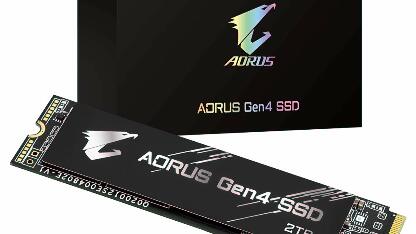
GALAX HOF Extreme 50S 2TB PCIe 5.0 NVMe SSD Review (2026)
Quick answer
Buy the GALAX HOF Extreme 50S 2TB if you are building a high-end desktop, you have a free PCIe 5.0 M.2 slot with room for a tall heatsink, and you want headroom for DirectStorage and large-file workflows where the 12,400 MB/s ceiling and 1,500K random read IOPS can actually pay off.
Read: 12400 MB/s Write: 11800 MB/s Endurance: 1400 TBW Warranty: 5 years Interface: M.2 5.0
The GALAX HOF 50 2TB is the flagship PCIe 5.0 variant of GALAX's Hall of Fame line, rated at 12,400 MB/s sequential reads and active cooling built in.
Controller & Memory
The GALAX HOF 50 2TB (marketed as the HOF Extreme 50S) is the refresh of GALAX's first-generation HOF Extreme 50, bumping sequential reads from 10,000 MB/s to 12,400 MB/s and writes from 9,500 MB/s to 11,800 MB/s. The S suffix sits at the top of GALAX's SSD stack and launched exclusively in 2TB before a 4TB follow-up, which makes the 2TB capacity the volume SKU of the family rather than a half-step to something larger.
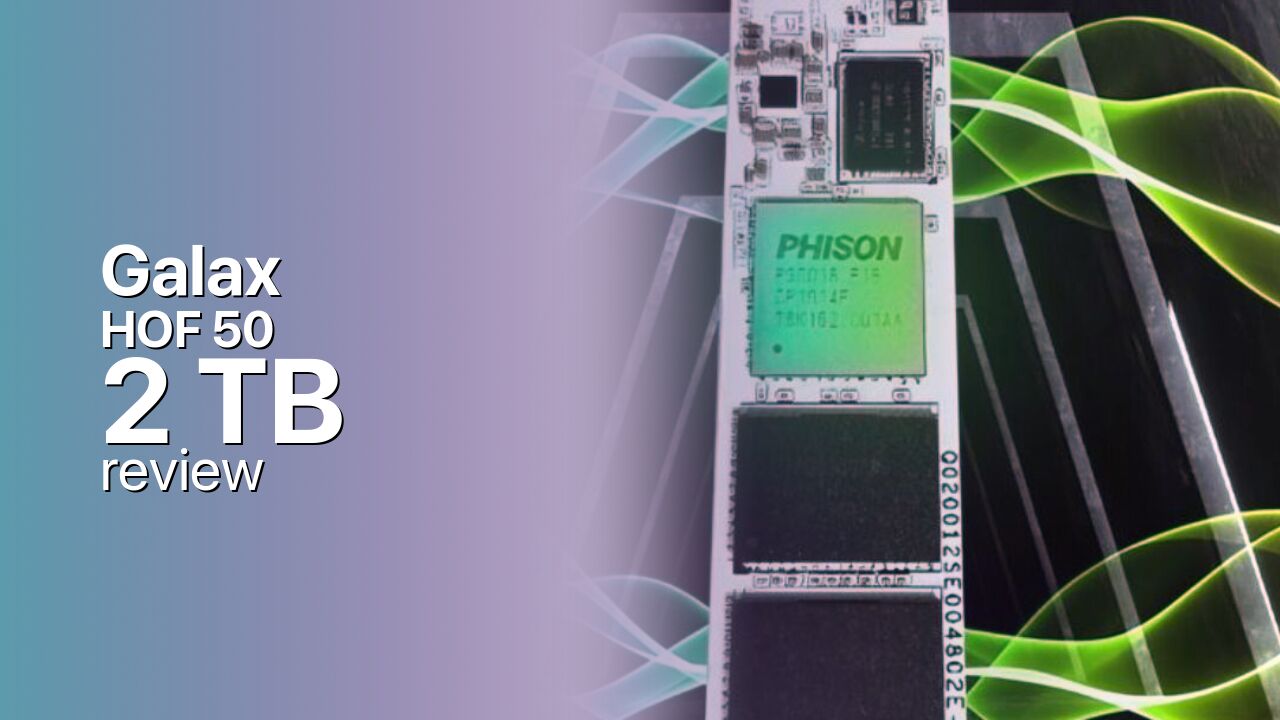
Under the heatsink it is a familiar Gen5 recipe. The controller is Phison's PS5026-E26 eight-channel flagship, paired with Micron 232-layer 3D TLC NAND and an LPDDR4 DRAM cache that maps the flash translation layer. The E26 platform is the same silicon used by the Crucial T700 and Corsair MP700, so the differentiator here is firmware tuning and the cooling solution rather than exotic hardware. Both random read and random write are rated at 1,500K IOPS on the 50S, a step up from the 1,250K write figure of the non-S model.
The defining physical feature is the heatsink. PCIe 5.0 drives run hot when they sustain their rated throughput, and GALAX ships the 50S with a chunky active cooler combining a copper base, a white metal shroud and a small fan. GALAX reports internal thermals in the 40 to 45 degrees Celsius range under load, which is meaningfully cooler than the throttling behaviour you see on bare M.2 Gen5 drives in cramped slots. The trade-off is that the assembly is tall and will not fit under a graphics card or in an ITX build without planning. PS5 owners should treat this as a desktop-only part, not a console upgrade. Direct competitors at the same tier include the Crucial T705/T700 and the Corsair MP700 Pro, both of which use the same Phison E26 platform but ship with a more conventional motherboard-mounted heatsink or a bare PCB.
Storage Comparisons:
HOF 50 Performance & Benchmarks
GALAX rates the HOF Extreme 50S 2TB at up to 12,400 MB/s sequential read and 11,800 MB/s sequential write on a PCIe 5.0 x4 link, which puts it within roughly 20 percent of the theoretical ceiling of the interface (about 15.76 GB/s after encoding overhead). Random performance is rated at 1,500K IOPS for both read and write, the latter being the meaningful bump over the non-S HOF Extreme 50, which capped random writes at 1,250K IOPS.
Galax HOF 50 2 TB vs M.2 5.0 peers
Switch between sequential throughput and random IOPS to see how this drive stacks up against other M.2 5.0 SSDs in our database. The highlighted bar is the drive on this page — click any other bar to open that drive.
- Corsair MP700 Pro XT 1 TB: 14,900 MB/s read, 14,200 MB/s write
- Corsair MP700 Pro XT 2 TB: 14,900 MB/s read, 14,500 MB/s write
- Corsair MP700 Pro XT 4 TB: 14,900 MB/s read, 14,400 MB/s write
- Crucial T710 1 TB: 14,900 MB/s read, 13,800 MB/s write
- Galax HOF 50 2 TB (this drive): 12,400 MB/s read, 11,800 MB/s write
In practice, those numbers describe the SLC-cached burst region of the drive, not steady-state behaviour. Like every E26 plus TLC combination on the market, the 50S maintains peak throughput only while its fast cache buffer holds out; once that buffer fills during a large sustained transfer, write speed collapses to the native TLC rate, typically in the 2,000 to 3,000 MB/s band. For a boot drive, game library or scratch disk handling many small files, the cache essentially never exhausts and the drive feels every bit as fast as the spec sheet promises. For 4K video capture or moving a 500 GB Steam library in a single pass, expect the second half of that transfer to slow noticeably.
Independent reviewers covering the Phison E26 platform consistently find that Gen5 drives of this class close the gap to the interface limit in synthetic benchmarks but deliver a much smaller real-world delta over a fast PCIe 4.0 flagship like the Samsung 990 Pro for gaming and OS responsiveness. The 50S's value case rests on DirectStorage-class workloads, large media projects, and buyers who want headroom for the next few years of game engines rather than a measurable frame-rate jump today. We have not published our own benchmark numbers for this drive; treat the rated figures as manufacturer-claimed ceilings and look for independent CrystalDiskMark and 3DMark Storage Test results before buying on speed alone.
Galax HOF 50 vs Competitors
See how the HOF 50 stacks up against other M.2 5.0 drives in our database:
Compare with rival drives:
Endurance, TBW & Warranty
GALAX backs the HOF Extreme 50S 2TB with a 1,400 TBW endurance rating and a five-year limited warranty, which is the standard coverage envelope for a flagship PCIe 5.0 consumer drive and matches what Crucial and Corsair offer on the T700 and MP700 Pro. The warranty is the longer of the two limits, five years or 1,400 TBW written, so the drive is covered for roughly 280 GB of writes per day every day for five years before the endurance clause bites. A typical mixed workload of OS, games and occasional media work lands somewhere between 20 and 50 GB/day, which means the vast majority of buyers will never approach the TBW ceiling and the warranty term will expire first.
The rated MTBF of 2,000,000 hours is a population-reliability statistic, not a per-drive life expectancy, and should be read as a quality bin rather than a countdown. GALAX's RMA process varies by region because the HOF line has limited Western retail distribution; buyers outside Asia should confirm warranty support through their retailer before purchase, as direct-to-manufacturer returns are not always straightforward for GALAX storage products. Keep the active heatsink's fan clear of dust, since sustained throttling from a blocked intake will not damage the drive but will erase the performance margin you paid the Gen5 premium for.
Galax HOF 50 2 TB Specifications
| Category | Value |
|---|---|
| Capacity [?] | 2 TB |
| Interface [?] | M.2 5.0 |
| Controller [?] | Phison PS5026-E26 8 Channel |
| Memory type [?] | Micron 232L TLC |
| DRAM [?] | Yes |
| Read speed (MB/s) [?] | 12400 |
| Write speed (MB/s) [?] | 11800 |
| Read IOPS [?] | 1500000 |
| Write IOPS [?] | 1500000 |
| Endurance (TBW) [?] | 1400 |
| MTBF (million hours) [?] | 2000000 |
| Warranty (years) [?] | 5 |
Verdict: Is the HOF 50 Worth It in 2026?
Buy the GALAX HOF Extreme 50S 2TB if you are building a high-end desktop, you have a free PCIe 5.0 M.2 slot with room for a tall heatsink, and you want headroom for DirectStorage and large-file workflows where the 12,400 MB/s ceiling and 1,500K random read IOPS can actually pay off. Skip it if you are on PCIe 4.0 only, building small-form-factor, or shopping for a PS5 SSD, since the bundled active cooler will not fit and the premium over a Samsung 990 Pro buys no perceivable gaming benefit today. The strongest same-platform alternative is the Crucial T700 2TB, which uses the same Phison E26 controller and Micron TLC but offers wider retail availability and easier warranty support outside Asia. Our overall take: a genuinely fast Gen5 drive with sensible cooling and competitive endurance, let down mainly by limited distribution and a price that only makes sense for buyers who will actually stress the interface.
+ Pros
- 12,400 MB/s rated sequential reads
- 1,500K random read and write IOPS
- Active copper heatsink keeps temps around 40 to 45 Celsius
- Micron 232-layer 3D TLC NAND
- 1,400 TBW endurance over five years
- LPDDR4 DRAM cache for stable mapping
- Cons
- Tall active heatsink fouls ITX and laptop slots
- Write speed drops sharply past the SLC cache
- Limited retail and RMA support outside Asia
- No real-world gaming benefit over PCIe 4.0 flagships
- Not a PS5-compatible form factor
Buy this or similar SSD Storage:
Video Review
Análisis Térmico GALAX HOF Pro M.2 NVMe PCIe Gen4 x4 2TB SSD