Integral Ultima Pro X 4TB Review — the Rare Gen3 Flagship (2026)
Quick answer
The Integral Ultima Pro X 4TB is the capacity for Gen3-era owners who need bulk storage without abandoning an older board — media workstations, archive drives, and multi-game libraries fit its 3,400/3,000 MB/s ratings and enormous 6,070 TBW budget.
Read: 3400 MB/s Write: 3000 MB/s Endurance: 6070 TBW Warranty: 3 years Interface: M.2 3.0 x 4
The Integral Ultima Pro X 4TB was Integral's Gen3 flagship — full 3,400/3,000 MB/s speeds, the family's highest random-read rating, and 6,070 TBW of endurance.
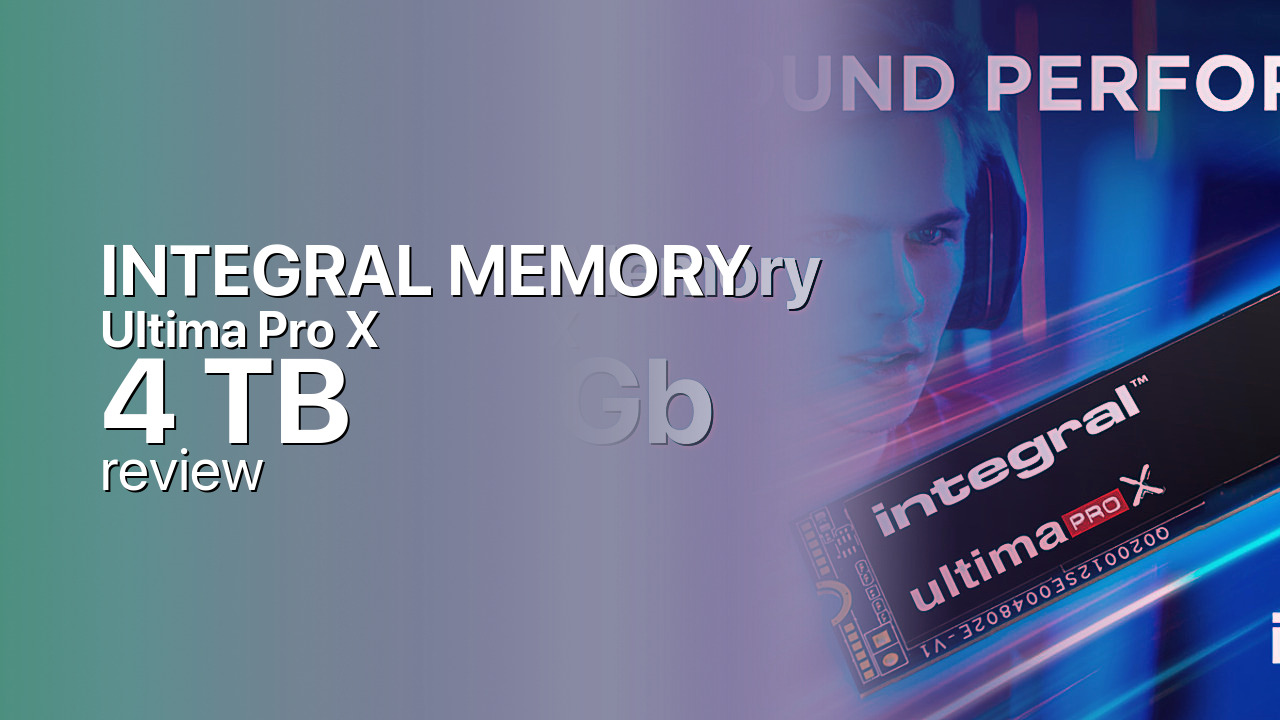
Controller & Memory
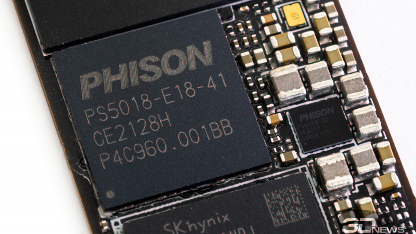
The Integral Ultima Pro X 4TB — part code INSSD4TM280NUPX2 in Integral's Version 2 family — is the drive the rest of the range is measured against. Integral's own datasheet footnotes its advertised 3,400/3,000 MB/s speeds as 4TB model performance, and this capacity also carries the family's highest random-read rating at 570K IOPS, paired with 650K random writes. The platform is consistent across the range: Phison E12 controller with DRAM, 3D TLC NAND, PCIe 3.1 x4, NVMe 1.3, and 256-bit AES hardware encryption with TCG Opal 2.0. What sets the 4TB apart is endurance — 6,070 TBW, the largest budget Integral published for the family — and sheer rarity, because few Gen3-era manufacturers bothered with 4 TB at all.
The family context: Version 2 stretched the UltimaPro X line from the original 2019 MLC design's 120-960 GB span into nine TLC capacities — 240 GB, 256 GB, 480 GB, 512 GB, 960 GB, 1 TB, 1920 GB, 2 TB, and this 4 TB (4096 GB). Every module is double-sided within a 3.8 mm height. The 4TB is also the thirstiest: Integral rates it at 7.5 W reading and 6.8 W writing, noticeably above the 2TB's 4.9/5.8 W, so a ventilated slot matters more here than for its siblings.
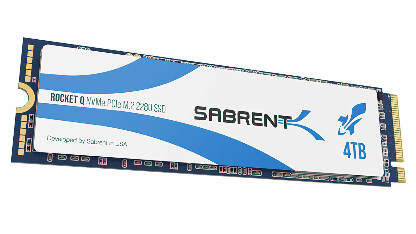
Who wants a 4 TB Gen3 drive in 2026? Buyers of Gen3-era workstations and media machines who cannot or will not move to PCIe 4.0, and anyone who values a documented 6,070 TBW budget for archive duty. The honest rival set is thin: Sabrent's Rocket 4TB played the same rare-capacity Gen3 game with a 5-year warranty, while current-generation alternatives such as the WD Black SN850X 4TB or Samsung 990 Pro 4TB offer Gen4 speeds for those with newer boards. This is a legacy part now — it survives in distributor datasheets and ICEcat listings far more often than on shelves — so treat it as a targeted hunt rather than a shelf purchase.
Storage Comparisons:
Ultima Pro X Performance & Benchmarks
The 4TB carries the ratings every other UltimaPro X Version 2 capacity is measured against: 3,400 MB/s sequential reads, 3,000 MB/s writes, 570K random reads, and 650K random writes. Integral's product-page footnote states that its advertised performance is the 4TB model's, which makes this the reference capacity of the family. In practice the numbers translate to near-SATA-eliminating behavior: multi-hundred-gigabyte game and footage transfers complete in minutes rather than tens of minutes against a 550 MB/s SATA ceiling, and the 570K random-read rating keeps large media libraries responsive.
INTEGRAL MEMORY Ultima Pro X 4 TB vs M.2 3.0 x 4 peers
Switch between sequential throughput and random IOPS to see how this drive stacks up against other M.2 3.0 x 4 SSDs in our database. The highlighted bar is the drive on this page — click any other bar to open that drive.
- ADATA SX 8800 Pro 512 GB: 3,500 MB/s read, 2,700 MB/s write
- ADATA SX 8800 Pro 1 TB: 3,500 MB/s read, 2,700 MB/s write
- ADATA XPG Spectrix S40G RGB 256 GB: 3,500 MB/s read, 3,000 MB/s write
- ADATA XPG Spectrix S40G RGB 512 GB: 3,500 MB/s read, 3,000 MB/s write
- INTEGRAL MEMORY Ultima Pro X 4 TB (this drive): 3,400 MB/s read, 3,000 MB/s write
The endurance-to-speed combination is the real story. A 6,070 TBW budget means roughly 500 GB of writes per day for 33 years — far beyond the 3-year warranty term. Sustained-write behavior follows the usual E12 pattern: a pseudo-SLC cache absorbs bursts, then throughput settles to native TLC rates, and at 4 TB the cache is generous enough that only extreme copy jobs see the transition. Two cautions: the drive draws up to 7.5 W reading and 6.8 W writing, the highest in the family, so give it airflow; and no independent 4TB benchmark coverage is known, with only Integral's datasheet behind these figures.
INTEGRAL MEMORY Ultima Pro X vs Competitors
See how the Ultima Pro X stacks up against other M.2 3.0 x 4 drives in our database:
Compare with rival drives:
Endurance, TBW & Warranty
Integral covers the 4TB with the family's 3-year limited warranty or the TBW rating, whichever arrives first — and here the rating is the standout: 6,070 TBW, the largest budget in the UltimaPro X Version 2 datasheet. At 500 GB of writes per day, an extremely heavy workload, the drive would last about 33 years; at 50 GB per day, well past three centuries. Either way the 3-year term, not the NAND, is the practical limit. MTBF is listed at 1.8 million hours — a population statistic from JEDEC-methodology testing, not a per-unit lifespan promise. Integral publishes this endurance figure openly for every capacity in the range, which remains rarer than it should be among Gen3-era brands; claims are handled through Integral's UK support with proof of purchase.
INTEGRAL MEMORY Ultima Pro X 4 TB Specifications
| Category | Value |
|---|---|
| Capacity [?] | 4 TB |
| Interface [?] | M.2 3.0 x 4 |
| Controller [?] | Phison PS5012-E12 8 Channel |
| Memory type [?] | 3D TLC |
| DRAM [?] | Yes |
| Read speed (MB/s) [?] | 3400 |
| Write speed (MB/s) [?] | 3000 |
| Read IOPS [?] | 570000 |
| Write IOPS [?] | 650000 |
| Endurance (TBW) [?] | 6070 |
| MTBF (million hours) [?] | 1800000 |
| Warranty (years) [?] | 3 |
Verdict: Is the Ultima Pro X Worth It in 2026?
The Integral Ultima Pro X 4TB is the capacity for Gen3-era owners who need bulk storage without abandoning an older board — media workstations, archive drives, and multi-game libraries fit its 3,400/3,000 MB/s ratings and enormous 6,070 TBW budget. Skip it on any PCIe 4.0-capable system: a WD Black SN850X 4TB or Samsung 990 Pro 4TB doubles the interface speed and is far easier to buy. Sabrent's Rocket 4TB remains the closest Gen3 rival, with a 5-year warranty offsetting its own scarcity. The catch is availability — this is a legacy drive that surfaces mainly in distributor listings, and the high 7.5 W power draw asks for a ventilated slot. When found at the right discount, it remains a uniquely documented 4 TB Gen3 option.
+ Pros
- 3,400 MB/s reads and 3,000 MB/s writes
- 6,070 TBW endurance rating
- 570K random-read IOPS, the family's highest
- TCG Opal 2.0 AES-256 hardware encryption
- Largest capacity in the UltimaPro X range
- Cons
- 3-year warranty, shorter than Gen3 rivals
- Up to 7.5 W draw needs airflow
- No heatsink included
- Double-sided PCB inside a 3.8 mm height
- Barely available at retail now
Buy this or similar SSD Storage:
Video Review
M.2 2230 NVME SSD GEN4 | Integral Memory